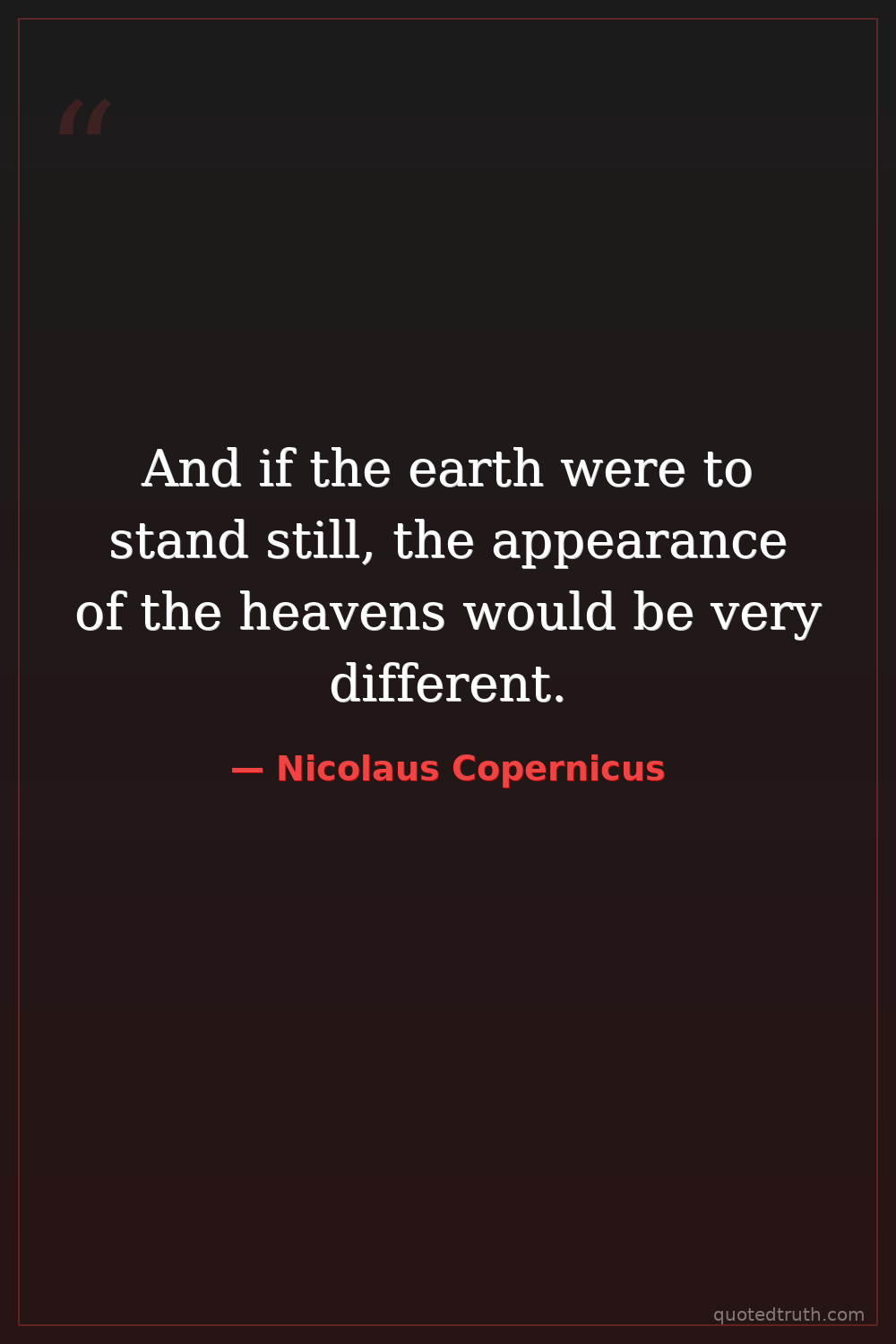
Nicolaus Copernicus — "And if the earth were to stand still, the appearance of the heavens would be ver…"
And if the earth were to stand still, the appearance of the heavens would be very different.
And if the earth were to stand still, the appearance of the heavens would be very different.
Click any product to generate a realistic preview. Up to 3 at a time.
* Initial load can take up to 90 seconds — revising the preview in another color is nearly instant.
"The universe is a spherical whole, and of all possible forms, the sphere is the most perfect."
"Having thus assumed the motions which I ascribe to the earth, I have, after long and careful investigation, finally discovered that, if the motions of the other planets be related to the revolution of…"
"Yet because the novelty of the undertaking, which I knew to be contrary to the accepted views of the common people, might be regarded as absurd, I long hesitated."
"The earth, too, has other motions than that of the daily rotation."
"The world is spherical; whether it is finite or infinite is an open question."
Found in 1 providers: grok
1 source checked
The quote argues that the sky's observed motions — planets wandering, stars cycling through retrograde, stars rising and setting — are not purely external events but partly products of Earth itself moving. If Earth were stationary, the celestial sphere would look utterly different. In modern terms: our perspective shapes what we observe; the apparent motion of heavenly bodies reflects our own movement through space as much as their own independent paths.
Copernicus spent decades quietly building his heliocentric model, knowing it overturned 1,400 years of Ptolemaic authority. As a Polish cathedral canon and physician, he pursued astronomy as devotion rather than profession. This quote encapsulates his central insight: Earth's daily rotation and annual orbit explain the apparent movements of stars and planets. He only published De Revolutionibus in 1543, the year he died, deliberately cautious about the controversy it would ignite.
In early 16th-century Europe, the Ptolemaic geocentric cosmos — Earth fixed at the universe's center — was scientific and theological orthodoxy enforced for over a millennium. The Renaissance was challenging ancient authorities across art and philosophy. Columbus's 1492 voyages had already shattered geographic certainties. The Protestant Reformation (1517) was fracturing religious authority. Copernicus's claim that Earth moves was radical: it displaced humanity from the cosmic center and threatened the worldview underpinning both Catholic cosmology and Aristotelian physics.
AI-generated insights based on extensive research and information for context. Factual errors? Email [email protected].
Your cart is empty