What it means
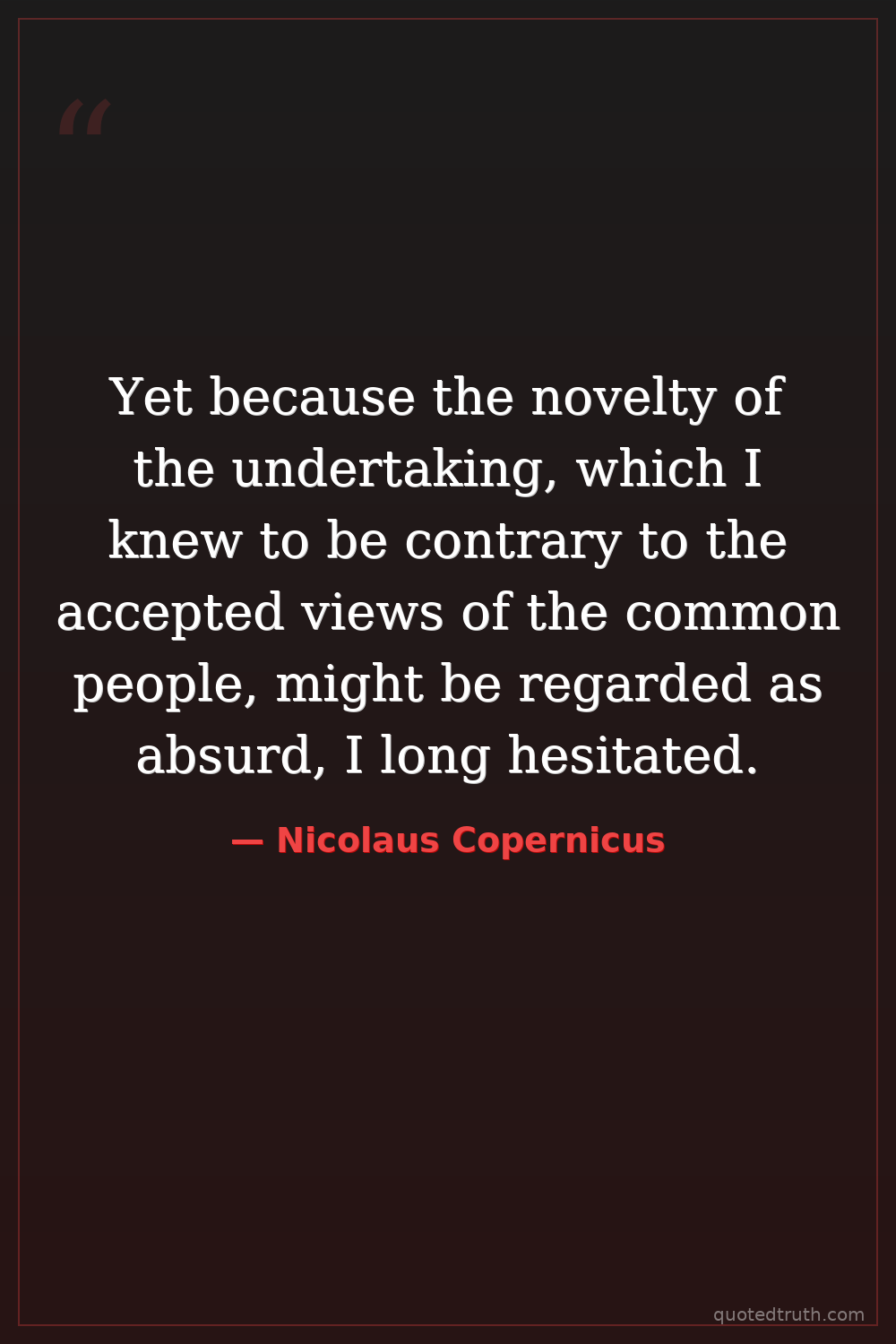
This quote captures the paralyzing gap between knowing something true and daring to say it publicly. Copernicus understood his heliocentric model contradicted everything ordinary people and authorities believed. He feared not being wrong but being dismissed as absurd. The hesitation was not scientific doubt but social and political calculation. He chose caution over courage for decades, revealing how even transformative thinkers must weigh the cost of speaking an unwelcome truth.
Relevance to Nicolaus Copernicus
Copernicus spent roughly thirty years refining heliocentrism before publishing De Revolutionibus in 1543, the year he died. As a Catholic canon in Poland, he operated within Church institutions he could not afford to alienate. He circulated his ideas privately through the Commentariolus around 1514 but resisted full publication for decades. A student's persistent encouragement finally moved him to publish. He reportedly received the finished book on his deathbed, having hesitated nearly his entire adult life.
The era
In early 16th-century Europe, Ptolemaic geocentrism was not merely scientific orthodoxy but theological doctrine. The Church taught Earth's central position as divine design. The Protestant Reformation was erupting, making Church authorities hypersensitive to any challenge to established truth. Scholars risked condemnation for contradicting Scripture or Aristotle. Though Copernicus avoided prosecution, the climate of censure was real; his book was eventually placed on the Index of Forbidden Books in 1616, decades after his death.
AI-generated insights based on extensive research and information for context. Factual errors? Email [email protected].