What it means
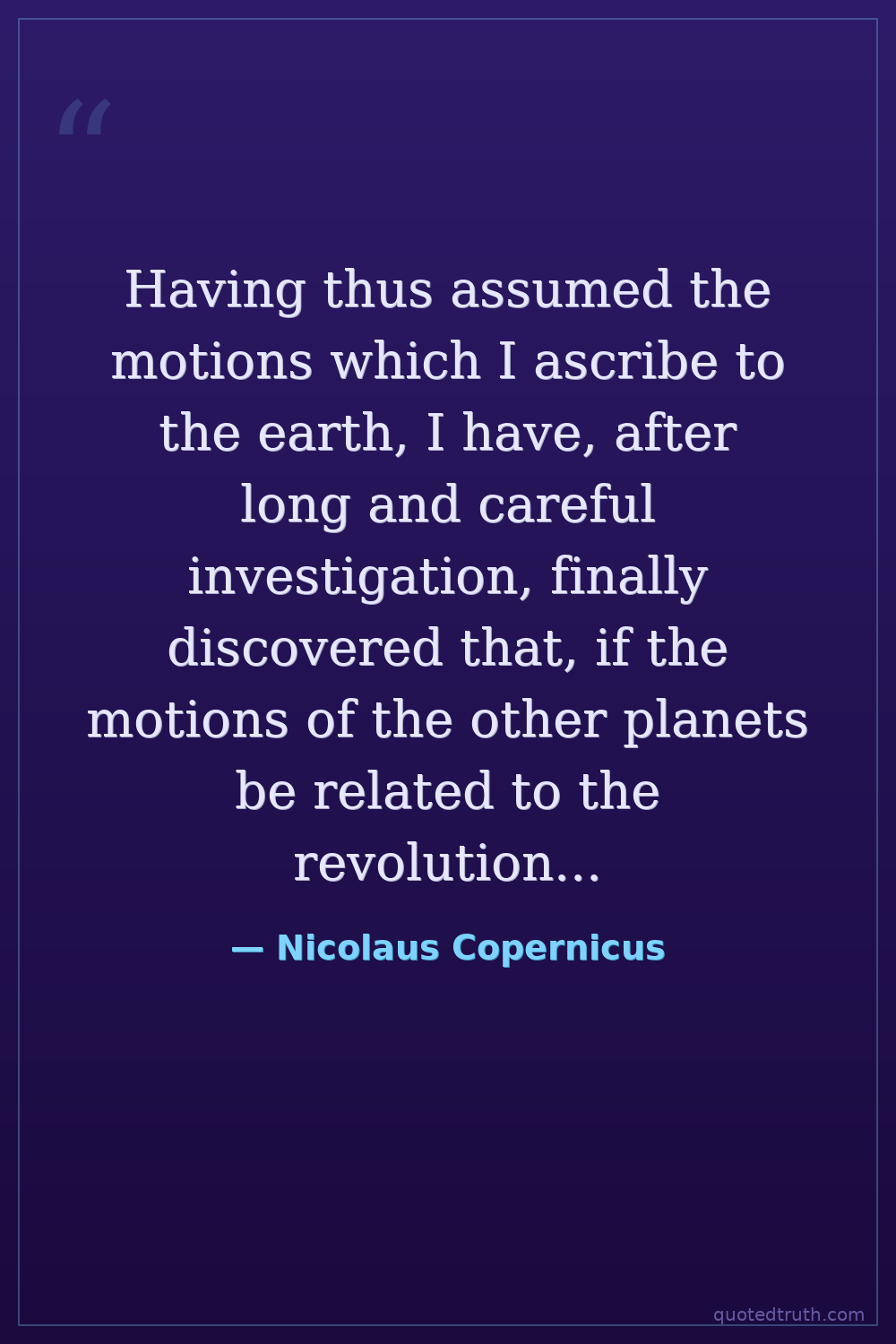
If you accept that Earth moves around the Sun rather than standing still, every planet's motion suddenly makes sense together. The sizes, distances, and speeds of all planets lock into one coherent system. Change any single piece and the whole arrangement breaks. The universe is not a collection of independent parts but an interconnected whole that only reveals its logic when you start from the right assumption.
Relevance to Nicolaus Copernicus
Copernicus spent decades at Frombork Cathedral quietly calculating planetary positions while serving as a church administrator. His heliocentric model, published in De Revolutionibus the year he died (1543), emerged from precisely this insight: Ptolemy's Earth-centered system required endless awkward corrections, while placing the Sun at center made everything geometrically consistent. This quote captures his core justification for overturning a millennium of accepted cosmology.
The era
In early sixteenth-century Europe, Ptolemaic astronomy and Aristotelian physics were institutional orthodoxy, embedded in university curricula and broadly compatible with Church theology. Challenging Earth's central position risked accusations of contradicting Scripture. Yet Renaissance humanism encouraged returning to primary observation over inherited authority. Copernicus worked within this tension, delaying publication for years, understanding that his claim was not merely astronomical but struck at humanity's assumed place in creation.
AI-generated insights based on extensive research and information for context. Factual errors? Email [email protected].