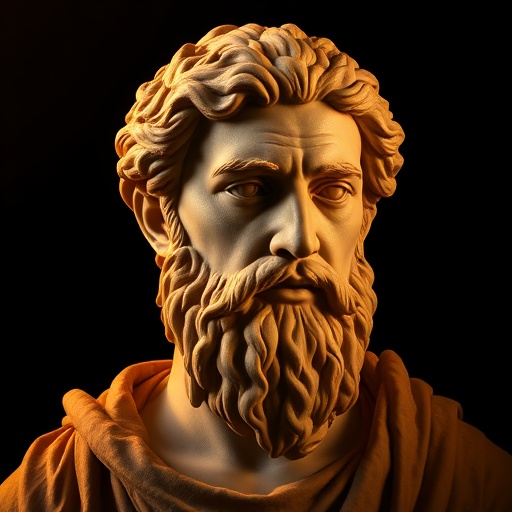
Euclid — "What has been affirmed without proof can also be denied without proof."
What has been affirmed without proof can also be denied without proof.
What has been affirmed without proof can also be denied without proof.
Click any product to generate a realistic preview. Up to 3 at a time.
* Initial load can take up to 90 seconds — revising the preview in another color is nearly instant.
"In any right-angled triangle, the square on the side subtending the right angle is equal to the squares on the sides containing the right angle."
"Parallelograms which are on the same base and in the same parallels are equal to one another."
"In any triangle, if one of the sides be produced, the exterior angle is equal to the two interior and opposite angles, and the three interior angles of the triangle are equal to two right angles."
"The square on the side subtending the right angle in right-angled triangles is equal to the squares on the sides containing the right angle."
"A plane angle is the inclination to one another of two lines in a plane which meet one another and do not lie in a straight line."
Widely attributed, but a direct primary source from Euclid's time is elusive.
Date: c. 300 BCE (attributed much later)
WisdomFound in 2 providers: gemini,deepseek
2 sources checked
Claims require evidence to hold any logical weight. If someone states something is true without providing supporting proof, that assertion deserves no more credibility than its denial. You're equally justified rejecting it as accepting it. This is a foundational principle of rational discourse — bare assertion, no matter how confidently delivered, cannot establish truth. Evidence and demonstration are what separate knowledge from opinion.
Euclid's Elements, written around 300 BCE, built all of geometry on five postulates — explicitly stated, minimally assumed starting points. Every theorem that followed was proven through strict logical deduction. Euclid never asserted a result without demonstration; his entire system was proof-driven by design. This quote captures the spirit of his mathematical philosophy: claims without proof are not geometry, they're guesswork, and guesswork has no place in rigorous mathematics.
Around 300 BCE, Greek intellectual culture was wrestling with how to establish reliable knowledge. Sophists charged money to teach persuasion over truth; philosophers debated everything from ethics to cosmology without settled methods. Euclid worked in Alexandria under Ptolemy I, where the great Library was being assembled. Greek logic, systematized by Aristotle just decades earlier, was reshaping educated thought. Demanding proof rather than accepting authority or clever rhetoric was itself a radical cultural stance.
AI-generated insights based on extensive research and information for context. Factual errors? Email [email protected].
Your cart is empty