Marie Curie — "There are cruel, ignorant people who have tried to make my work appear bad. But …"
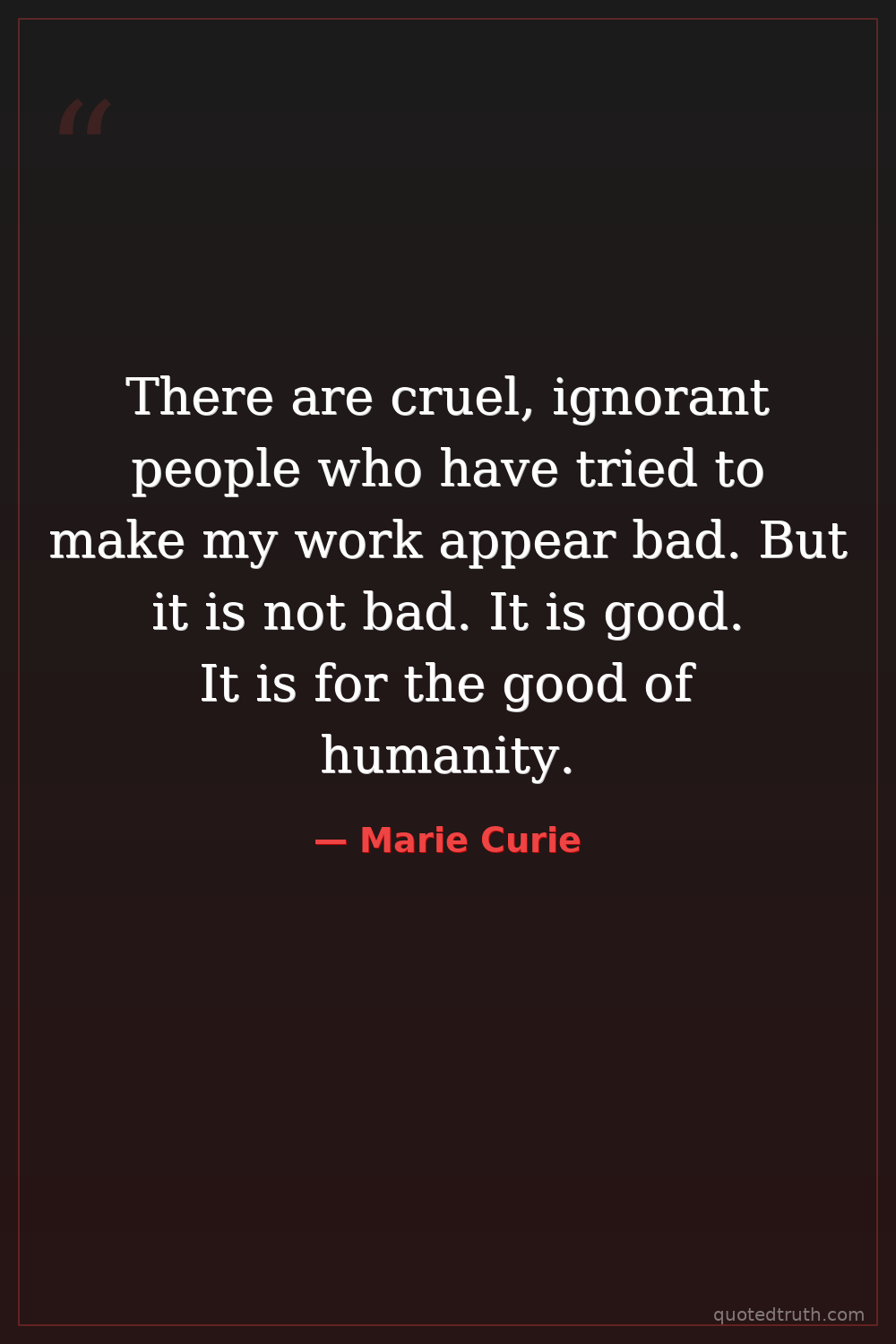
There are cruel, ignorant people who have tried to make my work appear bad. But it is not bad. It is good. It is for the good of humanity.
There are cruel, ignorant people who have tried to make my work appear bad. But it is not bad. It is good. It is for the good of humanity.
Click any product to generate a realistic preview. Up to 3 at a time.
* Initial load can take up to 90 seconds — revising the preview in another color is nearly instant.
"You cannot hope to build a better world without improving the individuals. To that end, each of us must work for his own improvement, and at the same time share a general responsibility for all humani…"
"The scientist in his laboratory is not merely a technician, but also a child confronting natural phenomena that impress him as though they were fairy tales."
"I believe that every woman who has a scientific career should be able to combine marriage with her work."
"There are sadistic scientists who hurry to hunt down errors instead of establishing the truth."
"One never notices what has been done; one can only see what remains to be done."
Found in 1 providers: grok
1 source checked
The speaker pushes back against critics who attack her work out of malice or misunderstanding. She refuses to let their slander redefine what she has done. Instead she insists on the moral worth of the work itself, framing it as a contribution to humanity rather than personal ambition. The tone is defensive but resolute: dismissing the attackers, then reaffirming purpose in plain, almost stubborn terms.
Curie faced relentless hostility, especially during the 1911 Langevin affair when French press branded her a foreign Jewish home-wrecker and a mob surrounded her house. Yet she pressed on, isolating radium, founding the Radium Institute, and running mobile X-ray units in WWI. Her insistence that radioactivity research served humanity reflects a lifelong refusal to patent discoveries, choosing open science over wealth even as she handled materials that ultimately killed her.
Curie worked from the 1890s through the 1930s, when women were barred from most European universities and the French Academy of Sciences rejected her in 1911. Xenophobia toward her Polish origins and sexist scandal-mongering ran rampant in the press. Simultaneously, radioactivity was reshaping physics and medicine, and WWI proved its battlefield value through her radiology units. Public understanding lagged far behind the science, fueling both wonder and suspicion.
AI-generated insights based on extensive research and information for context. Factual errors? Email [email protected].
Your cart is empty