What it means
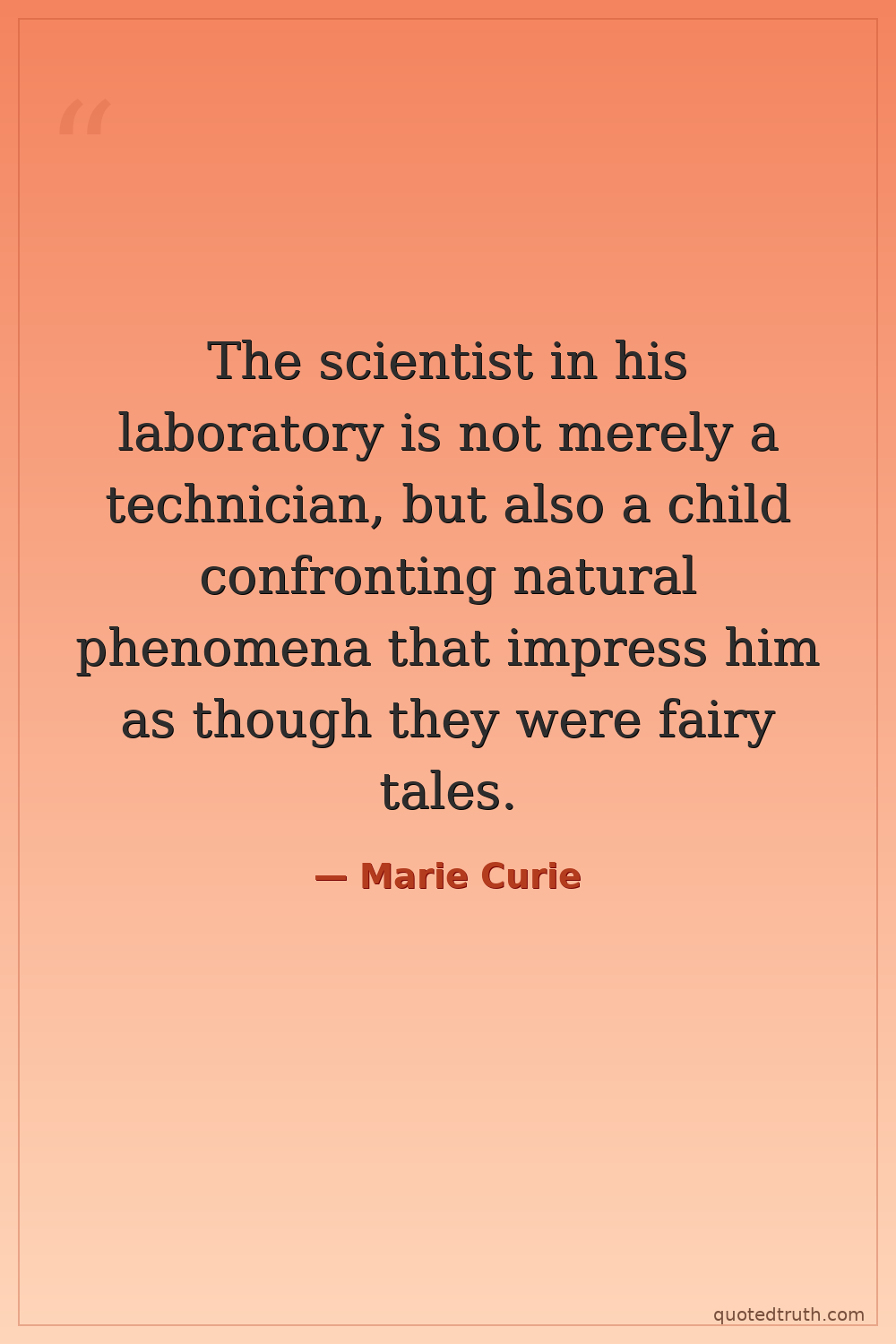
Curie argues that real science is not cold technical work. A scientist meets nature with the wonder of a child hearing a fairy tale, amazed by phenomena they cannot yet explain. Expertise and instruments matter, but curiosity and awe are what actually drive discovery. Treating the lab as a place of enchantment, not just measurement, is what turns a competent worker into someone capable of seeing something new.
Relevance to Marie Curie
Curie lived this attitude. She and Pierre spent years stirring tons of pitchblende in a leaky shed to isolate radium, driven less by career than by fascination with the faint glow in the dark. Despite two Nobels in physics and chemistry, she refused to patent her methods and spoke of radioactivity with almost reverent language. The quote mirrors her notebooks, where precise measurements sit beside obvious delight at what the elements were doing.
The era
Curie worked from the 1890s through the 1930s, when physics was being rewritten by X-rays, the electron, radioactivity, and relativity. Nature itself seemed to be opening secret doors. At the same time, science was professionalizing into industrial labs and male-dominated institutions that often treated her as an outsider. Insisting on childlike wonder pushed back against both the grey bureaucratic image of the scientist and the gatekeeping she personally faced as a Polish woman in French academia.
AI-generated insights based on extensive research and information for context. Factual errors? Email [email protected].