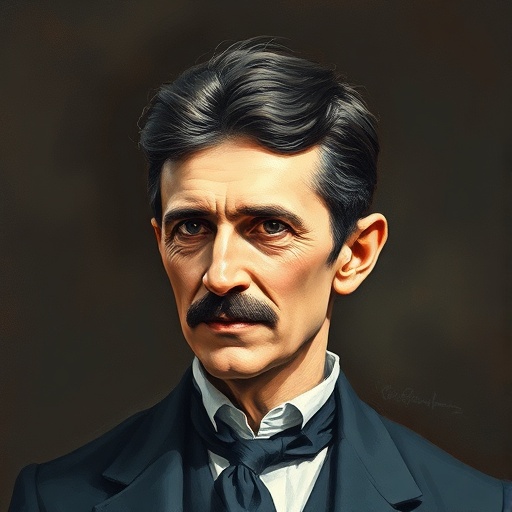
Nikola Tesla — "I do not believe in the spirit of competition, but in the spirit of cooperation."
I do not believe in the spirit of competition, but in the spirit of cooperation.
I do not believe in the spirit of competition, but in the spirit of cooperation.
Click any product to generate a realistic preview. Up to 3 at a time.
* Initial load can take up to 90 seconds — revising the preview in another color is nearly instant.
"The wireless transmission of energy is the most important discovery of all time."
"My method is different. I do not rush into actual work. When I get an idea I start at once building it up in my imagination. I change the construction, make improvements, and operate the device entire…"
"A new idea must not be judged by its immediate results."
"The scientific man does not aim at an immediate result. He does not expect that his advanced ideas will be readily grasped. His duty is to lay the foundation for those who are to come, and point the w…"
"I was educated in a monastery, and I read everything that came into my hands."
Serbian-American inventor and electrical engineer whose alternating-current designs powered the modern electrical grid; died poor and largely forgotten. Closely associated with George Westinghouse (his AC-power business partner) and Mihajlo Pupin (fellow Serbian-American physicist at Columbia). For an intellectual contrast, see Thomas Edison, American inventor and direct-current advocate — Edison's direct-current power-distribution scheme was displaced by Tesla-Westinghouse AC in the 1890s 'War of Currents'. Edison ran a public-relations campaign electrocuting animals to discredit AC — the most famous engineering-ethics rivalry in American history. Tesla's AC won and powers nearly every electrical grid on Earth.
Attributed, reflecting his vision for a collaborative world.
Date: Early 20th Century
InspirationalFound in 1 providers: grok
1 source checked
True progress comes not from rivals racing to outdo each other, but from people working together toward shared goals. Competition creates waste, duplication, and animosity, while cooperation multiplies individual strengths. When minds and resources align rather than clash, collective achievement far exceeds what any lone competitor could accomplish through rivalry alone.
Tesla lived this tension painfully. His brutal rivalry with Thomas Edison—the War of Currents—cost him enormously in stress, resources, and public standing. Tesla believed science served humanity, not personal glory. He shared knowledge freely, often to his financial ruin, and dreamed of worldwide free wireless energy, a fundamentally cooperative vision.
The late 1800s and early 1900s were the height of Gilded Age industrial capitalism, where titans like Carnegie, Rockefeller, and Edison weaponized competition ruthlessly. Patent wars, corporate monopolies, and labor exploitation defined the era. Tesla's cooperative idealism stood in sharp contrast to the cutthroat environment surrounding him, making his perspective both countercultural and prophetic.
AI-generated insights based on extensive research and information for context. Factual errors? Email [email protected].
Your cart is empty