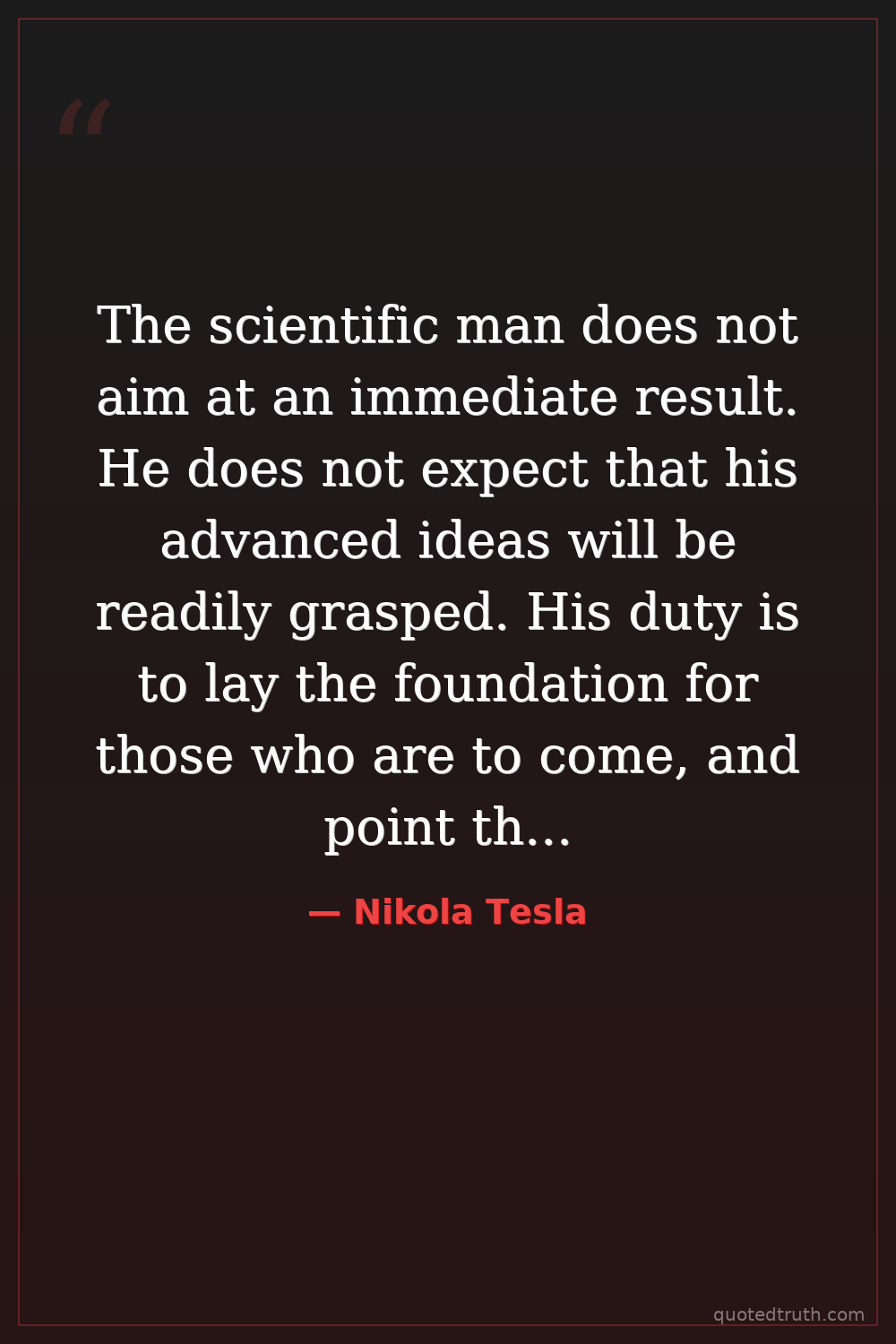
Nikola Tesla — "The scientific man does not aim at an immediate result. He does not expect that …"

The scientific man does not aim at an immediate result. He does not expect that his advanced ideas will be readily grasped. His duty is to lay the foundation for those who are to come, and point the way.
Nikola Tesla — Nikola Tesla Modern · AC electrical system, inventor

Get This Quote & Author's Image Illustrated On:

Click any product to generate a realistic preview. Up to 3 at a time.
* Initial load can take up to 90 seconds — revising the preview in another color is nearly instant.

Kitchen

Apparel

Other

About Nikola Tesla (1856-1943)

Serbian-American inventor and electrical engineer whose alternating-current designs powered the modern electrical grid; died poor and largely forgotten. Closely associated with George Westinghouse (his AC-power business partner) and Mihajlo Pupin (fellow Serbian-American physicist at Columbia). For an intellectual contrast, see Thomas Edison, American inventor and direct-current advocate — Edison's direct-current power-distribution scheme was displaced by Tesla-Westinghouse AC in the 1890s 'War of Currents'. Edison ran a public-relations campaign electrocuting animals to discredit AC — the most famous engineering-ethics rivalry in American history. Tesla's AC won and powers nearly every electrical grid on Earth.

Details

My Inventions: The Autobiography of Nikola Tesla

Date: 1919

General

Verification

Unverifiable

Found in 1 providers: grok

1 source checked

Understanding this quote

What it means

A true scientist works for the long game, not quick recognition. They plant seeds knowing others will harvest them. The goal is building durable knowledge and pointing toward future discovery, not chasing applause or immediate validation. Science is a relay race across generations, and each contributor's job is passing the baton forward, not crossing the finish line alone.

Relevance to Nikola Tesla

Tesla spent his life being misunderstood, underfunded, and eclipsed by Edison in public perception, yet he developed alternating current that powers modern civilization. He held over 300 patents, many not commercialized in his lifetime. He died nearly penniless in 1943 while concepts like wireless energy transmission he pioneered only became mainstream decades later, embodying this exact philosophy.

The era

Tesla worked during the Second Industrial Revolution, when electricity was transforming society and fierce commercial competition pressured inventors toward immediate profitable applications. Edison's direct current dominated early infrastructure. Scientific purists like Tesla clashed with market-driven invention culture. The era rewarded showmanship and patents over theoretical groundwork, making Tesla's patient, foundational approach both radical and economically costly.

AI-generated insights based on extensive research and information for context. Factual errors? Email [email protected].
Your Cart

Your cart is empty