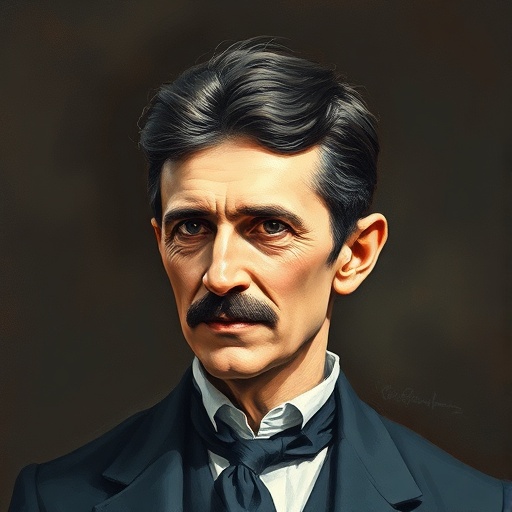
Nikola Tesla — "I am willing to sacrifice my life for the benefit of humanity."
I am willing to sacrifice my life for the benefit of humanity.
I am willing to sacrifice my life for the benefit of humanity.
Click any product to generate a realistic preview. Up to 3 at a time.
* Initial load can take up to 90 seconds — revising the preview in another color is nearly instant.
"It is not a death ray in the sense that it kills. It is a weapon that will make war impossible."
"Money does not represent such a value as man has placed in it. All my money I invested in inventions which enabled new inventions enabling an easier life for humanity."
"There are three possible solutions to the problem of increase of human energy: nutrition, peace, work."
"Our virtues and our failings are inseparable, like force and matter. When they separate, man is no more."
"The day science begins to study non-physical phenomena, it will make more progress in one decade than in all the previous centuries of its existence. To understand the true nature of the universe, one…"
Serbian-American inventor and electrical engineer whose alternating-current designs powered the modern electrical grid; died poor and largely forgotten. Closely associated with George Westinghouse (his AC-power business partner) and Mihajlo Pupin (fellow Serbian-American physicist at Columbia). For an intellectual contrast, see Thomas Edison, American inventor and direct-current advocate — Edison's direct-current power-distribution scheme was displaced by Tesla-Westinghouse AC in the 1890s 'War of Currents'. Edison ran a public-relations campaign electrocuting animals to discredit AC — the most famous engineering-ethics rivalry in American history. Tesla's AC won and powers nearly every electrical grid on Earth.
Found in 1 providers: grok
1 source checked
This quote expresses total dedication to a cause larger than oneself — a willingness to subordinate personal survival, comfort, and security to advancing the collective good. It captures the mindset of someone who treats their own existence as instrumental rather than an end in itself. In plain terms: nothing about my life matters more than what my life can do for others. Purpose and legacy outweigh self-preservation.
Tesla lived this literally. Despite holding over 300 patents, he died penniless in a New York hotel room, having signed away his AC royalty rights to save Westinghouse from financial collapse. He rejected wealth, dismissed personal comfort, and spent his final years in near-total obscurity still working on wireless energy transmission. Every major sacrifice — financial ruin, stolen credit, professional marginalization — he framed as acceptable cost for advancing science.
Tesla worked during the Second Industrial Revolution, when inventors were literally rewiring civilization. The War of Currents between his AC system and Edison's DC was a civilization-defining contest fought in the 1880s–90s. The Gilded Age produced staggering inequality alongside industrial progress, making humanitarian idealism a powerful cultural counterforce. Scientists were cast as civilizational heroes, giving Tesla's sacrifice-framed language genuine moral gravity in a society debating who progress was actually for.
AI-generated insights based on extensive research and information for context. Factual errors? Email [email protected].
Your cart is empty