What it means
Science limits itself by studying only physical, measurable phenomena. Once it seriously investigates non-physical dimensions of reality, progress will accelerate dramatically. The claim is that energy, frequency, and vibration are more fundamental than matter itself—the deepest truths of the universe operate at this invisible level. Understanding reality requires moving beyond particles and mass toward these underlying principles that physics can detect but rarely treats as the primary framework for existence.
Relevance to Nikola Tesla
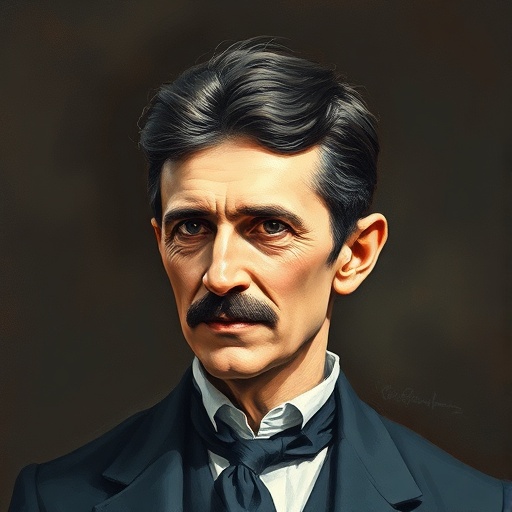
Tesla built his career on invisible forces—alternating current, electromagnetic fields, radio waves, and resonance. His Colorado Springs experiments probed earth frequencies; Wardenclyffe sought wireless energy transmission through the planet itself. He believed resonance was a universal principle, claiming a pocket oscillator could collapse the Brooklyn Bridge. His AC motors and transformers were fundamentally engineering of frequency and oscillation at industrial scale, making this statement a direct expression of his professional worldview.
The era
Tesla's productive decades spanned the 1880s–1910s, a period of radical scientific upheaval. Maxwell's equations had unified light and electromagnetism; quantum mechanics was emerging; Einstein's 1905 relativity papers dissolved strictly mechanical models of reality. Simultaneously, Victorian spiritualism—séances, mesmerism, telepathy societies—ran parallel to scientific progress, reflecting public hunger for non-material explanations. This tension between materialist science and invisible forces made Tesla's energy-frequency framework feel like a bridge between rigorous physics and deeper metaphysical questions.
AI-generated insights based on extensive research and information for context. Factual errors? Email [email protected].