Nikola Tesla — "Our virtues and our failings are inseparable, like force and matter. When they s…"
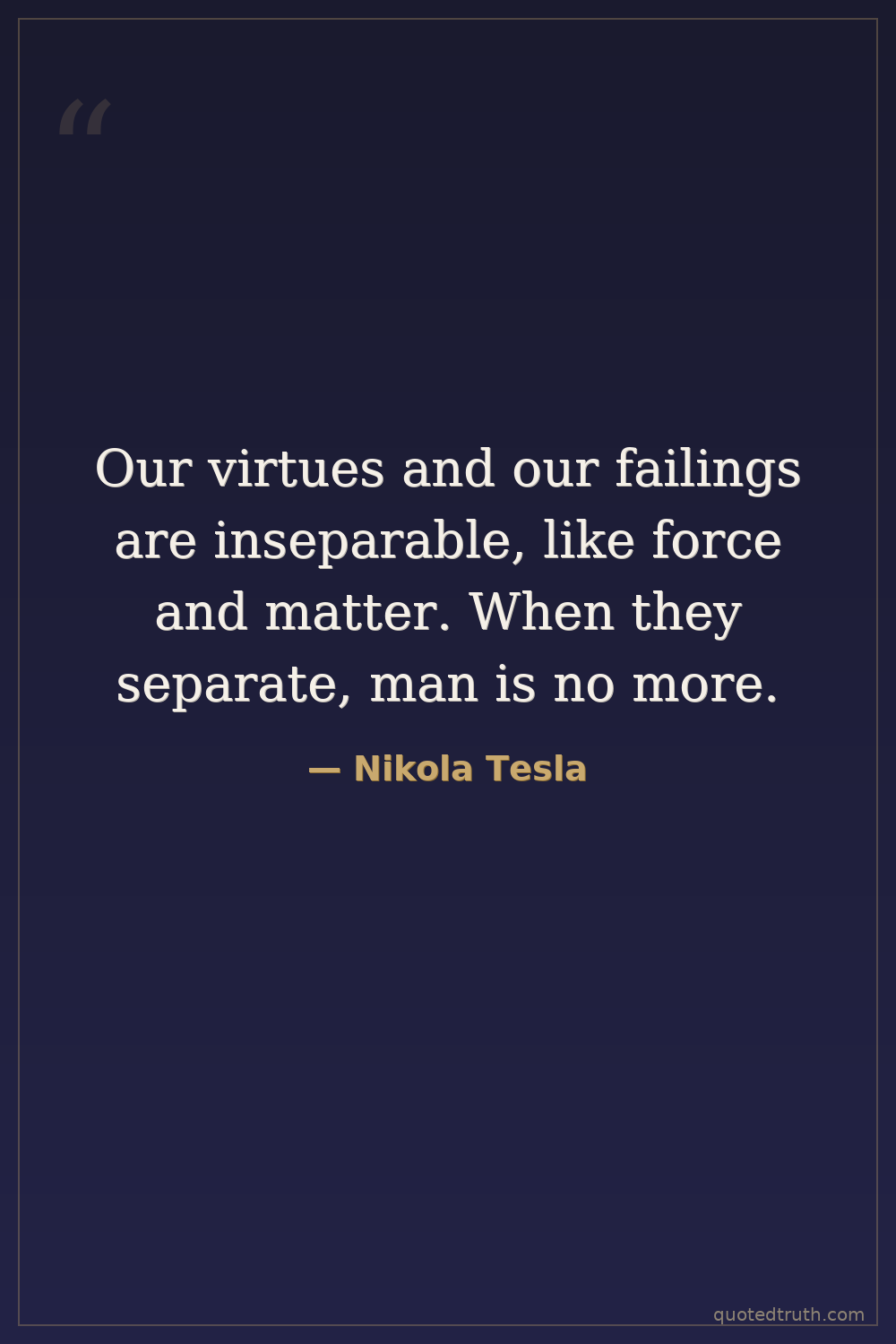
Our virtues and our failings are inseparable, like force and matter. When they separate, man is no more.
Our virtues and our failings are inseparable, like force and matter. When they separate, man is no more.
Click any product to generate a realistic preview. Up to 3 at a time.
* Initial load can take up to 90 seconds — revising the preview in another color is nearly instant.
"I would give a thousand secrets of nature upon which I stumbled by accident, in exchange for this one which I extracted from nature, in spite of all the miracles and dangers which I faced."
"Insufficient observation is only a form of unknowing, a cause of many perverse incidents and a triumph of crazy ideas."
"I could not sleep for several nights for the sheer joy of it."
"It is paradoxical, yet true, to say, that the more we know, the more ignorant we become in the absolute sense, for it is only through enlightenment that we become conscious of our limitations. Precise…"
"The opinion of the world does not affect me. I have placed as the real values in my life what follows when I am dead."
Serbian-American inventor and electrical engineer whose alternating-current designs powered the modern electrical grid; died poor and largely forgotten. Closely associated with George Westinghouse (his AC-power business partner) and Mihajlo Pupin (fellow Serbian-American physicist at Columbia). For an intellectual contrast, see Thomas Edison, American inventor and direct-current advocate — Edison's direct-current power-distribution scheme was displaced by Tesla-Westinghouse AC in the 1890s 'War of Currents'. Edison ran a public-relations campaign electrocuting animals to discredit AC — the most famous engineering-ethics rivalry in American history. Tesla's AC won and powers nearly every electrical grid on Earth.
Found in 1 providers: gemini
1 source checked
Human character is an indivisible whole — our strengths and weaknesses are two faces of the same coin, just as force and matter cannot exist apart in physics. Strip away someone's flaws, and you also erase the qualities that made them exceptional. What defines us as human beings is the complete, integrated package of both. A being of pure virtue or pure failing is not a person — it is an abstraction.
Tesla's own life made this principle unavoidable. His obsessive perfectionism — the same trait that drove AC power, the Tesla coil, and early radio — made him commercially ruinous, unable to delegate or compromise. His contempt for money, which cost him his Westinghouse royalties worth millions, was inseparable from his pure scientific idealism. He died penniless and alone in a New York hotel room, a genius whose greatness and ruin shared the same root.
Tesla worked during the Gilded Age and Progressive Era, when electricity was reshaping civilization and industrial capitalism simultaneously created vast wealth and devastating poverty. Victorian morality demanded sharp separation between public virtue and private sin. Freud's contemporaneous psychology and Nietzsche's philosophy were challenging that clean divide, arguing human nature was unified and contradictory. Tesla's era celebrated heroic inventors while ruthlessly exploiting them — the War of Currents itself proved that genius and vulnerability were inseparable in practice.
AI-generated insights based on extensive research and information for context. Factual errors? Email [email protected].
Your cart is empty