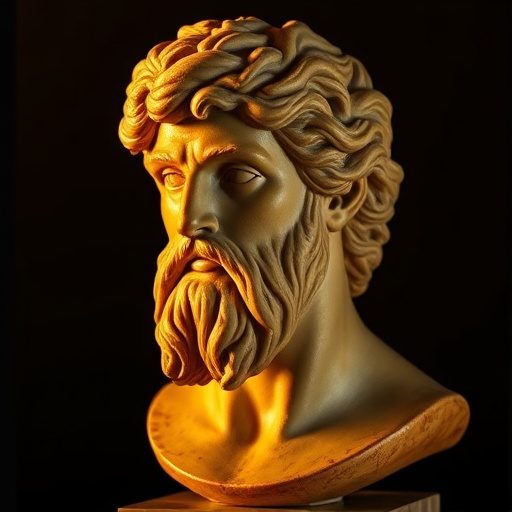
Pythagoras — "Don't step over a balance beam."
Don't step over a balance beam.
Don't step over a balance beam.
Click any product to generate a realistic preview. Up to 3 at a time.
* Initial load can take up to 90 seconds — revising the preview in another color is nearly instant.
"The highest goal of music is to connect one's soul to their Divine Nature, not entertainment."
"Lust weakens both body and mind."
"Do not look in a mirror by lamplight."
"Do not eat beans."
"Not to speak of Pythagorean beans, from which, it is said, Pythagoras himself abstained."
Greek philosopher and mathematician whose school in Croton combined geometry (the Pythagorean theorem), number-mysticism, and a religious-vegetarian way of life. Closely associated with Thales of Miletus (earlier pre-Socratic and the first philosopher). For an intellectual contrast, see Heraclitus, pre-Socratic Greek philosopher of flux — Heraclitus called Pythagoras 'the chief of swindlers' — among the founding insults of the philosophical-rivalry tradition. Their 'all is flux' vs 'all is number' poles still organize the philosophy of mathematics today (Platonist vs anti-realist).
A Pythagorean 'Symbol', interpreted by Diogenes Laertius as 'don't transgress equality and justice'.
Date: c. 570-495 BCE (interpreted 3rd century CE)
WisdomFound in 1 providers: gemini
1 source checked
Don't violate fairness or overstep the bounds of justice. The balance beam represents equity and proportion—stepping over it symbolizes transgressing what is right and fair. Live within measured limits, respect others' rightful share, and maintain equilibrium in your actions and dealings. This is a call to honor justice not merely as a legal concept but as a fundamental principle of ethical living.
Pythagoras built his entire worldview on number, proportion, and harmony. His theorem reveals perfect balance between a triangle's sides; his cosmology held that planets emit harmonious tones in precise mathematical ratios. The Pythagorean brotherhood followed cryptic commandments called acusmata governing conduct. For Pythagoras, mathematical balance wasn't abstract—it was the moral architecture of the cosmos, and violating proportion in life was as wrong as error in geometry.
In sixth-century BCE Greece, scales were instruments of commerce, law, and divine justice—the goddess Themis held them. Greek society feared hubris, overstepping one's proper station, as the source of divine punishment. Pythagoras founded his brotherhood in Croton amid Greek colonial expansion, where fair measure in trade and civic life was a survival value. Cosmic order through proportion was the era's defining philosophical obsession among early pre-Socratic thinkers.
AI-generated insights based on extensive research and information for context. Factual errors? Email [email protected].
Your cart is empty