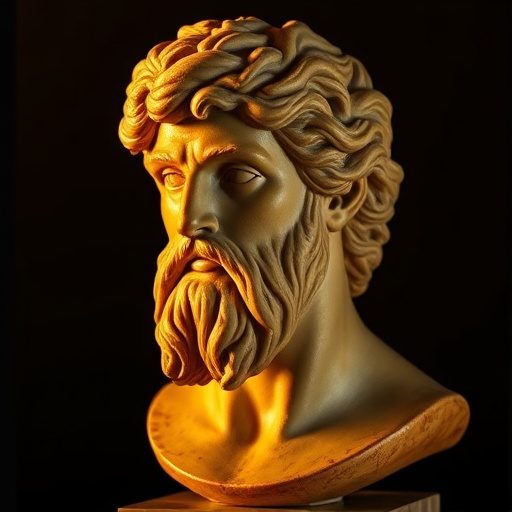
Pythagoras — "No one is free who has not obtained the empire of himself."
No one is free who has not obtained the empire of himself.
No one is free who has not obtained the empire of himself.
Click any product to generate a realistic preview. Up to 3 at a time.
* Initial load can take up to 90 seconds — revising the preview in another color is nearly instant.
"Don't wipe up a mess with a torch."
"The beginning is half of the whole."
"Concern should drive us into action and not into a depression. No man is free who is not master of himself."
"The souls of animals called unreasoning are reasonable, not however with active reasoning powers, because of an imperfect mixture of the bodies and because they do not have the power of speech, as in …"
"All is number."
Greek philosopher and mathematician whose school in Croton combined geometry (the Pythagorean theorem), number-mysticism, and a religious-vegetarian way of life. Closely associated with Thales of Miletus (earlier pre-Socratic and the first philosopher). For an intellectual contrast, see Heraclitus, pre-Socratic Greek philosopher of flux — Heraclitus called Pythagoras 'the chief of swindlers' — among the founding insults of the philosophical-rivalry tradition. Their 'all is flux' vs 'all is number' poles still organize the philosophy of mathematics today (Platonist vs anti-realist).
Found in 1 providers: deepseek
1 source checked
True freedom isn't about lacking chains or holding political rights—it's about mastering yourself. Someone ruled by impulses, addictions, or unchecked emotions is a slave regardless of legal status. Self-governance—controlling desires, anger, and habits—is what real freedom means. Without that internal sovereignty, external liberty is hollow. Freedom becomes an internal achievement you earn through discipline, not something society grants or circumstance provides.
Pythagoras founded a disciplined philosophical brotherhood in Croton demanding strict dietary rules, silence practices, and communal asceticism from all members. He believed mathematical study and bodily restraint purified the soul toward wisdom. His school's entire structure rested on self-mastery as prerequisite to understanding truth. A man who imposed rigorous behavioral codes on himself and followers, Pythagoras treated the undisciplined mind as fundamentally incapable of accessing higher knowledge—making this quote the practical cornerstone of his entire philosophy.
In 6th-century BCE Greece, literal slavery was ubiquitous and civic freedom depended entirely on birthright or political status. City-states were debating democracy while Persian imperial power threatened Greek autonomy. Pre-Socratic philosophers were beginning to distinguish political freedom from philosophical freedom—a genuinely radical move. In a world where most people's liberty was externally defined by conquest or birth, claiming true freedom was an inner state earned through discipline rather than granted by law was a subversive, consequential idea.
AI-generated insights based on extensive research and information for context. Factual errors? Email [email protected].
Your cart is empty