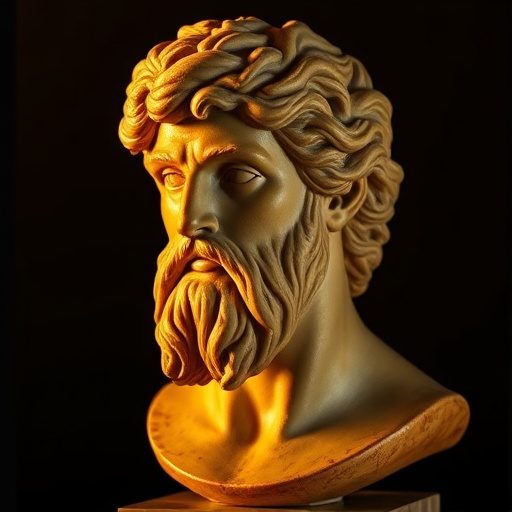
Pythagoras — "Do not receive the swallow into your house."
Do not receive the swallow into your house.
Do not receive the swallow into your house.
Click any product to generate a realistic preview. Up to 3 at a time.
* Initial load can take up to 90 seconds — revising the preview in another color is nearly instant.
"The soul of man is divided into three parts, intelligence, reason, and passion. Intelligence and passion are possessed by other animals, but reason by man alone."
"Spit upon the parings of your nails, and the clippings of your hair."
"Don't piss or stand on your cut nails and hair."
"Eat not the brain."
"Eat not the matrix of animals."
Greek philosopher and mathematician whose school in Croton combined geometry (the Pythagorean theorem), number-mysticism, and a religious-vegetarian way of life. Closely associated with Thales of Miletus (earlier pre-Socratic and the first philosopher). For an intellectual contrast, see Heraclitus, pre-Socratic Greek philosopher of flux — Heraclitus called Pythagoras 'the chief of swindlers' — among the founding insults of the philosophical-rivalry tradition. Their 'all is flux' vs 'all is number' poles still organize the philosophy of mathematics today (Platonist vs anti-realist).
One of the 'symbols,' possibly an allegory against accepting treacherous or unreliable people.
Date: c. 570 – c. 495 BC
ShockingFound in 1 providers: grok
1 source checked
Don't take in people who chatter constantly, drop by unpredictably, and leave messes behind without contributing anything lasting. The saying warns against welcoming gossipy, transient guests or housemates who create noise and disorder, then vanish when conditions change. Choose the company you let into your private space carefully, because shallow, restless personalities disrupt the calm and discipline of a well-ordered home, even if they seem harmless or charming on arrival.
Pythagoras ran a tightly disciplined brotherhood at Croton where initiates observed silence, vegetarianism, and strict rules about speech and companionship. This cryptic maxim is one of his famous symbola, riddles used to train disciples to read beneath surface meaning. Given his obsession with purity of mind, controlled speech, and guarding the sanctity of the communal household, warning against chattering 'swallows' fits his whole philosophy of mental and domestic order.
In 6th-century BCE Greece, swallows nested inside homes and were associated with idle chatter and foreign barbarian speech, which sounded like twittering to Greek ears. Hospitality was a sacred duty, so refusing a guest required justification through proverb. Pythagoras taught in Croton, a Greek colony in southern Italy, during an age when oral wisdom traditions, mystery cults, and philosophical schools competed, and coded sayings protected esoteric teachings from outsiders.
AI-generated insights based on extensive research and information for context. Factual errors? Email [email protected].
Your cart is empty