Neil deGrasse Tyson — "You know, the nice thing about science is that it’s an equal-opportunity destroy…"
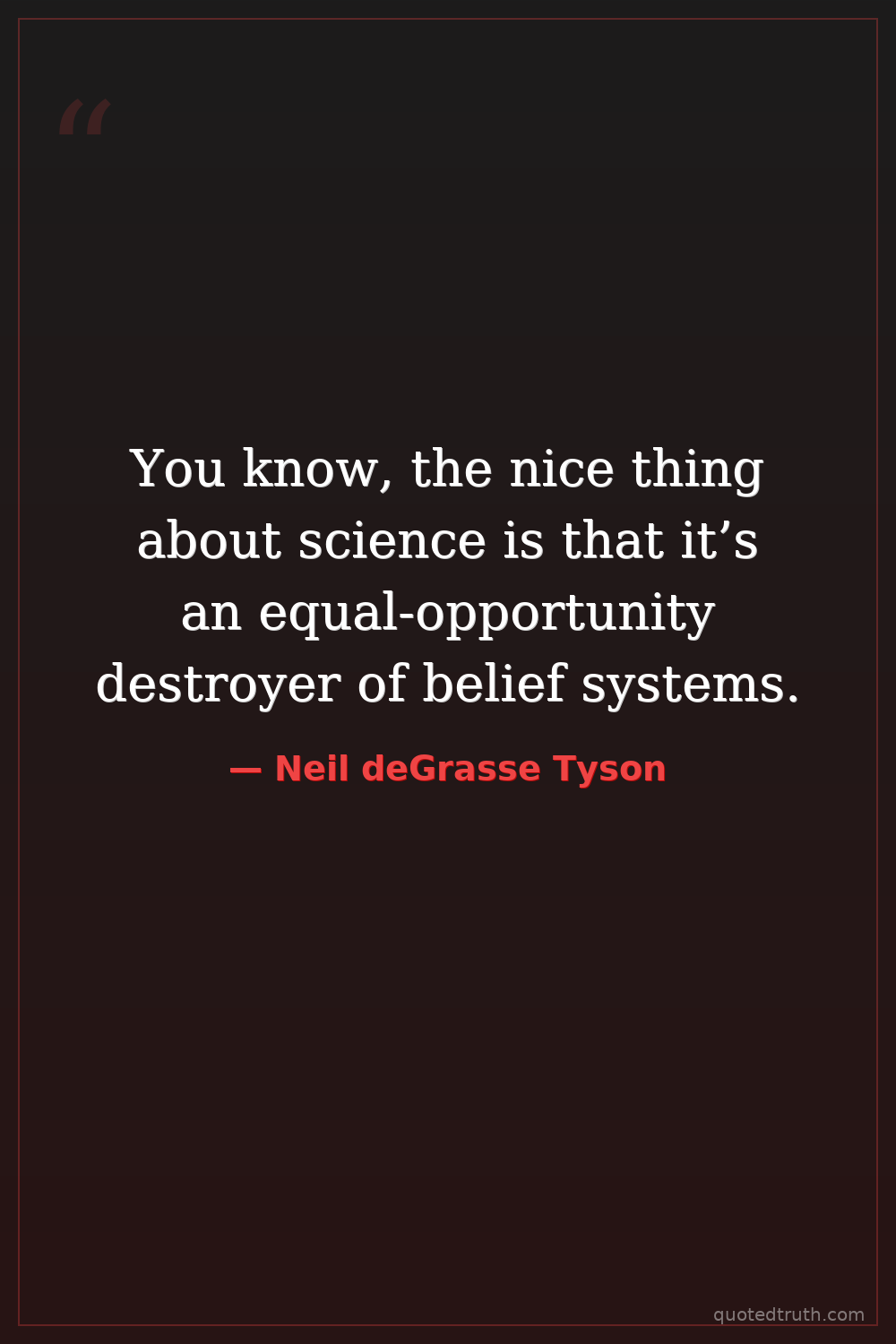
You know, the nice thing about science is that it’s an equal-opportunity destroyer of belief systems.
You know, the nice thing about science is that it’s an equal-opportunity destroyer of belief systems.
Click any product to generate a realistic preview. Up to 3 at a time.
* Initial load can take up to 90 seconds — revising the preview in another color is nearly instant.
"We spend the first year of a child's life teaching it to walk and talk and the rest of its life telling it to sit down and shut up. Is it any wonder the world is in the mess it's in?"
"If you're not learning, you're not living."
"The universe is not just big. It's vast."
"I'm an agnostic. I'm not an atheist, because I don't know enough to be an atheist."
"I don't care what you believe. I care what you can prove."
American astrophysicist, Hayden Planetarium director, and Cosmos: A Spacetime Odyssey host who carries the Carl Sagan public-science mantle. Closely associated with Bill Nye (fellow science communicator) and Brian Greene (theoretical physicist and string-theory popularizer). For an intellectual contrast, see Ken Ham, founder of Answers in Genesis and the Creation Museum — Ham's career has been organized around defending biblical 6-day creationism — exactly the science-education position Tyson's mainstream-science communication is structured to refute.
Found in 1 providers: grok
1 source checked
Science doesn't play favorites when it comes to overturning established ideas. Whether religious doctrine, political ideology, cultural tradition, or even previously accepted scientific theories, empirical evidence will challenge and dismantle beliefs that don't hold up. This is framed positively: science's impartiality is a feature, not a bug, making it the most reliable method humans have for understanding reality.
Tyson built his career democratizing science through television, podcasts, and books like Astrophysics for People in a Hurry. As a Black scientist navigating institutions historically resistant to outsiders, he understands that science's meritocracy transcends social hierarchies. His StarTalk platform regularly confronts pseudoscience and creationism, embodying this belief that evidence-based reasoning respects no sacred cows.
Tyson became prominent during intensifying culture wars over evolution, climate change denial, and vaccine skepticism in the 2000s-2020s. Political polarization made scientific consensus itself contested terrain. Meanwhile, the internet amplified misinformation at unprecedented scale. His framing of science as an equal-opportunity challenger responded directly to accusations that scientists selectively target religious or conservative belief systems.
AI-generated insights based on extensive research and information for context. Factual errors? Email [email protected].
Your cart is empty