What it means
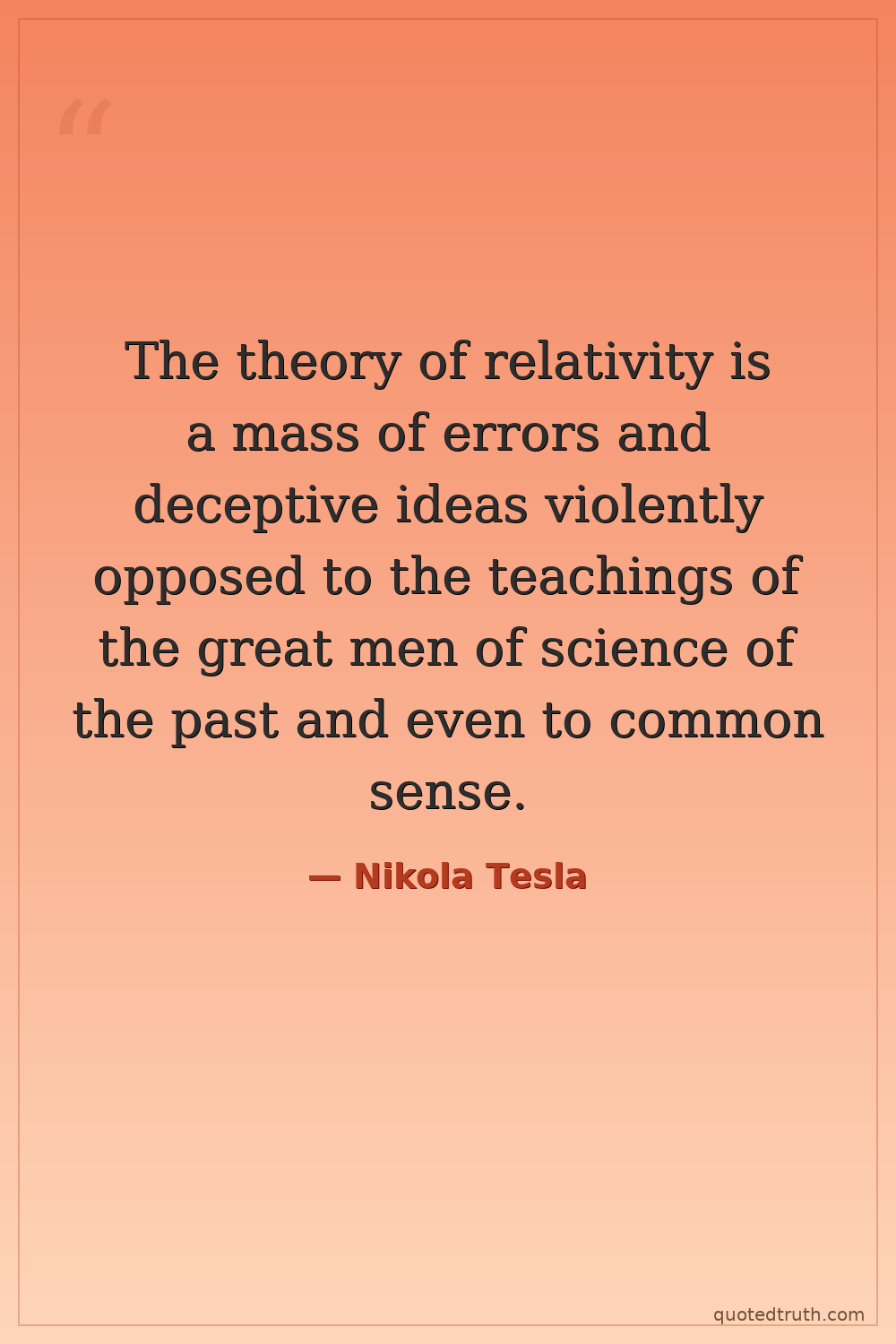
The speaker flatly rejects Einstein's theory of relativity as fundamentally flawed, calling it a pile of mistakes that contradicts centuries of established scientific thought and basic human intuition. The argument is that revolutionary new physics shouldn't discard what great scientists before us built. It's a defense of classical, observable, logical science against abstract mathematical theories that seem to contradict lived experience and the foundational work of physics' greatest minds.
Relevance to Nikola Tesla
Tesla built his entire career on classical electromagnetic theory — Maxwell's equations, Newtonian mechanics, the luminiferous ether. He believed in a physical medium for wave propagation and rejected the idea that space itself could curve. His documented hostility toward Einstein was personal and professional: Tesla publicly disputed mass-energy equivalence and felt relativity abandoned the concrete, testable engineering principles he relied on. His late-career isolation amplified these views as mainstream physics moved decisively away from his worldview.
The era
The early 20th century was physics in upheaval. Einstein's 1905 special relativity and 1915 general relativity dismantled the Newtonian framework governing science for 250 years. Quantum mechanics arrived simultaneously. Many established scientists, not just Tesla, resisted these paradigm shifts. Science was becoming increasingly abstract and mathematical rather than empirical and mechanical. The public debate between classical and modern physics was culturally significant, with scientific authority and foundational assumptions about reality itself openly contested.
AI-generated insights based on extensive research and information for context. Factual errors? Email [email protected].