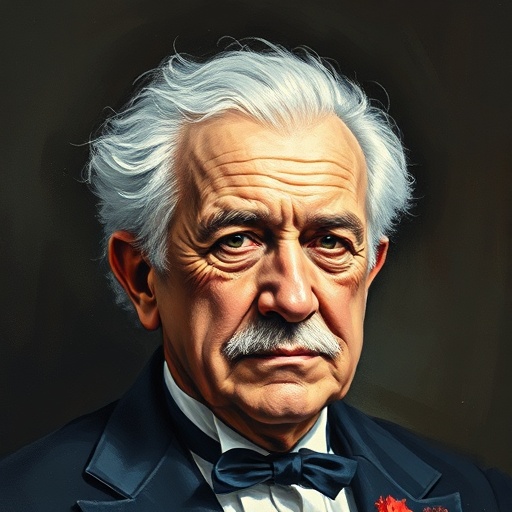
Thomas Edison — "I am proud of the fact that I never invented weapons to kill."
I am proud of the fact that I never invented weapons to kill.
I am proud of the fact that I never invented weapons to kill.
Click any product to generate a realistic preview. Up to 3 at a time.
* Initial load can take up to 90 seconds — revising the preview in another color is nearly instant.
"I am not a believer in the theory of evolution. I believe in the theory of creation."
"My main purpose in life is to make money so that I can afford to carry on more experiments."
"I have not failed. I've just found 10,000 ways that won't work."
"We don't know a millionth of one percent about anything."
"I don't think there's any substitute for a good idea."
A statement of principle, potentially ironic given the military applications of some technologies.
Date: Late 19th - early 20th century (approximate)
Self-DeprecatingFound in 1 providers: gemini
1 source checked
Edison takes pride in directing his creative work toward tools that improve daily life rather than instruments designed to destroy it. He draws a clear moral line: an inventor's genius can be measured not only by what they build but by what they refuse to build. Technical skill, he suggests, carries ethical weight, and choosing to reject weapons development is itself a meaningful achievement worth claiming openly.
Edison held 1,093 US patents covering the light bulb, phonograph, motion picture camera, and electrical distribution, all aimed at domestic and industrial use. Unlike contemporaries such as Hiram Maxim or Alfred Nobel, he avoided munitions work for most of his career. Though he later led the Naval Consulting Board in WWI, he focused on defensive detection systems and famously disliked offensive arms, reflecting his self-image as a civilian improver of everyday life.
Edison worked from the 1870s through the 1920s, an era when industrial inventors like Maxim, Krupp, and Nobel grew wealthy arming empires during colonial expansion, the American Civil War's aftermath, and World War I. Chemistry and mechanical engineering were rapidly weaponized, and public debate emerged over scientists' moral responsibility. Against that backdrop, a celebrity inventor publicly rejecting weapons work was a pointed cultural statement about the proper direction of technological progress.
AI-generated insights based on extensive research and information for context. Factual errors? Email [email protected].
Your cart is empty