Marie Curie — "A scientist in his laboratory is not only a technician: he is also a child place…"
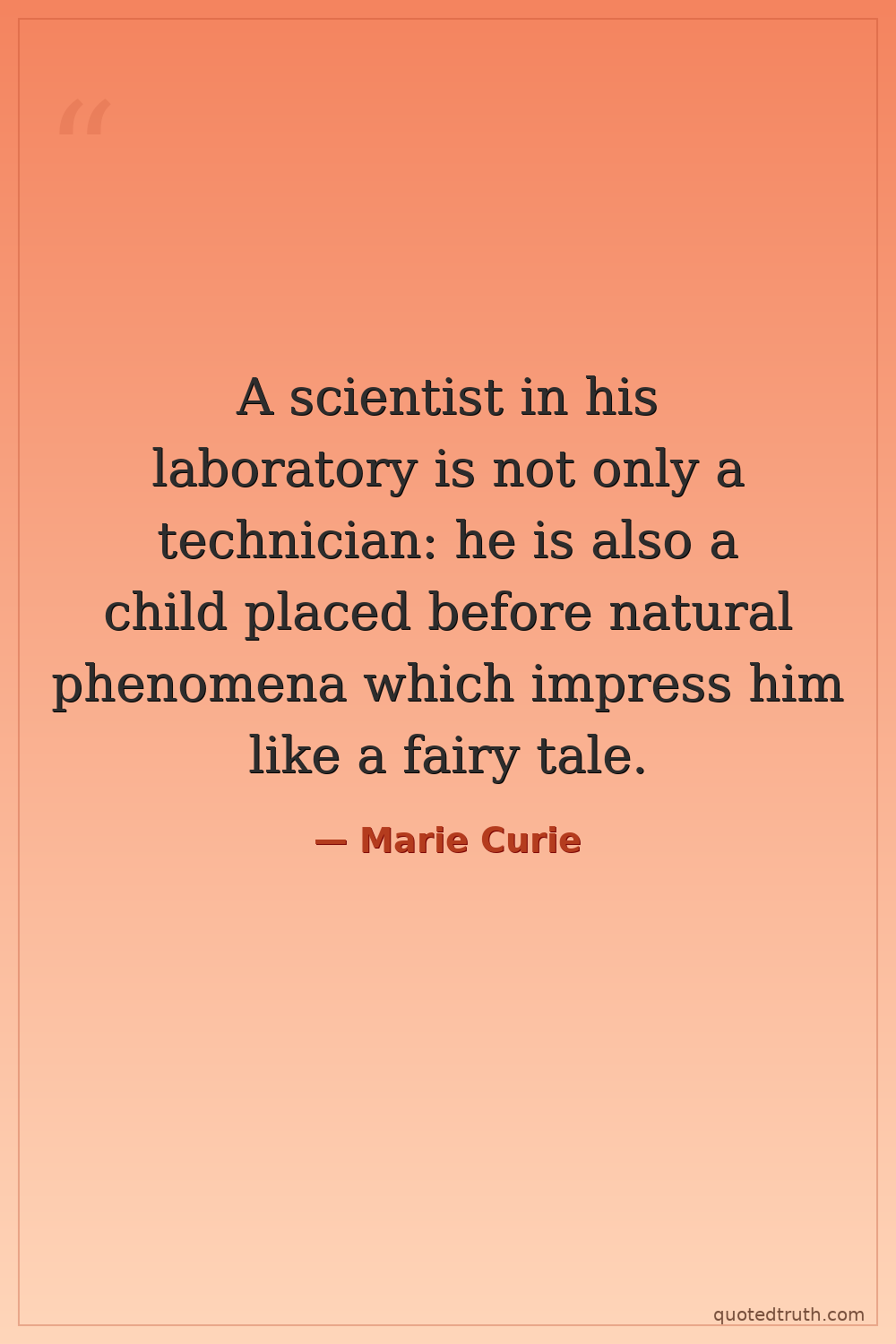
A scientist in his laboratory is not only a technician: he is also a child placed before natural phenomena which impress him like a fairy tale.
A scientist in his laboratory is not only a technician: he is also a child placed before natural phenomena which impress him like a fairy tale.
Click any product to generate a realistic preview. Up to 3 at a time.
* Initial load can take up to 90 seconds — revising the preview in another color is nearly instant.
"First principle: never to let one's self be beaten down by persons or by events."
"You cannot hope to build a better world without improving the individuals."
"I have been reproached for having given myself to science. I have been reproached for having neglected my family. I have been reproached for having neglected my country. I have been reproached for hav…"
"I was very much absorbed in the study of physics and chemistry."
"I am not afraid of anything. I am only afraid of not being able to do my work. I am only afraid of not being able to discover new things. I am only afraid of not being able to contribute to the progre…"
A poetic and somewhat absurd comparison, revealing a sense of wonder.
Date: Early 20th century (approximate)
GeneralFound in 1 providers: gemini
1 source checked
Curie is saying that real scientific work is not just cold, mechanical procedure. The researcher approaches nature with the same wide-eyed wonder a child feels hearing a fairy tale. Curiosity, awe, and imagination are as essential to discovery as instruments and technique. Stripping science of that sense of enchantment misses what actually drives people to investigate the unknown and keep pushing when results are uncertain or slow.
Curie spent years hand-processing tons of pitchblende in a leaking shed to isolate radium, a grind that demanded both rigorous technique and sustained wonder. She described the faint blue glow of radium samples in the dark as enchanting, and twice won the Nobel Prize while working in brutal conditions. Her pairing of meticulous lab discipline with genuine awe at nature's hidden forces is exactly the dual identity, technician and astonished child, this quote captures.
Curie worked at the turn of the twentieth century, when physics was being upended by X-rays, radioactivity, and the electron. The atom, once thought indivisible, was cracking open. Women were largely barred from European science, and she was the first woman to win a Nobel and the first person to win two. Against that backdrop, framing the scientist as a wonder-struck child pushed back on the era's austere, male, purely mechanistic image of research.
AI-generated insights based on extensive research and information for context. Factual errors? Email [email protected].
Your cart is empty