Louis Pasteur — "Posterity will one day laugh at the sublime foolishness of the modern materialis…"
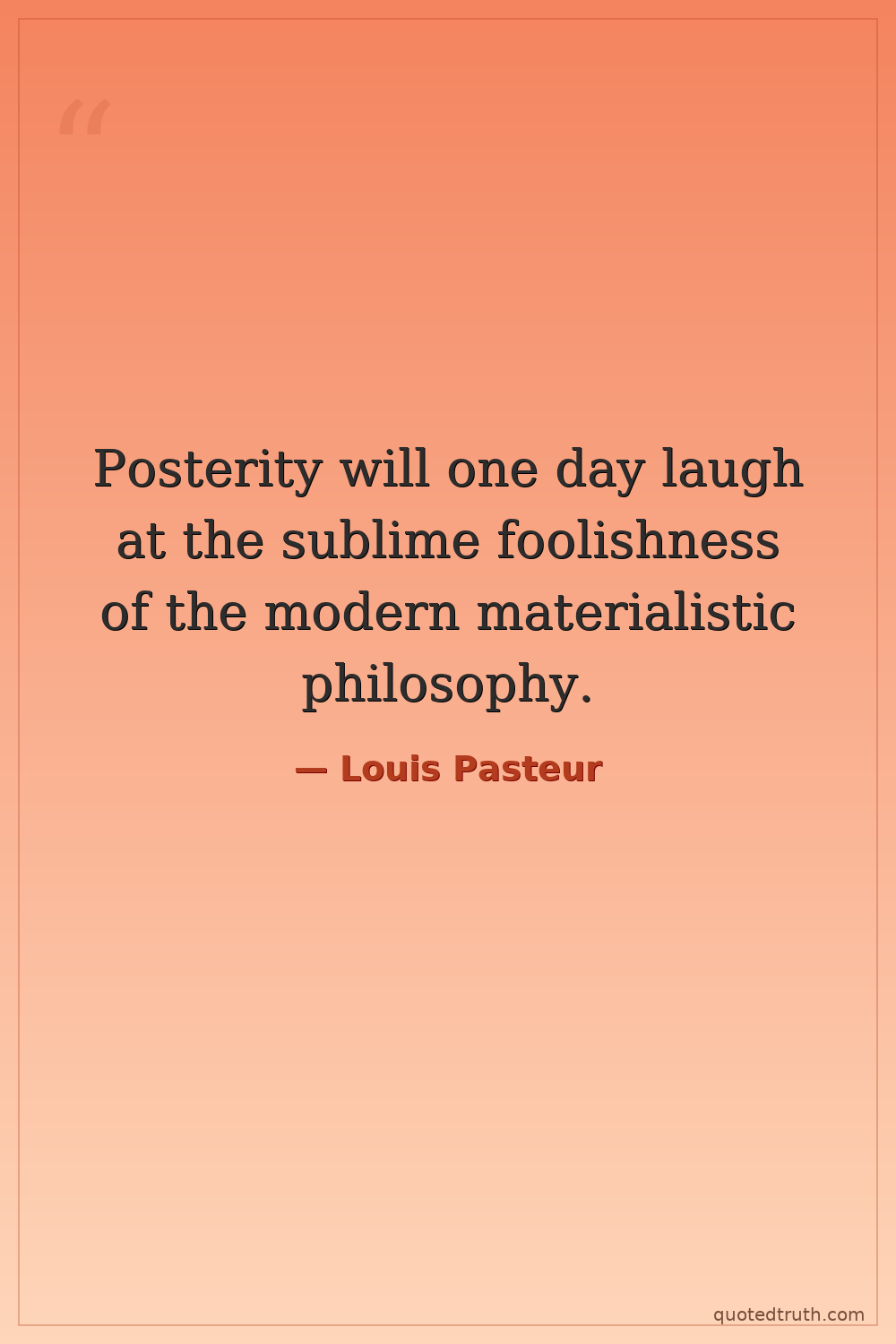
Posterity will one day laugh at the sublime foolishness of the modern materialistic philosophy.
Posterity will one day laugh at the sublime foolishness of the modern materialistic philosophy.
Click any product to generate a realistic preview. Up to 3 at a time.
* Initial load can take up to 90 seconds — revising the preview in another color is nearly instant.
"The future belongs to those who believe in the beauty of their dreams."
"My passion for truth was the only guide of my life."
"Without laboratories, men of science are soldiers without arms."
"I am on the edge of mysteries and the veil is getting thinner and thinner."
"When I approach a child, he inspires in me two sentiments: tenderness for what he is, and respect for what he may become."
A strong, dramatic, and potentially ironic prediction about future scientific understanding.
Date: 19th century (approximate)
GeneralFound in 1 providers: gemini
1 source checked
Future generations will look back and find it absurd that people today believe matter alone explains everything. The confident claim that physical processes can account for life, mind, and meaning will appear as naive overreach once more is understood. What seems rigorous and advanced now will read as arrogant and shortsighted, a fashionable certainty that mistook its own limits for the boundaries of reality itself.
Pasteur, who disproved spontaneous generation and founded germ theory, was a devout Catholic who saw science and faith as complementary. His meticulous experiments convinced him that life's complexity resisted purely mechanical explanation. Having watched colleagues dismiss invisible microbes as superstition before vindication, he trusted that today's materialist certainties would similarly collapse. His laboratory rigor coexisted with conviction that reducing existence to matter alone betrayed both evidence and humility.
Nineteenth-century Europe was gripped by scientific materialism, Darwinian reductionism, and positivist philosophy claiming matter explained everything. Buchner, Haeckel, and Comte argued religion and metaphysics were obsolete. Pasteur worked amid this fervor while defending vitalism against Pouchet's spontaneous-generation claims. Industrial progress fueled confidence that science had dethroned mystery, making Pasteur's skepticism toward triumphalist materialism a minority stance among intellectuals convinced their worldview was the final word.
AI-generated insights based on extensive research and information for context. Factual errors? Email [email protected].
Your cart is empty