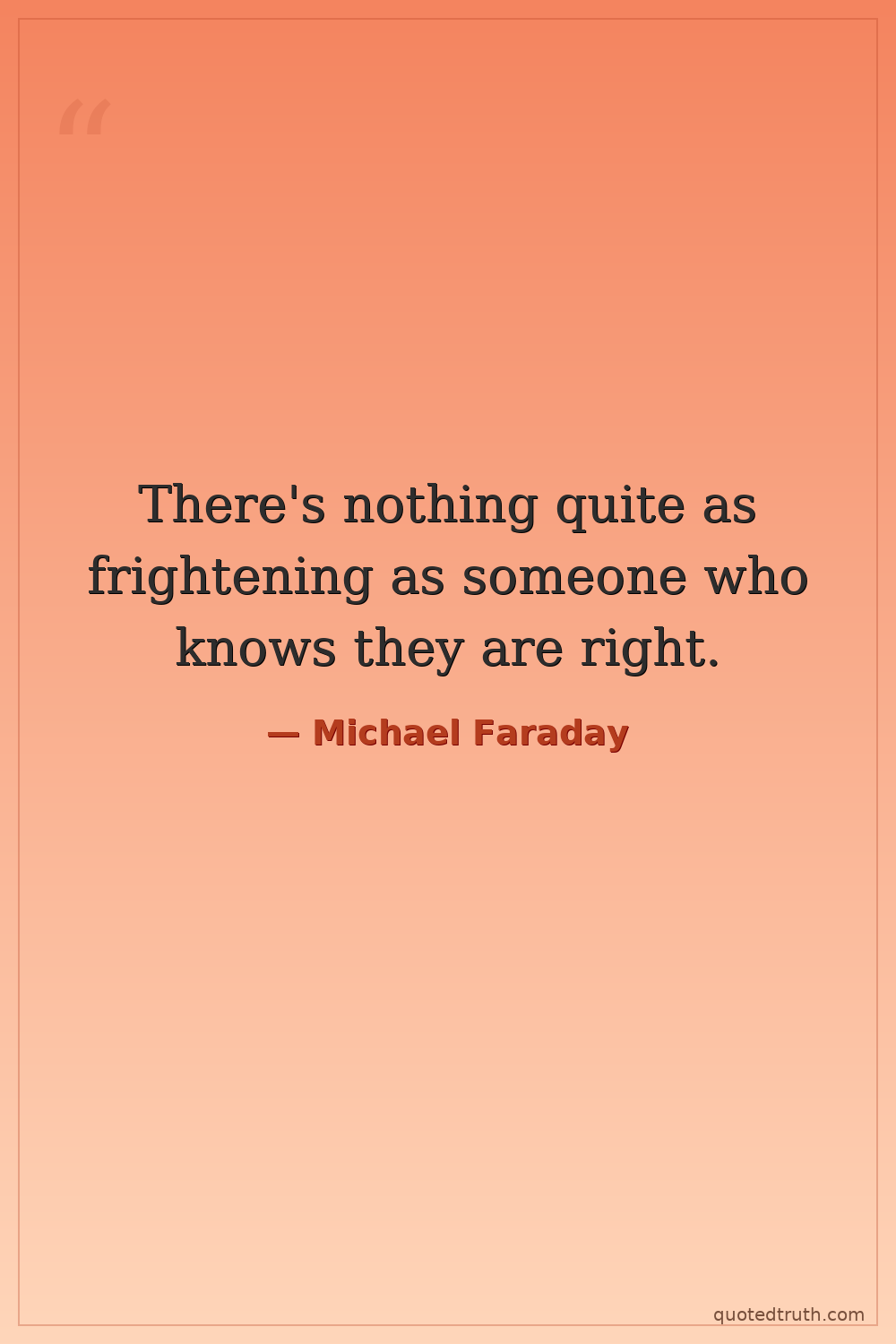
Michael Faraday — "There's nothing quite as frightening as someone who knows they are right."
There's nothing quite as frightening as someone who knows they are right.
There's nothing quite as frightening as someone who knows they are right.
Click any product to generate a realistic preview. Up to 3 at a time.
* Initial load can take up to 90 seconds — revising the preview in another color is nearly instant.
"But still try, for who knows what is possible?"
"The greatest enemy of knowledge is not ignorance, it is the illusion of knowledge."
"The five essential entrepreneurial skills for success are concentration, discrimination, organization, innovation and communication."
"The power of the human mind is immense, and it is capable of comprehending the most complex phenomena."
"The lecturer should give the audience full reason to believe that all his powers have been exerted for their pleasure and instruction."
A witty and insightful observation on human certainty and dogmatism.
Date: 19th century (approximate)
GeneralFound in 1 providers: gemini
1 source checked
This warns that absolute certainty in a person is more dangerous than ignorance or doubt. Someone convinced they possess the truth stops listening, stops questioning, and dismisses evidence that challenges them. Their confidence makes them immovable and willing to push their views onto others without hesitation. Genuine wisdom, by contrast, involves humility and openness to being wrong. The quote argues that conviction without doubt is a closed door, not a sign of intelligence.
Faraday was a self-taught bookbinder's apprentice who rose to become one of history's greatest experimentalists, discovering electromagnetic induction in 1831. Devoutly Sandemanian, he held firm faith yet practiced relentless empirical humility, testing assumptions through thousands of careful experiments. He declined a knighthood and the Royal Society presidency, distrusting status and dogma. His caution against certainty mirrors his method: conclusions were provisional, always subject to the next measurement, never asserted beyond what the evidence allowed.
Faraday worked during the early-to-mid 19th century, when scientific authority, religious orthodoxy, and political ideology frequently collided. The Industrial Revolution was reshaping Britain, and confident thinkers pushed sweeping theories about economics, race, and natural law. Mesmerism, spiritualism, and pseudoscientific certainties drew crowds, while dogmatic clergy clashed with emerging geology and biology. Faraday, lecturing at the Royal Institution, repeatedly urged audiences toward skepticism and careful observation, warning against the charismatic certainty that dominated Victorian public life and often misled its most educated listeners.
AI-generated insights based on extensive research and information for context. Factual errors? Email [email protected].
Your cart is empty