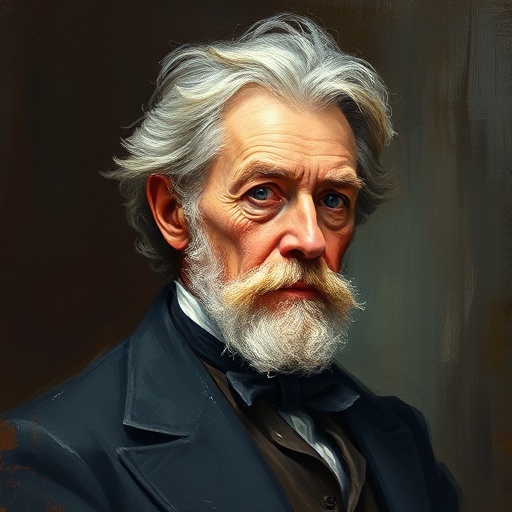
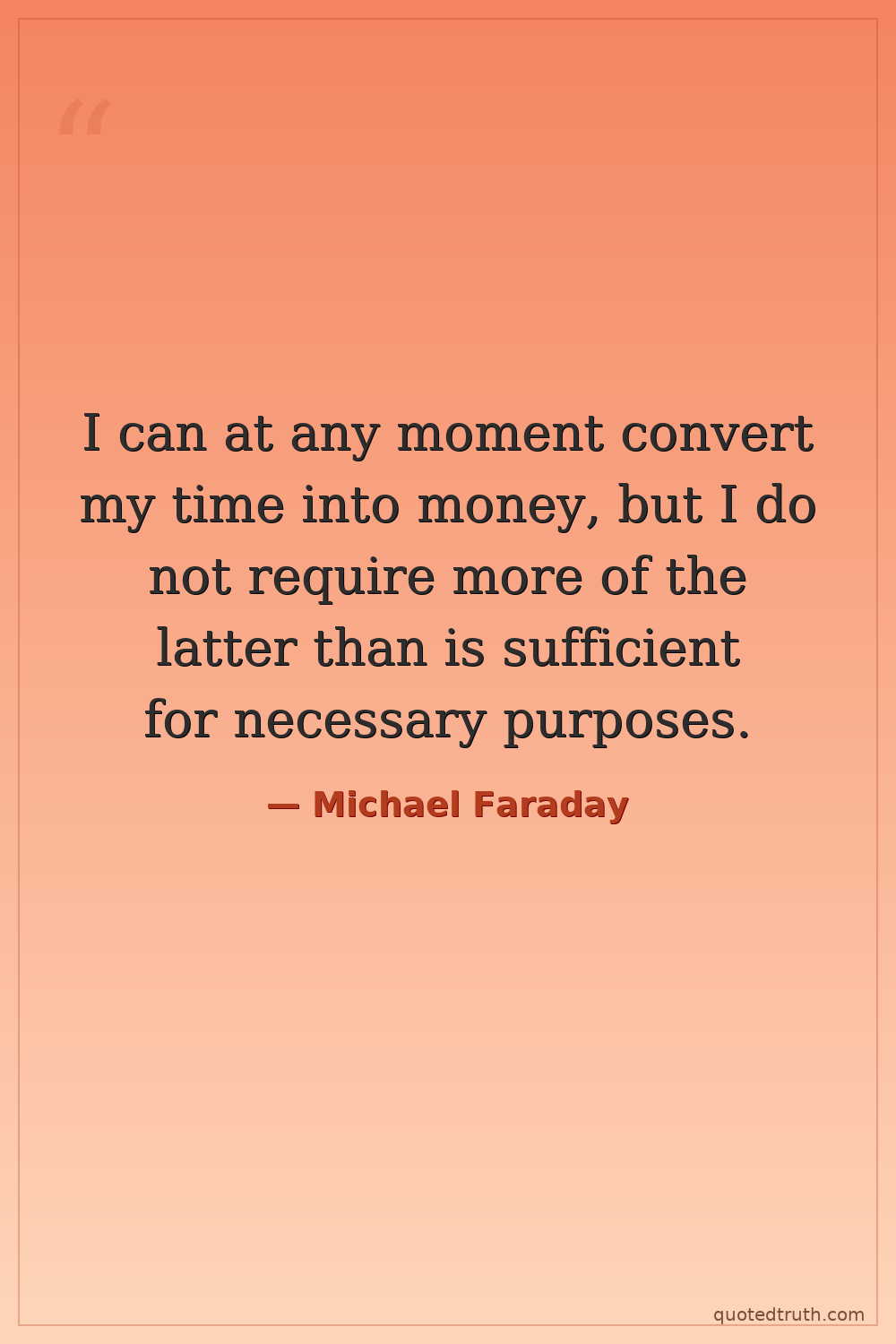
Michael Faraday — "I can at any moment convert my time into money, but I do not require more of the…"
I can at any moment convert my time into money, but I do not require more of the latter than is sufficient for necessary purposes.
I can at any moment convert my time into money, but I do not require more of the latter than is sufficient for necessary purposes.
Click any product to generate a realistic preview. Up to 3 at a time.
* Initial load can take up to 90 seconds — revising the preview in another color is nearly instant.
"The greatest discovery is to find that which has always been there, but has never been seen."
"I am working on the conversion of magnetism into electricity, and I have every hope of success."
"Work, finish, publish."
"The true scientist is a man who is always learning, and never assumes that he knows everything."
"It is right that we should stand by and act on our principles; but not right to hold them in obstinate blindness."
A statement of personal values, with a blunt and witty dismissal of excessive wealth.
Date: 19th century (approximate, quoted in 2010 book)
Self-DeprecatingFound in 1 providers: gemini
1 source checked
The speaker is saying they have the skills and opportunities to earn more money whenever they choose, but they deliberately don't. They only want enough to cover what's actually needed. Wealth beyond basic necessities holds no appeal. It's a statement about valuing time, purpose, and simplicity over accumulation, and about refusing to let the pursuit of money dictate how one spends one's life.
Faraday famously turned down lucrative consulting work and declined a knighthood and burial in Westminster Abbey, preferring his modest laboratory salary at the Royal Institution. A blacksmith's son with only basic schooling, he chose research over riches, rejecting industrial clients who would have made him wealthy. His Sandemanian Christian faith emphasized humility and rejection of worldly status, directly shaping his refusal to commercialize his discoveries in electromagnetism.
Faraday lived during the Industrial Revolution (1791-1867), when his discoveries in electromagnetic induction were actively minting fortunes for inventors and industrialists. Britain was transforming into a wealth-obsessed Victorian society where scientific breakthroughs meant patents and profit. By choosing subsistence over commercialization, Faraday stood against the era's dominant current. His refusal mattered because it preserved pure research at the Royal Institution and modeled an alternative to the age's rampant commercial exploitation of science.
AI-generated insights based on extensive research and information for context. Factual errors? Email [email protected].
Your cart is empty