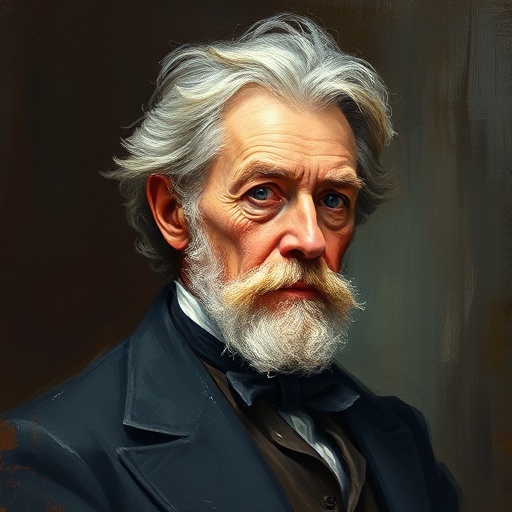
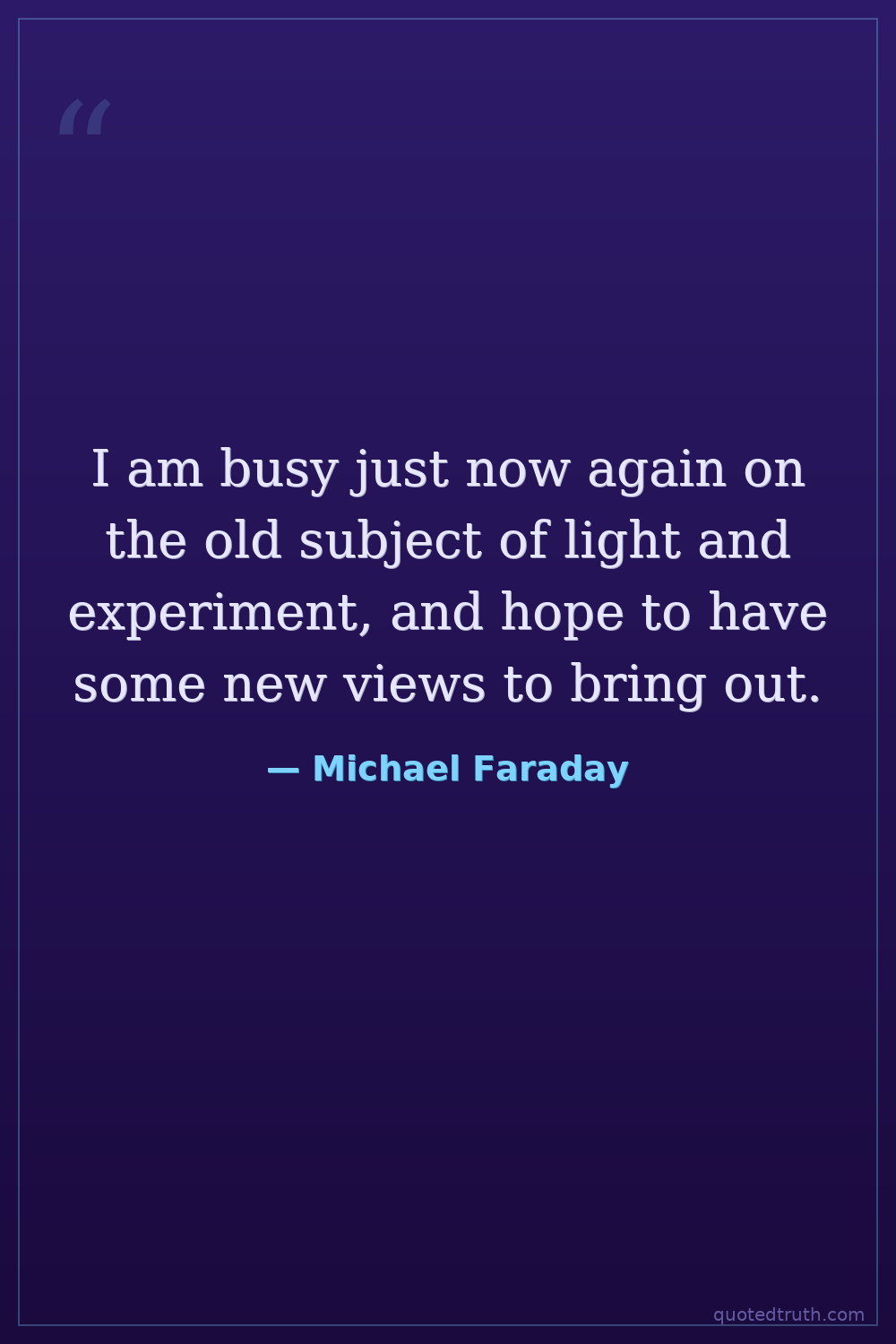
Michael Faraday — "I am busy just now again on the old subject of light and experiment, and hope to…"
I am busy just now again on the old subject of light and experiment, and hope to have some new views to bring out.
I am busy just now again on the old subject of light and experiment, and hope to have some new views to bring out.
Click any product to generate a realistic preview. Up to 3 at a time.
* Initial load can take up to 90 seconds — revising the preview in another color is nearly instant.
"Magnetic curves are lines of force; they are not only lines of force but lines of action."
"I have always found that the more I work, the more I enjoy it."
"I am a firm believer in the power of observation and experimentation."
"The five essential entrepreneurial skills for success are concentration, discrimination, organization, innovation and communication."
"The most important instrument a scientist has is his own mind."
Found in 1 providers: grok
1 source checked
Faraday is saying he's once again deeply engaged in studying light and running experiments, and he expects these investigations to yield fresh insights worth sharing. It's a working scientist's update: returning to a familiar topic with renewed energy, confident that hands-on testing will produce original perspectives rather than rehashed ideas. The tone blends humility with quiet excitement about discovery still ahead.
Faraday spent decades circling back to light, culminating in his 1845 discovery that magnetism rotates the plane of polarized light—the Faraday effect—linking electromagnetism and optics. A self-taught bookbinder's apprentice turned Royal Institution experimentalist, he worked by relentless hands-on testing rather than mathematics. This quote captures his signature method: revisiting 'old subjects' with patience until experiment revealed something genuinely new, exactly how he unified previously separate forces of nature.
Faraday wrote during the early-to-mid 1800s, when natural philosophy was fracturing into specialized sciences and Britain's Industrial Revolution made electricity and optics urgent practical questions. Gaslight was replacing candles, telegraphy was emerging, and wave-versus-particle debates about light raged between followers of Young, Fresnel, and Newton's older corpuscular theory. The Royal Institution's public lectures turned experimenters into celebrities, and Faraday's persistent return to light reflected an era convinced that careful benchtop work could still overturn centuries of assumed physics.
AI-generated insights based on extensive research and information for context. Factual errors? Email [email protected].
Your cart is empty