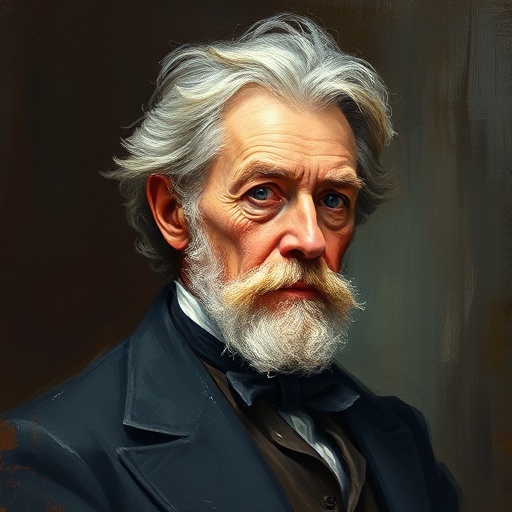
Michael Faraday — "I am a firm believer in the power of observation and experimentation."
I am a firm believer in the power of observation and experimentation.
I am a firm believer in the power of observation and experimentation.
Click any product to generate a realistic preview. Up to 3 at a time.
* Initial load can take up to 90 seconds — revising the preview in another color is nearly instant.
"I am no poet, but if you think for yourselves, as I proceed, the facts will form a poem in your minds."
"Let us now consider, for a little while, how wonderfully we stand upon this world. Here it is we are born, bred, and live, and yet we view these things with an almost entire absence of wonder to ourse…"
"The greatest enemy of knowledge is not ignorance, it is the illusion of knowledge."
"Nothing is too wonderful to be true, if it be consistent with the laws of nature; and in such things as these, experiment is the best test of consistency."
"The history of science is his library."
Attributed, summarizing his scientific methodology.
Date: Mid 19th Century (approx.)
EducationalFound in 1 providers: grok
1 source checked
The speaker trusts what can be seen and tested over what is merely assumed or argued. Rather than relying on tradition, authority, or pure theory, they commit to watching how things actually behave and running controlled tests to confirm or reject ideas. Knowledge, in this view, is earned by careful looking and deliberate trial, not inherited or declared. It is a pledge to let reality, not opinion, decide what is true.
Faraday had almost no formal schooling and taught himself science as a bookbinder's apprentice, which left him distrustful of abstract mathematics and devoted to hands-on inquiry. His discoveries of electromagnetic induction, the laws of electrolysis, and diamagnetism came from relentless bench work, meticulous notebooks, and simple apparatus. He famously reasoned through physical pictures rather than equations, making careful observation and patient experiment the literal engine of his entire career at the Royal Institution.
Faraday worked in early-to-mid 1800s Britain, when natural philosophy was professionalizing into modern science and the Industrial Revolution demanded practical knowledge of electricity, chemistry, and materials. Royal Institution lectures drew public crowds, and rival Continental theorists leaned on elegant mathematics. Against that backdrop, insisting on observation and experiment aligned Faraday with an empirical, Baconian tradition and helped legitimize laboratory science as the route to reliable truth, paving the way for Maxwell's later mathematical synthesis of his field ideas.
AI-generated insights based on extensive research and information for context. Factual errors? Email [email protected].
Your cart is empty