Michael Faraday — "I have lived to see the day when electricity is no longer a toy, but a powerful …"
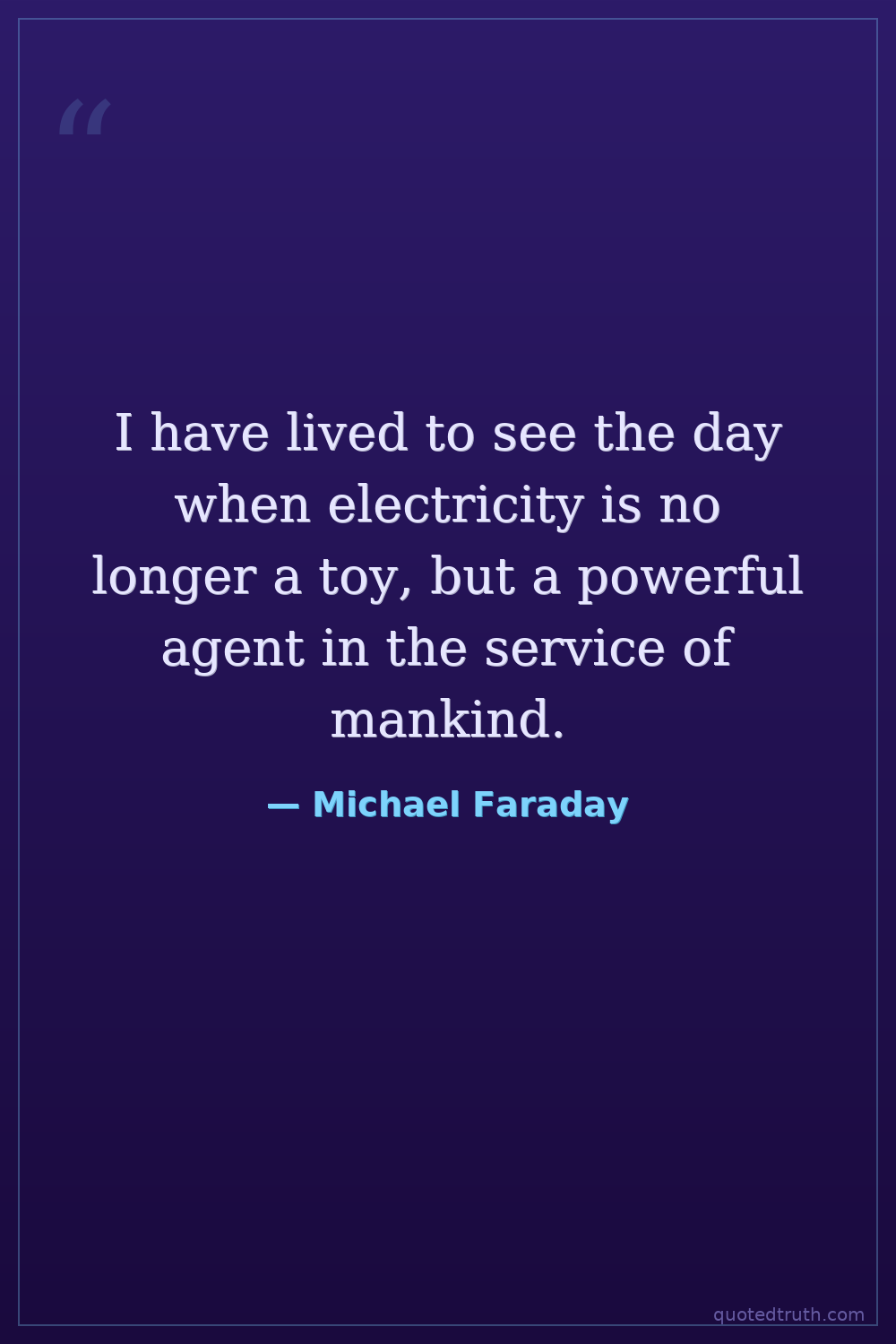
I have lived to see the day when electricity is no longer a toy, but a powerful agent in the service of mankind.
I have lived to see the day when electricity is no longer a toy, but a powerful agent in the service of mankind.
Click any product to generate a realistic preview. Up to 3 at a time.
* Initial load can take up to 90 seconds — revising the preview in another color is nearly instant.
"The lecturer should endeavor to rouse the minds of his auditors, and to fix their attention."
"The power of the human mind is immense, and it is capable of comprehending the most complex phenomena."
"Magnetic curves are lines of force; they are not only lines of force but lines of action."
"Let us now consider, for a little while, how wonderfully we stand upon this world. Here it is we are born, bred, and live, and yet we view these things with an almost entire absence of wonder to ourse…"
"But still try, for who knows what is possible?"
Attributed, reflecting on the impact of his work.
Date: Late in his career (approx.)
Power & LeadershipFound in 1 providers: grok
1 source checked
The speaker is celebrating a transformation they witnessed firsthand: electricity moving from a curious novelty, demonstrated as sparks and parlor tricks, into a practical force that does real work for people. What once entertained audiences in lecture halls now powers machines, lights, and communication. The statement marks a turning point where a mysterious natural phenomenon became a reliable tool society depends on for everyday labor and progress.
Faraday spent decades turning electromagnetic curiosities into working principles. His 1831 discovery of electromagnetic induction became the foundation for generators and transformers, making practical power generation possible. As a self-taught bookbinder's apprentice turned Royal Institution lecturer, he demonstrated electricity publicly for years before industrial applications emerged. Watching telegraphs, electroplating, and early motors develop from his laboratory work, he personally bridged the gap between scientific toy and industrial agent.
Faraday lived 1791 to 1867, spanning the Industrial Revolution's mechanical peak and electricity's emergence. Early in his career, electricity meant Leyden jars and Voltaic piles shown at public demonstrations. By his later years, telegraph cables crossed the Atlantic, arc lamps lit streets, and electroplating transformed manufacturing. Steam still dominated, but electrical engineering was becoming a profession. His lifetime captured the exact pivot from natural philosophy as entertainment to applied science as economic infrastructure.
AI-generated insights based on extensive research and information for context. Factual errors? Email [email protected].
Your cart is empty