Michael Faraday — "The lecturer should endeavor to rouse the minds of his auditors, and to fix thei…"
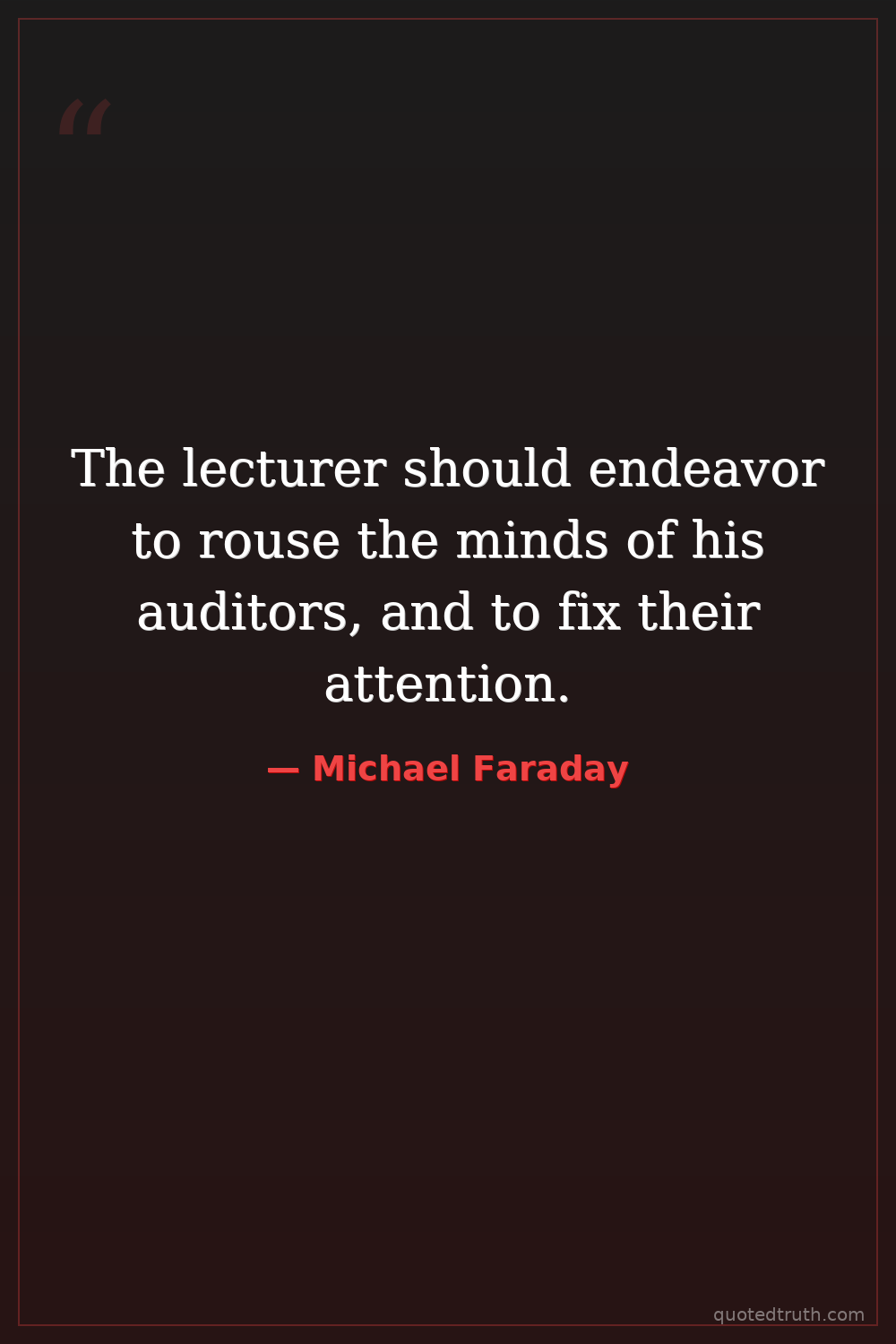
The lecturer should endeavor to rouse the minds of his auditors, and to fix their attention.
The lecturer should endeavor to rouse the minds of his auditors, and to fix their attention.
Click any product to generate a realistic preview. Up to 3 at a time.
* Initial load can take up to 90 seconds — revising the preview in another color is nearly instant.
"The power of the human mind is immense, and it is capable of comprehending the most complex phenomena."
"I have no other guide than the truth, and I will follow it wherever it leads."
"The pursuit of knowledge is a noble endeavor, and it is one that brings great rewards."
"A man who is certain he is right is almost sure to be wrong."
"The five essential entrepreneurial skills for success are concentration, discrimination, organization, innovation and communication."
Found in 1 providers: deepseek
1 source checked
A good lecturer must actively engage the audience, stirring their curiosity and holding their focus throughout the talk. Simply delivering information is not enough; the speaker carries responsibility for keeping listeners mentally alert and invested. Attention is not automatic, it must be earned through deliberate effort, compelling delivery, and a clear sense that what is being said matters to the people sitting in the room.
Faraday rose from bookbinder's apprentice to one of history's greatest experimental scientists largely because Humphry Davy's electrifying Royal Institution lectures captivated him. He later delivered the famous Christmas Lectures for young audiences, pioneered live demonstrations with coils, magnets, and candles, and treated public teaching as a moral duty. Despite limited formal schooling, his gift for vivid, accessible explanation made electromagnetism understandable to ordinary Londoners.
In early nineteenth-century Britain, science was migrating from private gentlemen's clubs into public auditoriums. The Royal Institution charged admission, and packed halls funded research. Industrial Revolution audiences craved understanding of electricity, chemistry, and steam. Without projectors, microphones, or film, a speaker's voice, tabletop apparatus, and theatrical timing had to carry the room. Public lectures were entertainment, education, and scientific proof-of-concept rolled into one evening.
AI-generated insights based on extensive research and information for context. Factual errors? Email [email protected].
Your cart is empty