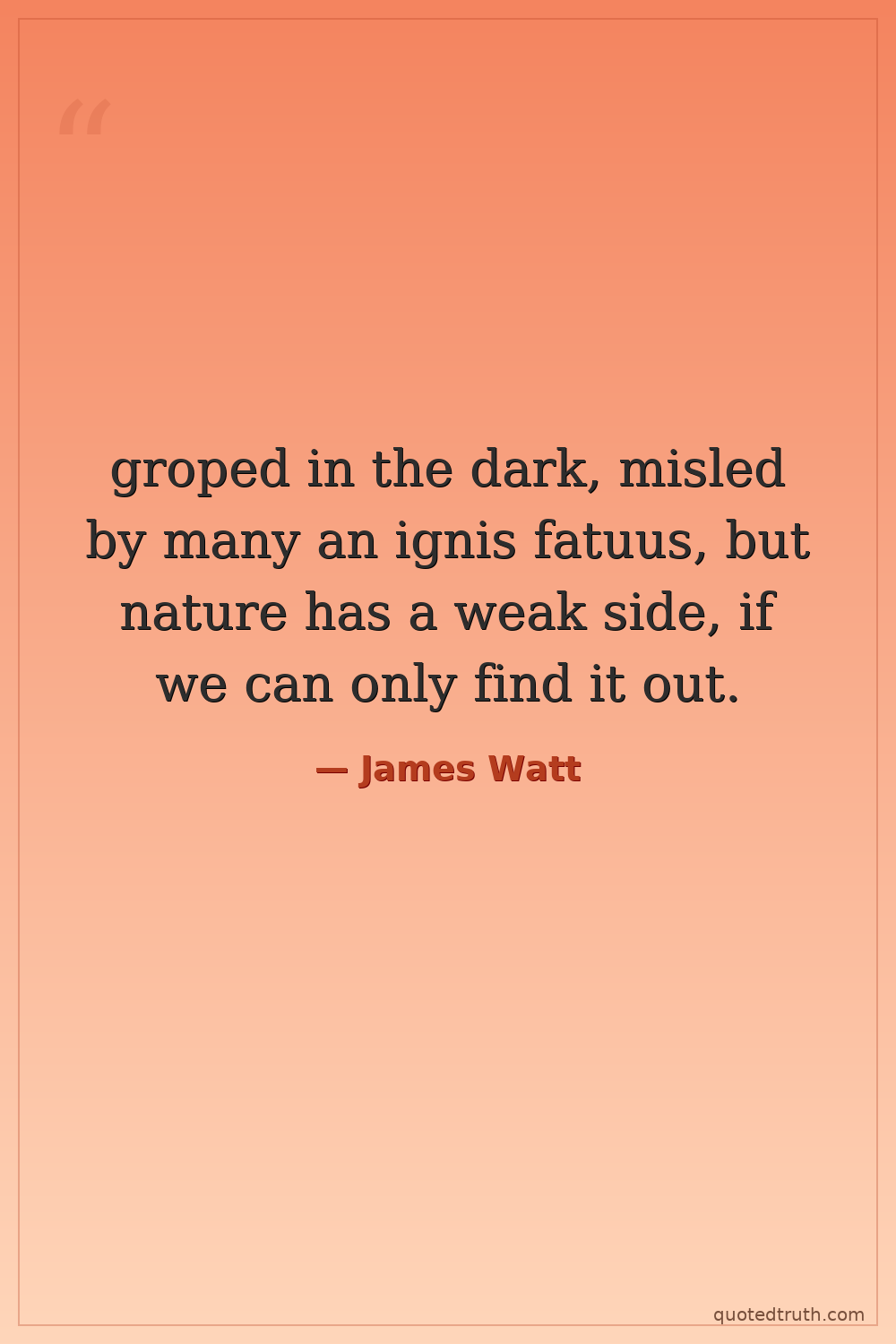
James Watt — "groped in the dark, misled by many an ignis fatuus, but nature has a weak side, …"
groped in the dark, misled by many an ignis fatuus, but nature has a weak side, if we can only find it out.
groped in the dark, misled by many an ignis fatuus, but nature has a weak side, if we can only find it out.
Click any product to generate a realistic preview. Up to 3 at a time.
* Initial load can take up to 90 seconds — revising the preview in another color is nearly instant.
"In the mean time do all you can to cure him of Bashfullness which will ruin him in this impudent age; but beware he be not led into the opposite vice of self conceit or arrogance which is 1000 times w…"
"My great success in life has been owing to my having paid attention to every detail."
"About 6 or 8 years ago My Ingenious friend Mr John Robinson having [contrived] conceived that a fire engine might be made without a Lever—by Inverting the Cylinder & placing it above the mouth of the …"
"Every inefficiency in machinery is an insult to the engineer."
"I have made an engine that shall not waste a single particle of steam."
Found in 1 providers: gemini
1 source checked
Discovery means stumbling through uncertainty, chasing false leads that go nowhere—like will-o'-the-wisps luring travelers into bogs. But underneath the confusion, nature operates by consistent, discoverable rules. Persist long enough and you will find the crack in the system—the exploitable principle that unlocks progress. Failure and misdirection are the price of admission, because nature can ultimately be cracked by anyone stubborn enough to keep looking.
Watt spent nearly a decade wrestling with the Newcomen steam engine's crippling inefficiency before his 1765 breakthrough: the separate condenser. He ran hundreds of experiments at his Glasgow workshop, suffering dead ends and financial ruin before realizing the engine wasted most of its energy reheating the cylinder. That relentless empirical grind—groping in the dark—was his career. The quote is practically autobiography: nature's weak side was latent heat, and Watt found it.
Watt worked during the height of the Enlightenment and the dawn of the Industrial Revolution in the 1760s–1800s. Natural philosophy was transitioning from theory to applied experiment, yet thermodynamics as a science didn't exist—engineers invented by feel. Britain's coal-powered industries desperately needed efficient engines but had no theory to guide them. The Newcomen engine had been adequate for fifty years. Watt's generation proved that systematic tinkering could beat entrenched limitations.
AI-generated insights based on extensive research and information for context. Factual errors? Email [email protected].
Your cart is empty