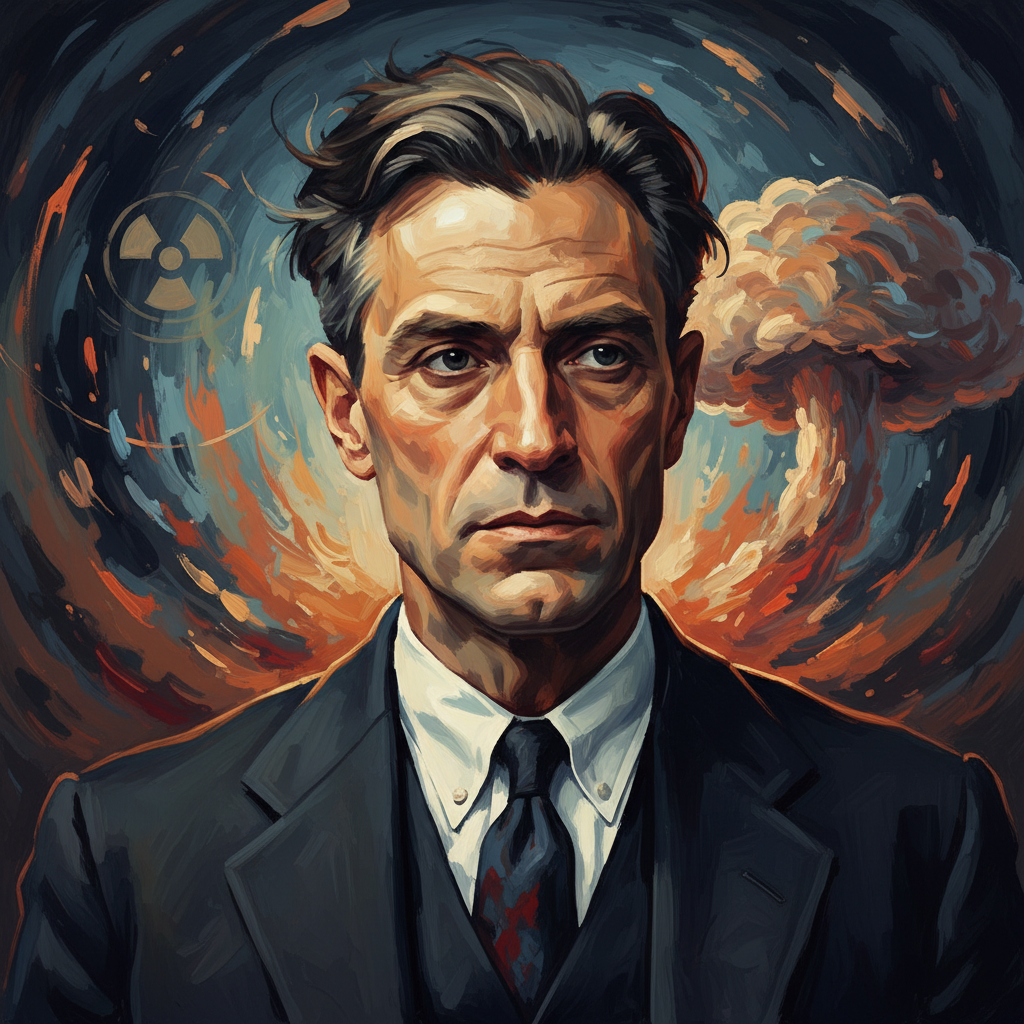
Robert Oppenheimer — "I had had a continuing smoldering fury about the treatment of Jews in Germany."
I had had a continuing smoldering fury about the treatment of Jews in Germany.
I had had a continuing smoldering fury about the treatment of Jews in Germany.
Click any product to generate a realistic preview. Up to 3 at a time.
* Initial load can take up to 90 seconds — revising the preview in another color is nearly instant.
"We have made a rod for our own backs."
"We have made a thing, a most terrible weapon, that has altered the nature of the world and of man."
"My childhood did not prepare me for the fact that the world is full of cruel and bitter things."
"We have to find a way to use science for the benefit of all humanity, not just for destruction."
"We know too much for one man to know too much."
American theoretical physicist who directed the Manhattan Project's Los Alamos Laboratory and oversaw the atomic bombs; lost his security clearance in 1954. Closely associated with Niels Bohr (Manhattan Project consultant and atomic-policy advisor) and Hans Bethe (Los Alamos theoretical-division chief). For an intellectual contrast, see Edward Teller, Hungarian-American physicist and 'father of the H-bomb' — Teller pushed the H-bomb against Oppenheimer's objections and testified against him at his 1954 security hearing — the precise moment that ended Oppenheimer's career. The canonical 'physicist-of-conscience vs physicist-of-state' pairing in nuclear-age ethics; Christopher Nolan's Oppenheimer (2023) dramatized this rivalry for a mass audience.
Found in 1 providers: gemini
1 source checked
A confession of sustained, low-burning moral rage at the systematic persecution of Jewish people under Nazi rule. 'Smoldering' distinguishes this from a passing reaction — it was continuous, suppressed, and enduring. Oppenheimer was not emotionally detached from European events but carried a deep private indignation at state-sponsored antisemitism that shaped his worldview and sense of personal urgency about the war against Hitler.
Oppenheimer came from a secular Jewish family in New York. Though not religiously observant, his Jewish identity gave him a personal stake in Nazi Germany's rise. This fury drove his early commitment to the Manhattan Project — he joined partly to ensure the Allies, not Hitler, built nuclear weapons first. Several Jewish colleagues had fled Europe as refugees. His anger was not abstract; it was the emotional engine beneath his wartime scientific mission.
Nazi Germany's antisemitic campaign escalated rapidly: the Nuremberg Laws in 1935 stripped Jews of citizenship, Kristallnacht in 1938 brought mass state-sanctioned violence, and by the early 1940s the Holocaust was industrially murdering millions. When Oppenheimer expressed this fury, concentration camps were operating across Europe. The Allied scientific community, including Jewish refugee physicists like Szilard and Fermi, felt profound moral urgency — making Oppenheimer's smoldering anger a widely shared undercurrent of wartime science.
AI-generated insights based on extensive research and information for context. Factual errors? Email [email protected].
Your cart is empty