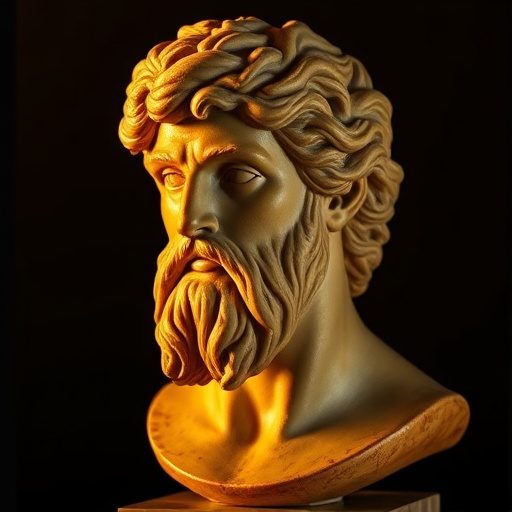
Pythagoras — "Time is the soul of this world."
Time is the soul of this world.
Time is the soul of this world.
Click any product to generate a realistic preview. Up to 3 at a time.
* Initial load can take up to 90 seconds — revising the preview in another color is nearly instant.
"The oldest and shortest words, 'yes' and 'no,' are those which require the most thought."
"There is nothing so easy but that it becomes difficult when you do it reluctantly."
"A chewed bean placed in the sun smells of human semen or of murderously spilt human blood."
"Eat not the matrix of animals."
"Do not put your hand to anything without thinking."
Greek philosopher and mathematician whose school in Croton combined geometry (the Pythagorean theorem), number-mysticism, and a religious-vegetarian way of life. Closely associated with Thales of Miletus (earlier pre-Socratic and the first philosopher). For an intellectual contrast, see Heraclitus, pre-Socratic Greek philosopher of flux — Heraclitus called Pythagoras 'the chief of swindlers' — among the founding insults of the philosophical-rivalry tradition. Their 'all is flux' vs 'all is number' poles still organize the philosophy of mathematics today (Platonist vs anti-realist).
Found in 1 providers: gemini
1 source checked
Time is not merely a measurement or background condition of existence — it is the animating principle, the fundamental essence that gives the world its life and coherence. Just as a soul gives a body purpose and continuity, time gives the universe its structure, change, and direction. Without time, nothing could move, grow, or be distinguished from anything else. Time is what makes existence dynamic and ordered.
Pythagoras built his entire philosophy around the idea that an invisible, mathematical order underlies physical reality. He also taught metempsychosis — the soul's transmigration through bodies — making the soul a central organizing force. Calling time 'the soul of this world' merges both convictions: time is the unseen, eternal principle that orders all change and movement, just as the soul orders biological life. It reflects his cosmic, numerical worldview perfectly.
In 6th-century BC Greece, pre-Socratic philosophers competed to identify the cosmos's fundamental principle — water, air, fire, or abstract infinity. Pythagoras was a near-contemporary of Heraclitus, who argued flux and change define reality. Greek culture also personified time as Chronos, a primordial divine force. By naming time the world's 'soul,' Pythagoras entered this debate decisively, proposing that temporal change — not a material substance — is what gives the universe its animating coherence.
AI-generated insights based on extensive research and information for context. Factual errors? Email [email protected].
Your cart is empty