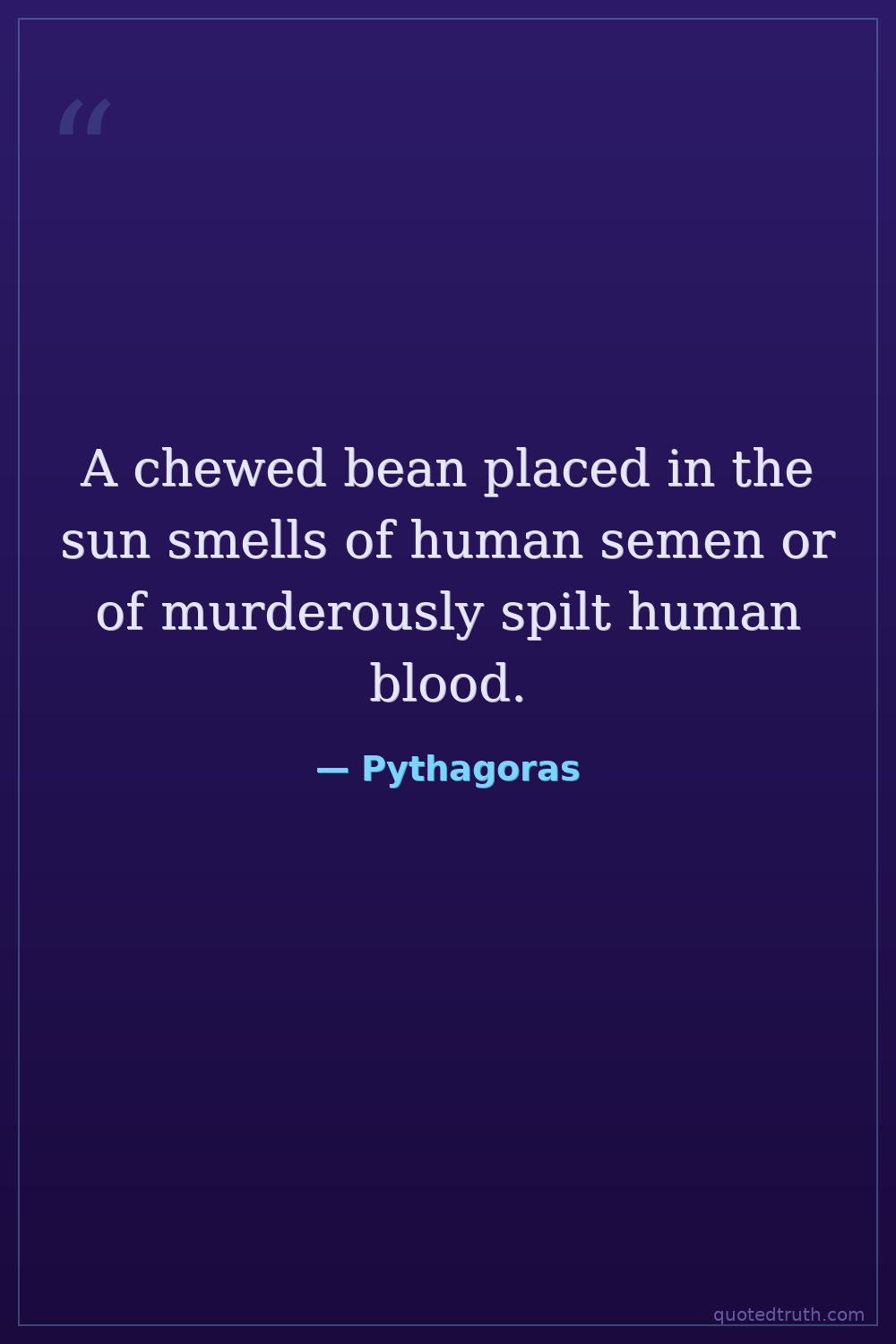
Pythagoras — "A chewed bean placed in the sun smells of human semen or of murderously spilt hu…"
A chewed bean placed in the sun smells of human semen or of murderously spilt human blood.
A chewed bean placed in the sun smells of human semen or of murderously spilt human blood.
Click any product to generate a realistic preview. Up to 3 at a time.
* Initial load can take up to 90 seconds — revising the preview in another color is nearly instant.
"The number seven held a sacred meaning since it correlated with the number of classical planets... as well as the number of strings on a lyre."
"Choose rather to be strong of soul than strong of body."
"Avoid all things that will occasion envy."
"Numbers rule the universe."
"Eat not the matrix of animals."
Greek philosopher and mathematician whose school in Croton combined geometry (the Pythagorean theorem), number-mysticism, and a religious-vegetarian way of life. Closely associated with Thales of Miletus (earlier pre-Socratic and the first philosopher). For an intellectual contrast, see Heraclitus, pre-Socratic Greek philosopher of flux — Heraclitus called Pythagoras 'the chief of swindlers' — among the founding insults of the philosophical-rivalry tradition. Their 'all is flux' vs 'all is number' poles still organize the philosophy of mathematics today (Platonist vs anti-realist).
One of the bizarre reasons attributed to Pythagoras for his prohibition against eating beans, reported by ancient commentators.
Date: c. 570-495 BCE (attributed later)
Nature & WorldFound in 1 providers: gemini
1 source checked
Beans, when chewed and left in sunlight, smell like human semen or freshly spilled blood. The claim asserts that beans carry an essence identical to human life — both its origin and its violent end. This makes them spiritually contaminated, not merely unpleasant food. The point is that consuming beans means consuming something essentially human, which is morally equivalent to cannibalism or participating in death.
Pythagoras famously forbade his followers from eating beans, and this quote explains why. His school taught metempsychosis — the soul transmigrates between bodies, including plants. Beans, with their hollow stems thought to connect underground to the realm of the dead, were believed to harbor souls in transit. His mathematical worldview rested on cosmic order and purity; violating food taboos disrupted that order. The bean prohibition was among his most strictly enforced brotherhood rules.
Sixth-century BCE Greece blended philosophy, religion, and proto-science indistinguishably. Mystery cults — Orphism especially — taught soul transmigration and dietary purity as spiritual obligations. Fava beans were used across the Mediterranean in funeral rites and offerings to the dead, already carrying associations with mortality. Pythagorean communities functioned as religious brotherhoods with strict purity codes. In this context, identifying beans with semen and blood was a serious theological claim, not a curiosity.
AI-generated insights based on extensive research and information for context. Factual errors? Email [email protected].
Your cart is empty