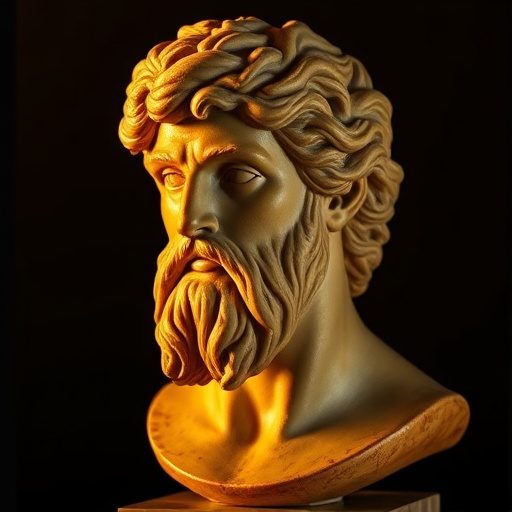
Pythagoras — "Do not put your hand to anything without thinking."
Do not put your hand to anything without thinking.
Do not put your hand to anything without thinking.
Click any product to generate a realistic preview. Up to 3 at a time.
* Initial load can take up to 90 seconds — revising the preview in another color is nearly instant.
"Don't help with a burden but put it on."
"Wisdom thoroughly learned will never be forgotten."
"The soul of man is immortal and that it changes into other kinds of animals."
"Time is the soul of this world."
"When you go to the temple to worship, do not wipe up the footprints."
Greek philosopher and mathematician whose school in Croton combined geometry (the Pythagorean theorem), number-mysticism, and a religious-vegetarian way of life. Closely associated with Thales of Miletus (earlier pre-Socratic and the first philosopher). For an intellectual contrast, see Heraclitus, pre-Socratic Greek philosopher of flux — Heraclitus called Pythagoras 'the chief of swindlers' — among the founding insults of the philosophical-rivalry tradition. Their 'all is flux' vs 'all is number' poles still organize the philosophy of mathematics today (Platonist vs anti-realist).
Found in 1 providers: grok
1 source checked
Think before you act. Before taking on any task, project, or commitment, pause to consider the consequences, your preparation, and whether the action aligns with your goals. Impulsive action leads to mistakes, wasted effort, and regret. Deliberation isn't hesitation—it's the discipline of examining a situation fully before committing your energy, so that when you do act, your effort is purposeful and effective.
Pythagoras founded a philosophical brotherhood that practiced rigorous self-examination, including a daily evening review of one's actions. As a mathematician who proved truths through careful deduction rather than assumption, he applied the same methodical thinking to ethics. His school required years of silent study before speaking, embodying this very principle: that deliberate reflection must precede both intellectual claims and daily conduct.
In 6th-century BCE Greece, philosophy was emerging from mythological explanation toward reasoned inquiry. Pythagoras's era saw the rise of the polis, where rash political decisions could exile or execute citizens, and commerce demanded careful contracts. Mystery religions emphasized purification rituals, while early philosophers like Thales sought rational principles behind nature. Pythagoras's call for forethought fit this broader cultural shift from impulse and tradition toward examined, disciplined living.
AI-generated insights based on extensive research and information for context. Factual errors? Email [email protected].
Your cart is empty