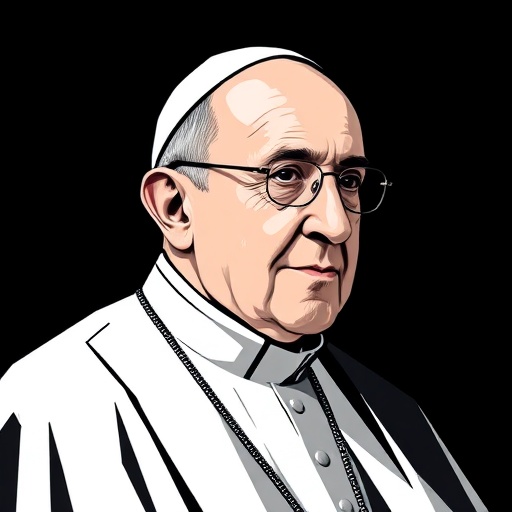
Pope Francis — "The death penalty is inadmissible because it is an attack on the inviolability a…"
The death penalty is inadmissible because it is an attack on the inviolability and dignity of the person.
The death penalty is inadmissible because it is an attack on the inviolability and dignity of the person.
Click any product to generate a realistic preview. Up to 3 at a time.
* Initial load can take up to 90 seconds — revising the preview in another color is nearly instant.
"There are cases in which separation is inevitable. Sometimes, it can even be morally necessary, when it comes to shielding the weaker spouse or young children from more serious wounds caused by intimi…"
"Always remember that the best way to win a war is to avoid it."
"The greatest danger is spiritual worldliness."
"The measure of a society is its treatment of the poor and vulnerable."
"The Church is not a supermarket. The Church is a Mother."
First Latin American and Jesuit pope (2013-), who has steered the Catholic Church toward pastoral inclusion on LGBTQ pastoral care, divorced Catholics, and climate. Closely associated with Pope John XXIII (the Vatican II reformer pope) and Cardinal Walter Kasper (his theological ally on pastoral reform). For an intellectual contrast, see Cardinal Raymond Burke, American traditionalist cardinal, former head of the Vatican Apostolic Signatura — Burke is the public face of Catholic traditionalism that views Francis's pastoral approach as doctrinally dangerous — he has formally challenged Amoris Laetitia and other Francis reforms.
Found in 2 providers: deepseek,grok
2 sources checked
No government or authority has the right to execute a person as punishment, because every human life holds inherent worth that cannot be lost—even through the worst crimes. Killing as a form of justice violates something irreversible: the dignity built into every person simply by being human. This is not about excusing crime; it is about recognizing that the state executing a person destroys what no power has the right to destroy.
Pope Francis, born Jorge Bergoglio in Argentina in 1936, grew up during brutal political upheaval and later navigated the military dictatorship of the 1970s as a Jesuit leader. He emerged with a deep commitment to human life's inviolability. As Pope since 2013, he championed mercy over punishment throughout his papacy. In 2018 he formally revised the Catechism to declare capital punishment inadmissible—converting personal conviction into binding Church doctrine for 1.3 billion Catholics.
When Francis updated the Catechism in 2018, capital punishment remained active in over 50 countries, including the United States. DNA exonerations had exposed widespread wrongful convictions, eroding public confidence in execution's fairness. Parallel human rights movements pushed for global abolition. His declaration arrived as US states debated moratoriums and Europe had already banned execution entirely. The Church's formal stance gave significant moral weight to abolition arguments in nations where Catholicism holds deep cultural and political influence.
AI-generated insights based on extensive research and information for context. Factual errors? Email [email protected].
Your cart is empty