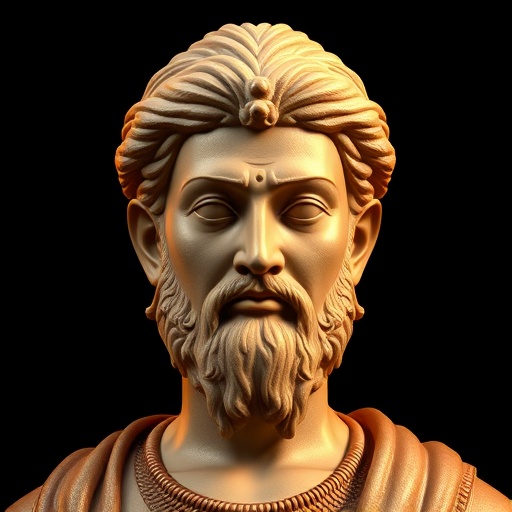
Mahavira — "He who knows one’s own soul knows the souls of all beings."
He who knows one’s own soul knows the souls of all beings.
He who knows one’s own soul knows the souls of all beings.
Click any product to generate a realistic preview. Up to 3 at a time.
* Initial load can take up to 90 seconds — revising the preview in another color is nearly instant.
"The soul is its own friend and its own enemy."
"The greatest wealth is health."
"One should not accumulate wealth beyond one's needs."
"A wise man should abstain from killing any living being."
"The soul is born alone and dies alone; no one shares another’s karma."
24th and last Tirthankara of Jainism, whose teachings of strict ahimsa (non-violence), aparigraha (non-attachment), and karma reshaped ancient Indian religion. Closely associated with The Buddha (near-contemporary moral revolutionary, also reacting against Vedic ritualism). For an intellectual contrast, see Vedic Brahmanical ritual sacrifice, the animal-sacrifice-centered Vedic religion of his era — Mahavira's ahimsa demanded total non-violence, including not eating root vegetables that kill the plant — a maximum-distance ethical move from the Vedic priestly tradition that ritually sacrificed cattle and horses. The two cleanest poles of ancient Indian religious ethics.
Found in 1 providers: deepseek
1 source checked
Understanding your own consciousness — your capacity to feel, suffer, desire, and perceive — reveals the identical inner life present in every other being. Self-knowledge isn't narcissism; it's universal empathy. When you deeply examine what it means to be a living soul, you recognize that same aliveness in animals, insects, and humans alike. Genuine self-understanding dissolves the illusion of separation between self and others.
Mahavira spent 12 years in silent, extreme ascetic meditation before achieving enlightenment, making self-examination his literal lifework. Jainism's central doctrine holds that all living beings, from humans to microorganisms, possess individual souls of equal inherent worth. His total renunciation of possessions and social identity was driven by this conviction: stripping away external layers to understand the bare soul reveals its fundamental sameness with all other souls.
Sixth-century BCE northeastern India was the Axial Age, a period of radical philosophical upheaval when thinkers questioned inherited authority. The Vedic caste system assigned spiritual worth by birth, restricting liberation to upper castes. Mahavira's claim that every soul, regardless of social rank, contains the same knowable essence was revolutionary, directly challenging brahmanical gatekeeping and declaring that inner truth was accessible to anyone willing to examine themselves honestly.
AI-generated insights based on extensive research and information for context. Factual errors? Email [email protected].
Your cart is empty