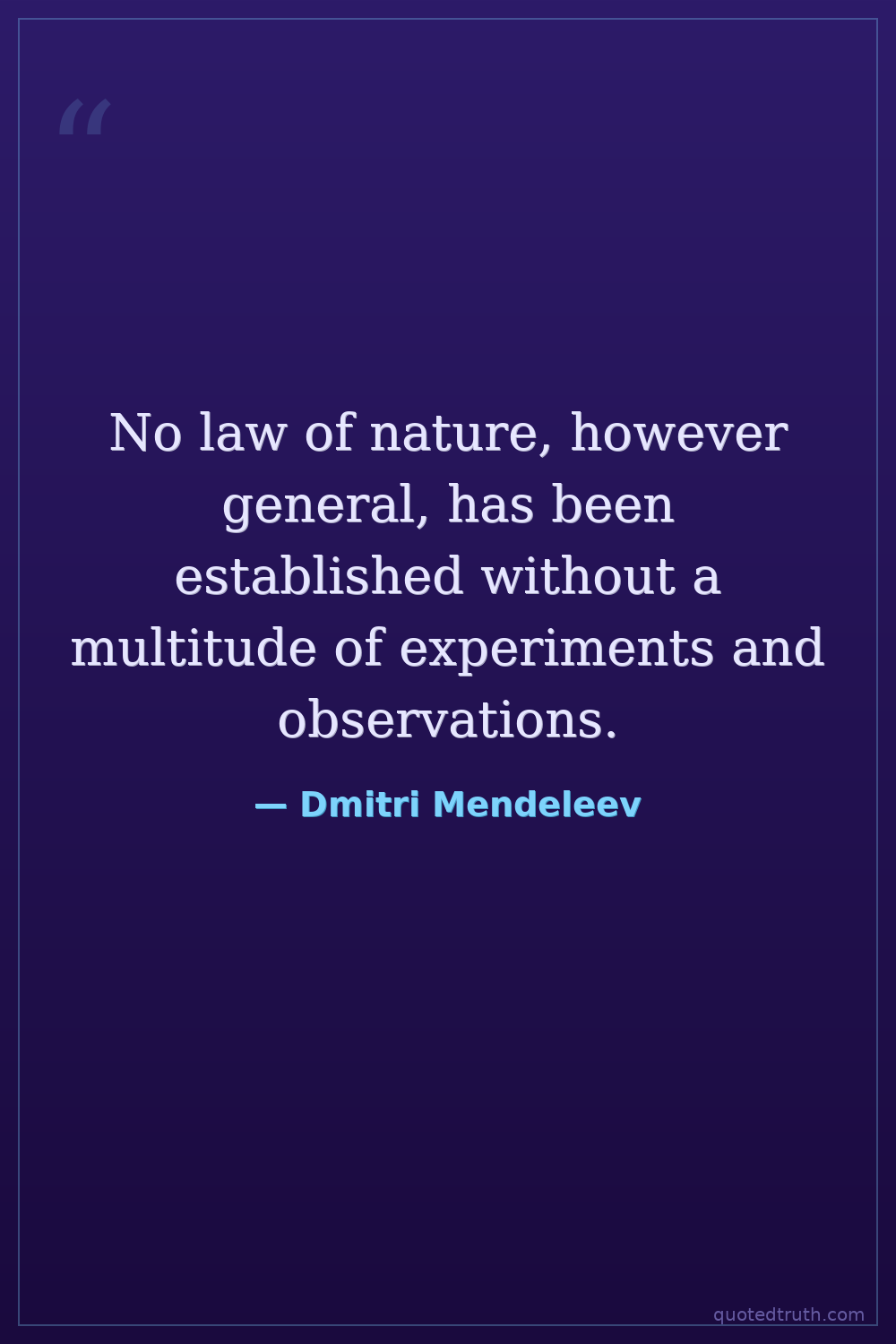
Dmitri Mendeleev — "No law of nature, however general, has been established without a multitude of e…"
No law of nature, however general, has been established without a multitude of experiments and observations.
No law of nature, however general, has been established without a multitude of experiments and observations.
Click any product to generate a realistic preview. Up to 3 at a time.
* Initial load can take up to 90 seconds — revising the preview in another color is nearly instant.
"I saw in a dream a table where all the elements fell into place as required."
"In science we must all submit not to what seems to us attractive from one point of view or another, but to what represents an agreement between theory and experiment."
"When we see the order of the elements, we must admit that there is a higher reason."
"A well-made theory is like a good overcoat; Eloquent words are like a beautiful tie."
"The chemist must descend into the depths within himself, and find the spark of an idea to illuminate the darkness."
Found in 1 providers: grok
1 source checked
Universal scientific laws are never discovered through pure thought or lucky guesses. They emerge only after scientists run countless experiments, gather massive amounts of data, and make repeated observations across many conditions. Even the broadest principles governing nature require this slow accumulation of evidence before they can be trusted. The statement insists that empirical work, not speculation, is the true foundation of knowledge about how the physical world behaves.
Mendeleev spent decades measuring atomic weights, studying chemical behaviors, and cataloging element properties before arranging the periodic table in 1869. He tested and retested data, famously predicting gallium, scandium, and germanium based on gaps his pattern revealed. His willingness to trust accumulated observation over prevailing theory embodies this quote. As a chemist who also studied petroleum, agriculture, and metrology, he lived the principle that generalizations must rest on exhaustive empirical groundwork.
Mendeleev worked in 19th-century Russia during a period of rapid industrialization and scientific professionalization. European chemistry was flooded with newly isolated elements, competing atomic weight systems, and disputes over atomism itself. Laboratories were becoming rigorous institutions, and journals demanded reproducible results. Against this backdrop of empirical fervor, his insistence on exhaustive experimentation reflected the broader Victorian scientific ethos, where figures like Darwin and Maxwell were similarly building sweeping theories only after decades of careful observation and measurement.
AI-generated insights based on extensive research and information for context. Factual errors? Email [email protected].
Your cart is empty