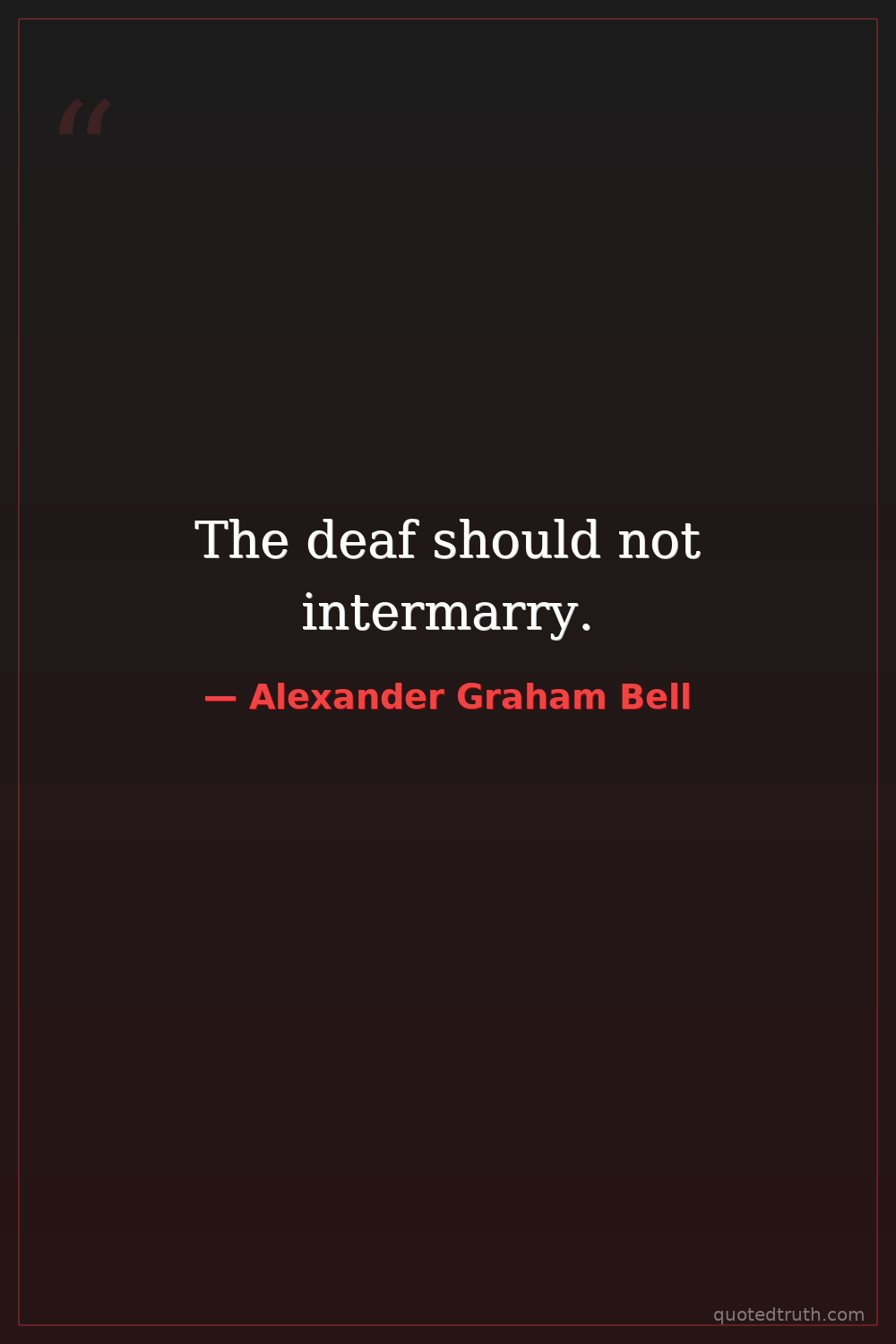
Alexander Graham Bell — "The deaf should not intermarry."
The deaf should not intermarry.
The deaf should not intermarry.
Click any product to generate a realistic preview. Up to 3 at a time.
* Initial load can take up to 90 seconds — revising the preview in another color is nearly instant.
"A man, as a general rule, owes very little to what he is born with — a man is what he makes of himself."
"I have been called a robber. I have been called a thief. I have been called a charlatan. I have even been called a murderer. But I have never been called a liar."
"The nation that secures control of the air will ultimately control the world."
"We are all born with a certain potential, and it is up to us to fulfill it."
"The telephone will be so important that every town will have one."
Found in 1 providers: deepseek
1 source checked
Bell argues that deaf individuals should not marry one another, believing this would reduce the likelihood of passing hereditary deafness to children. It is a eugenic position: human reproduction should be guided to eliminate traits society deemed deficiencies. In plain terms, he thought deaf people choosing deaf partners was a social problem requiring discouragement, not a personal or cultural choice deserving respect.
Bell's mother and wife were both deaf, yet he paradoxically campaigned against Deaf community formation. In 1883 he presented 'Memoir Upon the Formation of a Deaf Variety of the Human Race' to the National Academy of Sciences, arguing intermarriage among deaf people threatened to create a permanent separate population. He championed oral education over sign language for the same reason—assimilation, not separation, was his goal.
Bell spoke during the height of the eugenics movement, when Francis Galton's theories of hereditary improvement were mainstream science. The 1880 Milan Conference had just banned sign language from schools across the Western world. Deaf people were increasingly viewed through a medical-deficit lens rather than as a linguistic minority. Controlling reproduction to manage inherited conditions was considered rational social policy, not yet recognized as a human rights violation.
AI-generated insights based on extensive research and information for context. Factual errors? Email [email protected].
Your cart is empty