What it means
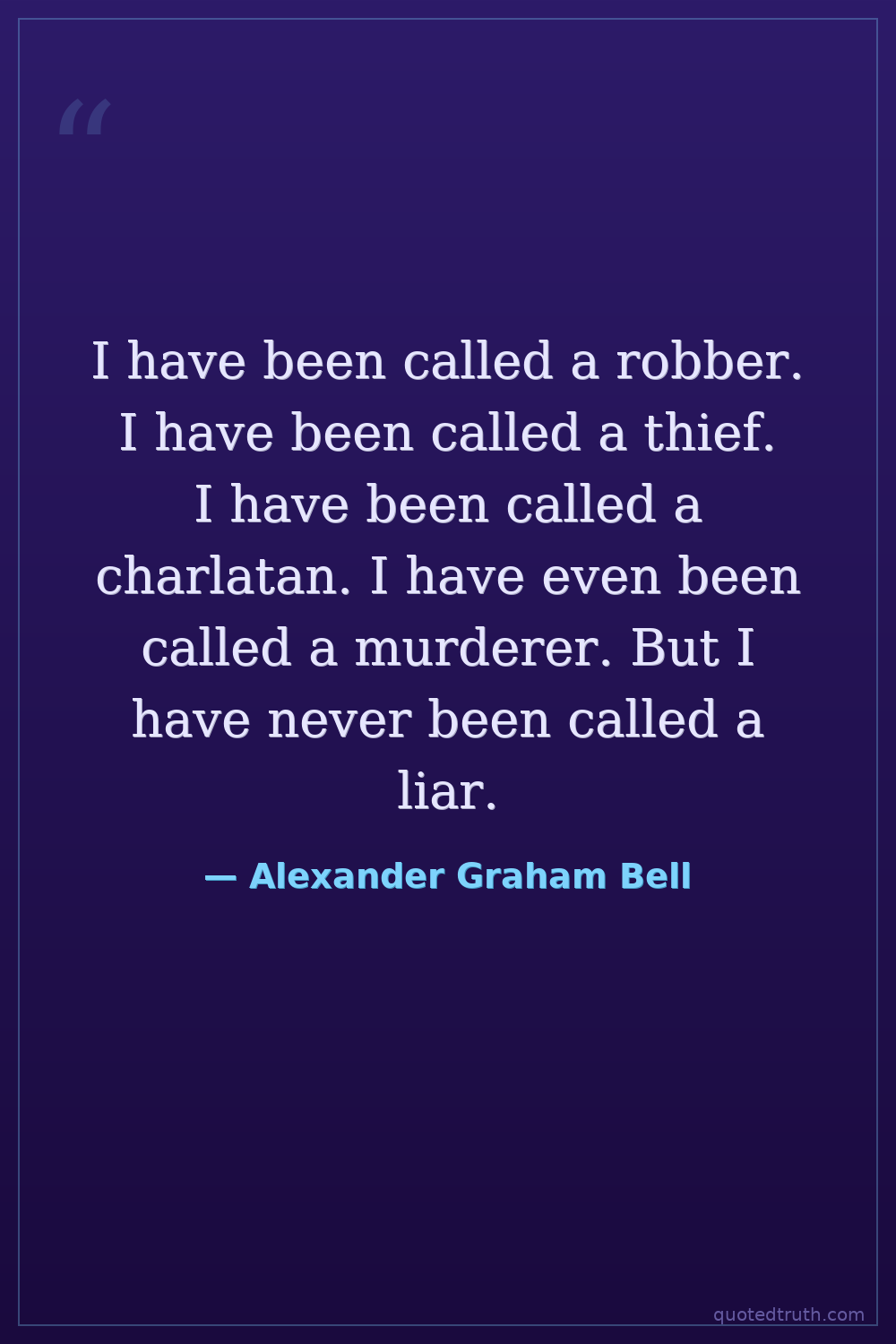
Bell is asserting that despite enduring an escalating cascade of character attacks throughout his career, his truthfulness remained the one thing his harshest critics could never question. He distinguishes dishonesty from all other accusations — financial crimes, fraud, even violence. Honesty, he implies, is the foundation of his identity. Every other attack he could absorb; being called a liar would have been the one wound he never had to bear.
Relevance to Alexander Graham Bell
Bell spent decades in brutal patent battles — Elisha Gray filed his telephone caveat the same day Bell filed his 1876 patent, triggering over 600 lawsuits. Rivals accused him of bribery, fraud, and stealing Antonio Meucci's earlier work. His failed metal-detector attempt to locate Garfield's assassin's bullet in 1881 drew public blame when Garfield died. Yet Bell kept meticulous lab notebooks and testified exhaustively — never credibly accused of fabricating evidence, only of winning fiercely.
The era
The Gilded Age (1870s–1900s) turned invention into cutthroat commerce. Patent litigation was warfare; Bell's telephone patent became the most contested in US history. Yellow journalism turned every dispute into headline scandal. Rival inventors — Edison, Gray, Westinghouse — attacked each other's character publicly and routinely. Reputational destruction was a standard competitive tactic. In that climate, Bell's claim to have never been called a liar was a genuine distinction, honesty being rarer than legal victory.
AI-generated insights based on extensive research and information for context. Factual errors? Email [email protected].