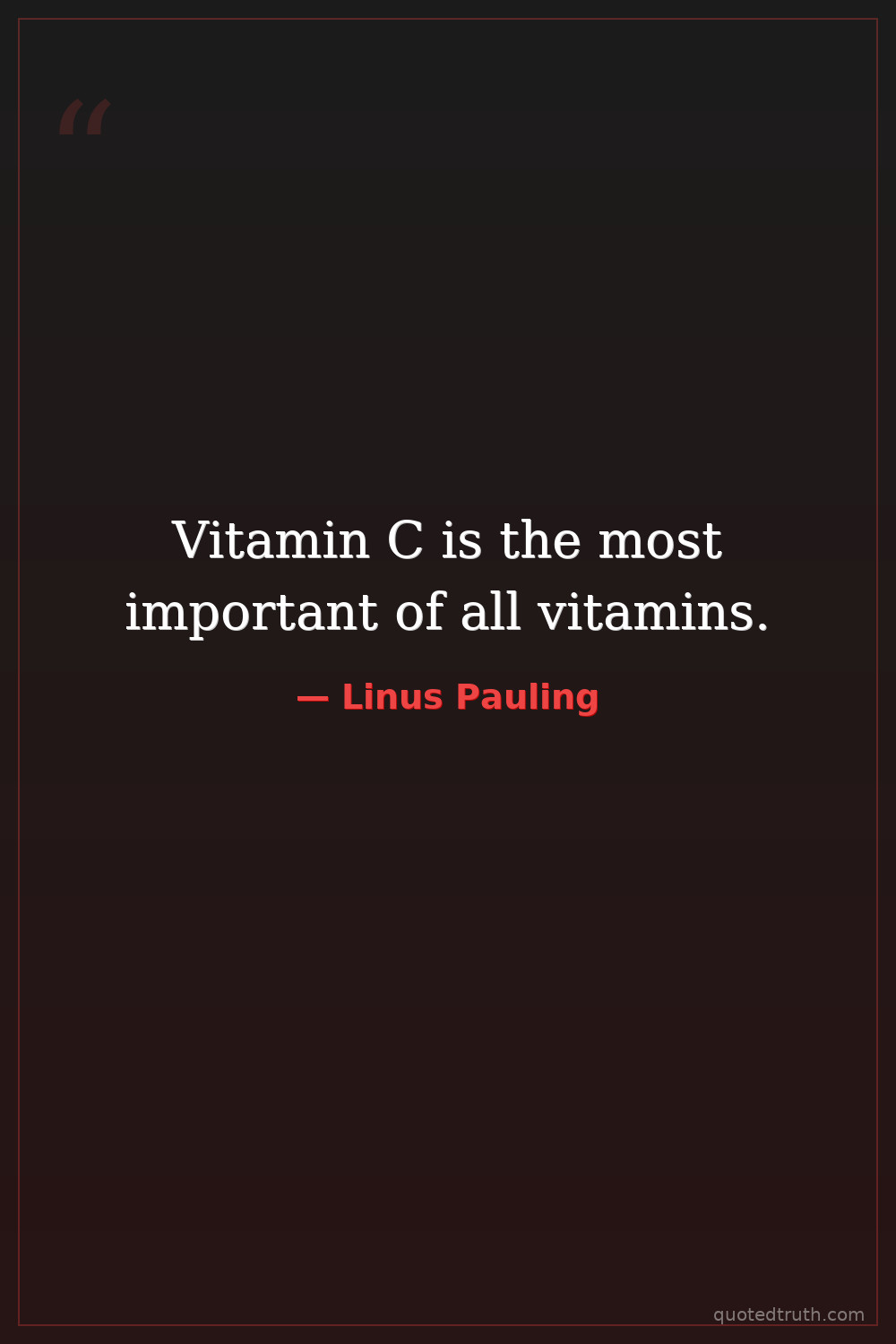
Linus Pauling — "Vitamin C is the most important of all vitamins."
Vitamin C is the most important of all vitamins.
Vitamin C is the most important of all vitamins.
Click any product to generate a realistic preview. Up to 3 at a time.
* Initial load can take up to 90 seconds — revising the preview in another color is nearly instant.
"The most important thing in life is to be happy."
"Everyone should know that the 'war on cancer' is largely a fraud."
"The only way to make sense out of change is to plunge into it, move with it, and join the dance."
"I have always been a lover of nature, and I believe that we should all strive to protect our planet."
"The only way to get a good idea is to get a lot of ideas and throw the bad ones away."
Found in 1 providers: deepseek
1 source checked
Among all vitamins the human body requires, Vitamin C is uniquely critical—not just adequate but paramount. Pauling extended this beyond basic nutrition: he argued that most people are chronically deficient and that megadoses of ascorbic acid could prevent and treat everything from the common cold to cancer, fundamentally redefining vitamin intake from avoiding deficiency disease to actively optimizing health and longevity.
Pauling won Nobel Prizes in Chemistry (1954) and Peace (1962), but spent his final decades championing orthomolecular medicine. He co-authored 'Vitamin C and the Common Cold' in 1970 and personally consumed grams of ascorbic acid daily. His biochemical expertise gave this claim scientific credibility even as mainstream medicine rejected megadose therapy. The conviction was genuine and consistent, though it ultimately strained his scientific legacy.
Pauling promoted this view through the 1970s and 1980s, when public trust in pharmaceutical institutions was eroding after thalidomide and Vietnam-era disillusionment. Natural health movements were growing rapidly, and cancer mortality remained stubbornly high despite aggressive chemotherapy regimens. His claims about Vitamin C fighting tumors found a receptive audience among patients desperate for alternatives, making this quote culturally charged far beyond nutrition science.
AI-generated insights based on extensive research and information for context. Factual errors? Email [email protected].
Your cart is empty