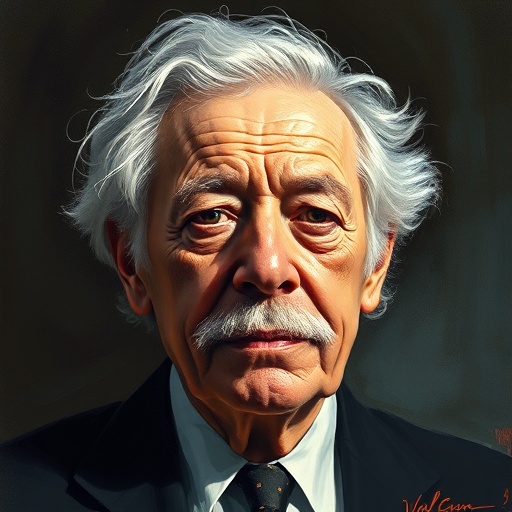
Linus Pauling — "Everyone should know that the 'war on cancer' is largely a fraud."
Everyone should know that the 'war on cancer' is largely a fraud.
Everyone should know that the 'war on cancer' is largely a fraud.
Click any product to generate a realistic preview. Up to 3 at a time.
* Initial load can take up to 90 seconds — revising the preview in another color is nearly instant.
"The best way to have a good idea is to have a lot of ideas."
"Well, I thought, that's nice of the old guy to say that, but I'm a little skeptical myself. And as the years went by, I thought, I don't do the sort of work for which Nobel Prizes are given."
"The best way to predict the future is to create it."
"I'm just a simple chemist."
"I have always been an optimist, and I believe that the future is bright."
Found in 1 providers: gemini
1 source checked
The quote charges that the official 'War on Cancer'—the government-funded campaign to defeat cancer—was more spectacle than substance: overpromising cures, misallocating research funding, and protecting institutional interests rather than genuinely pursuing effective treatments. It implies the public was being misled about real progress, and that financial and political incentives shaped cancer policy more than honest science, leaving patients worse off than a transparent, rigorous research program would allow.
Pauling, a two-time Nobel laureate (Chemistry 1954, Peace 1962), spent his final decades championing high-dose vitamin C as a cancer therapy, co-authoring 'Cancer and Vitamin C' with Ewan Cameron in 1979. The oncology establishment dismissed his findings without serious replication. Having also fought government authority over nuclear testing, he was predisposed to challenge official campaigns. His scientific stature made this critique especially pointed—and polarizing—within the medical community.
Nixon signed the National Cancer Act in 1971, promising a cure by the U.S. bicentennial. By the late 1970s those promises had collapsed while chemotherapy and radiation remained brutal and often ineffective. Post-Watergate distrust of government ran high. Critics argued the NCI entrenched chemotherapy-centric research while dismissing prevention and nutritional approaches. Pauling's statement landed in a climate of failed institutional promises and growing public skepticism toward the medical-industrial establishment.
AI-generated insights based on extensive research and information for context. Factual errors? Email [email protected].
Your cart is empty