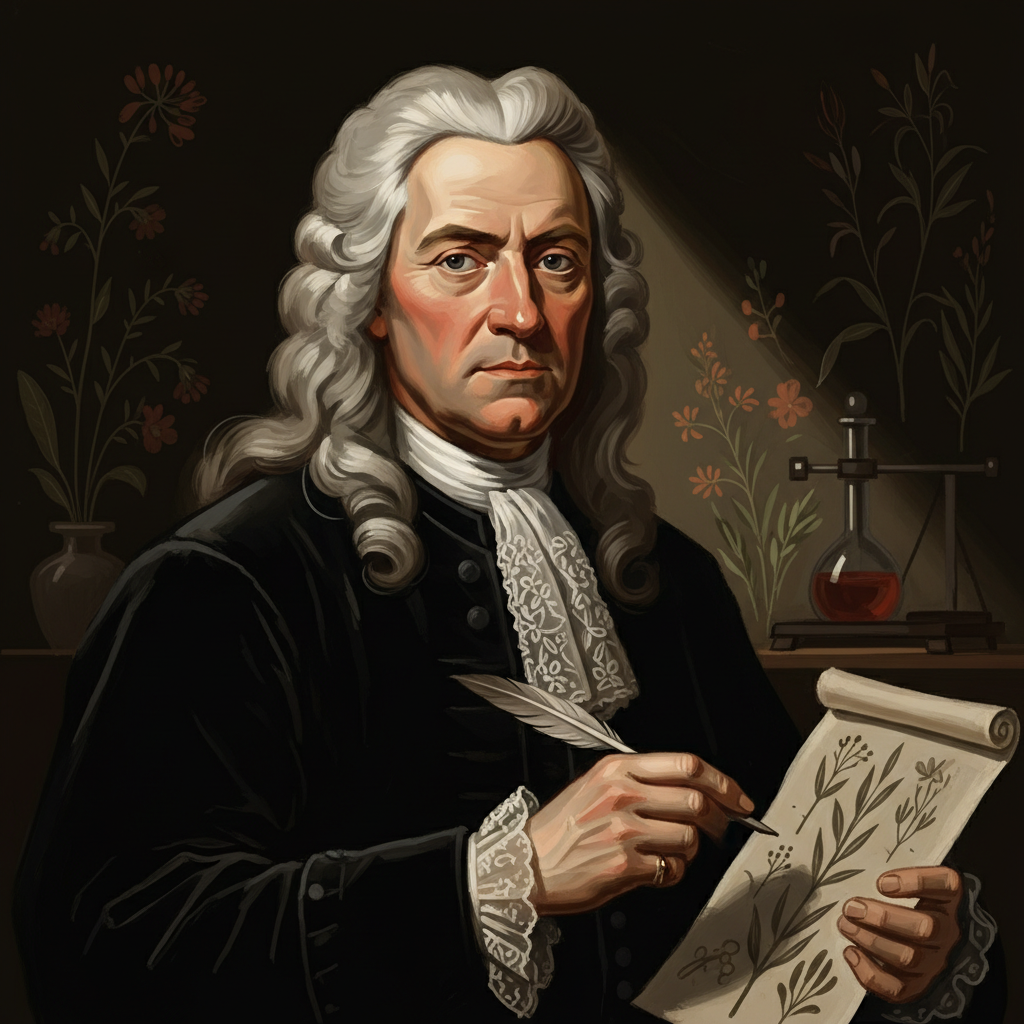
Carl Linnaeus — "It is not wealth or ancestry, but rather the spirit of the age, which has raised…"
It is not wealth or ancestry, but rather the spirit of the age, which has raised me to the highest pinnacle of fame.
It is not wealth or ancestry, but rather the spirit of the age, which has raised me to the highest pinnacle of fame.
Click any product to generate a realistic preview. Up to 3 at a time.
* Initial load can take up to 90 seconds — revising the preview in another color is nearly instant.
"A world without names is a world without knowledge."
"The whole world is a collection of wonders."
"The distinctions of sex are evident in plants, as in animals."
"Man is the masterpiece of creation."
"The earth is the Lord's, and the fullness thereof; the world, and they that dwell therein."
Swedish botanist and the father of modern taxonomy whose Systema Naturae (1735) introduced binomial nomenclature for naming all species. Closely associated with Joseph Banks (British naturalist who carried Linnaean classification on Cook's voyages). For an intellectual contrast, see Comte de Buffon, French naturalist and Histoire Naturelle author (1749-1788) — Buffon explicitly attacked Linnaean fixed-categories taxonomy as artificial and rejected the binomial system; his gradualist, environment-shaped natural history was the explicit alternative. Anticipates the fixed-species-vs-evolution debate Darwin would later resolve.
A statement reflecting his self-awareness of his impact and the scientific zeitgeist.
Date: c. 1770s
Money & BusinessFound in 1 providers: gemini
1 source checked
Fame and achievement come not from inherited money or noble birth, but from being attuned to what your era demands and needs. Linnaeus argues that timing and intellectual alignment with the moment matter more than privilege — that greatness is earned by embodying the dominant questions and energies of one's time, not by possessing advantages passed down through generations.
Linnaeus was born to a modest rural pastor in Sweden, with no aristocratic lineage or wealth. He rose to international celebrity purely through his Systema Naturae and binomial nomenclature, which organized all known life. His global correspondence network, royal patronage, and elevation to nobility came from intellectual achievement alone, validating his belief that ideas — not bloodlines — determined legacy.
Linnaeus worked during the Enlightenment, when Europe was systematically cataloguing the natural world through exploration, reason, and observation. The Scientific Revolution had displaced inherited authority with merit and empirical inquiry. Collectors, explorers, and naturalists were celebrated figures. This was an era hungry for order and classification, perfectly matching Linnaeus's genius — the 'spirit of the age' literally created demand for exactly what he offered.
AI-generated insights based on extensive research and information for context. Factual errors? Email [email protected].
Your cart is empty