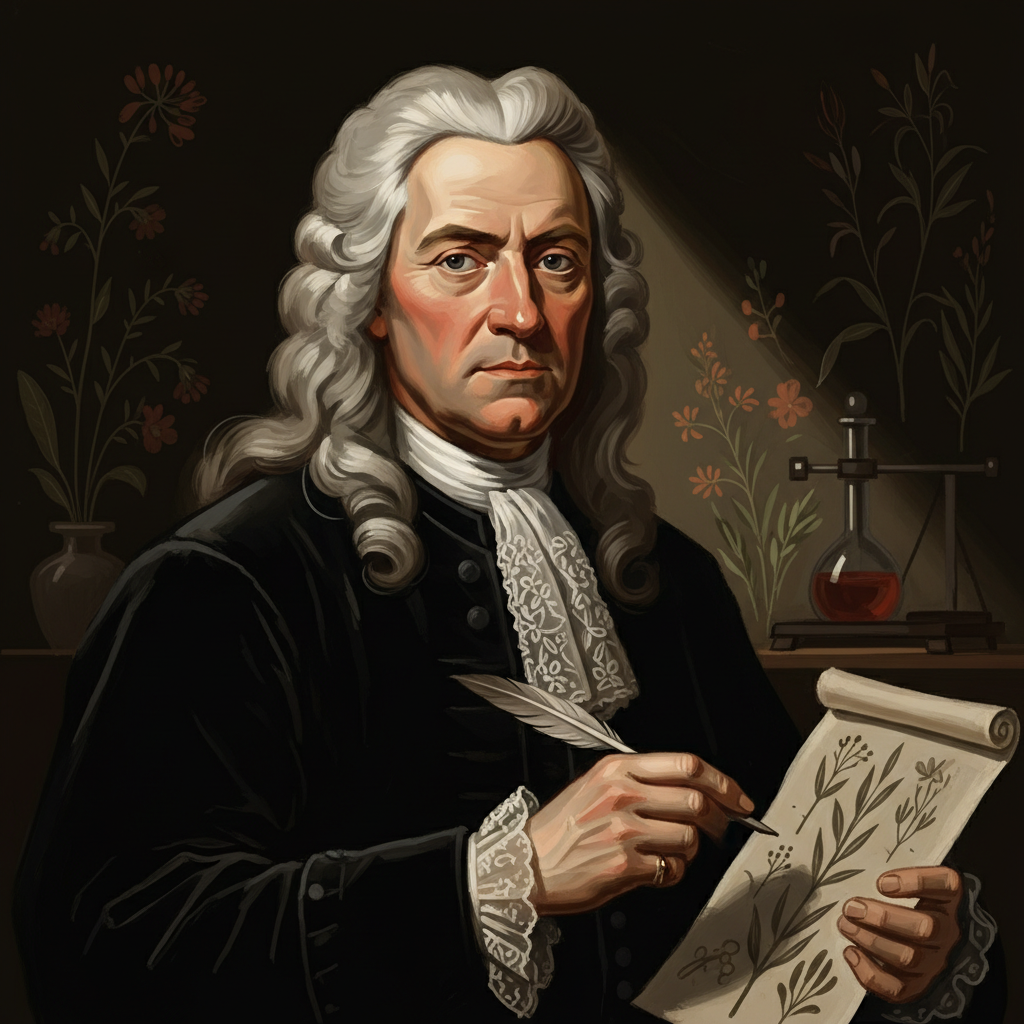
Carl Linnaeus — "The whole world is a collection of wonders."
The whole world is a collection of wonders.
The whole world is a collection of wonders.
Click any product to generate a realistic preview. Up to 3 at a time.
* Initial load can take up to 90 seconds — revising the preview in another color is nearly instant.
"The stinking corpse flower smells like a rotting corpse to attract carrion beetles and flesh flies, which are its pollinators. Nature is both beautiful and repulsive."
"Nature does not make any leaps. (Natura non facit saltus)"
"Blessed be the Lord for the beauty of summer and spring, for the air, the water, the verdure, and the song of birds."
"Nature is never exhausted; she has always new wonders for our admiration."
"The greatest pleasure is to be found in the smallest things."
Swedish botanist and the father of modern taxonomy whose Systema Naturae (1735) introduced binomial nomenclature for naming all species. Closely associated with Joseph Banks (British naturalist who carried Linnaean classification on Cook's voyages). For an intellectual contrast, see Comte de Buffon, French naturalist and Histoire Naturelle author (1749-1788) — Buffon explicitly attacked Linnaean fixed-categories taxonomy as artificial and rejected the binomial system; his gradualist, environment-shaped natural history was the explicit alternative. Anticipates the fixed-species-vs-evolution debate Darwin would later resolve.
Found in 1 providers: grok
1 source checked
Everything around us, from the smallest insect to the largest mountain, deserves awe and careful attention. The world isn't ordinary background noise — it's an endless parade of remarkable things waiting to be noticed, studied, and appreciated. Wonder is the appropriate default response to existence itself, not something reserved for rare spectacular events.
Linnaeus spent his life cataloguing thousands of plant and animal species, naming and classifying nature's diversity into a coherent system. His binomial nomenclature transformed chaotic natural history into ordered science. This sense of wonder wasn't poetic sentiment but professional fuel — every beetle, fern, and coral he encountered represented another astonishing piece of creation worth recording precisely.
The 18th-century Enlightenment sent naturalists on global expeditions — Cook's voyages, Humboldt's explorations — returning with thousands of unknown species. Europe was processing an exploding awareness that the world contained far more life than anyone had imagined. Linnaeus anchored this explosion of discovery: without his classification system, the sheer volume of wonders would have overwhelmed natural history entirely.
AI-generated insights based on extensive research and information for context. Factual errors? Email [email protected].
Your cart is empty