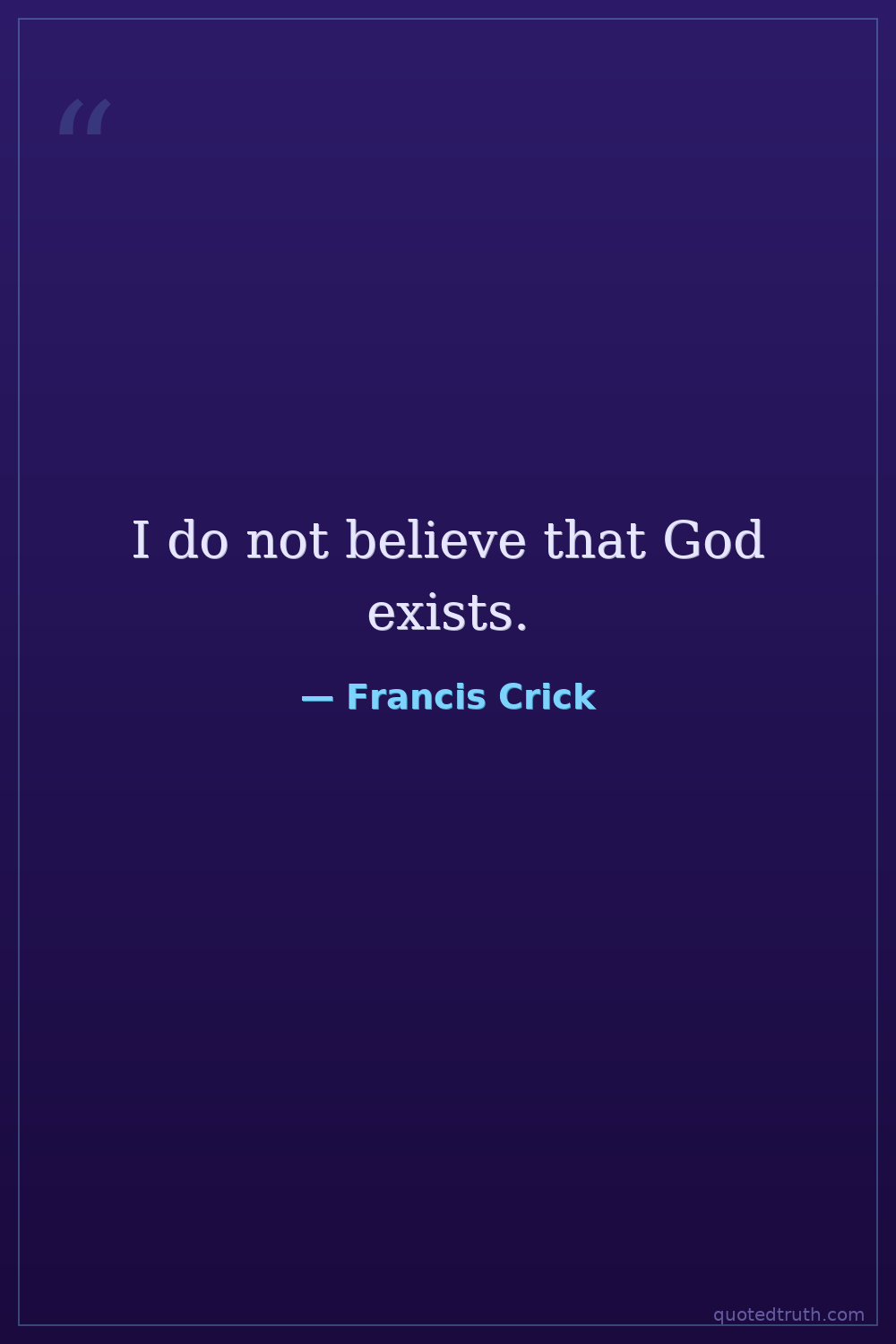
Francis Crick — "I do not believe that God exists."
I do not believe that God exists.
I do not believe that God exists.
Click any product to generate a realistic preview. Up to 3 at a time.
* Initial load can take up to 90 seconds — revising the preview in another color is nearly instant.
"The future of biology is in the brain."
"It is notoriously difficult to get rid of a really bad idea."
"The brain is a machine assembled not to understand itself, but to survive."
"It is not often that a man is given the chance to make such a discovery."
"The scientific method is a powerful tool, but it is not the only way to understand the world."
Found in 1 providers: grok
1 source checked
A direct rejection of theism — the belief that a god or gods exist and shape reality. The speaker takes a firm position: not agnosticism but active disbelief. It asserts that the natural world, including life and consciousness, requires no supernatural explanation. Reality is physical, knowable through evidence, and does not depend on divine creation or intervention. Science, not faith, is the proper tool for understanding existence.
Crick co-discovered DNA's double helix in 1953, revealing life's blueprint as chemistry — not divine design. He spent subsequent decades arguing consciousness is purely neural activity, detailed in his 1994 book 'The Astonishing Hypothesis,' which directly challenged religious concepts of the soul. His atheism was never passive; he believed molecular biology made God unnecessary as an explanatory device and said so publicly, viewing religion as offering false comfort in place of hard-won scientific truth.
The mid-20th century saw extraordinary scientific advances — quantum mechanics, Big Bang cosmology, evolutionary synthesis, and molecular biology — each displacing supernatural explanations with naturalistic ones. Crick worked during the Cold War, when secularism rose sharply in Western academia and religious institutional authority had weakened after two devastating World Wars. Scientists increasingly felt culturally safe declaring atheism openly, a stance that carried far greater social and professional risk in previous centuries.
AI-generated insights based on extensive research and information for context. Factual errors? Email [email protected].
Your cart is empty