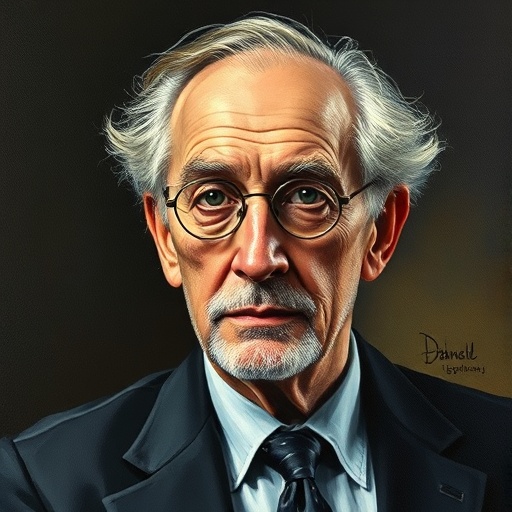
Francis Crick — "The future of biology is in the brain."
The future of biology is in the brain.
The future of biology is in the brain.
Click any product to generate a realistic preview. Up to 3 at a time.
* Initial load can take up to 90 seconds — revising the preview in another color is nearly instant.
"It is essential to be a bit arrogant to do good science."
"The more you learn, the more you realize how much you don't know."
"The brain is a machine that makes theories."
"The origin of life appears to be almost a miracle, so many are the conditions which would have had to be satisfied to get it going."
"No newborn child has a soul."
Found in 1 providers: grok
1 source checked
Crick is predicting where the next big breakthroughs in life science will happen. Having helped solve heredity at the molecular level, he argues that understanding the brain, how neurons produce thought, memory, and consciousness, is the next great frontier. The hardest unanswered question in biology is no longer how cells copy themselves, but how a physical organ generates the subjective mind. That problem, he believes, will define the coming decades of research.
After co-discovering the DNA double helix in 1953 with James Watson, Crick spent his later career, especially from the 1970s at the Salk Institute, abandoning molecular biology to study consciousness and visual awareness. He collaborated with Christof Koch on the neural correlates of consciousness and wrote The Astonishing Hypothesis, arguing the soul is just neurons firing. The quote captures his deliberate pivot from genes to brains as the unfinished business of biology.
Crick worked through the molecular biology revolution he helped launch, then watched genomics, PET scans, and fMRI mature in the 1980s and 1990s. As the Human Genome Project neared completion, many scientists felt heredity was largely solved while the brain remained a black box. Neuroscience was emerging as a distinct discipline, and consciousness, long dismissed as philosophy, was becoming a legitimate empirical target. Crick's statement reflects that late-twentieth-century shift in scientific ambition.
AI-generated insights based on extensive research and information for context. Factual errors? Email [email protected].
Your cart is empty