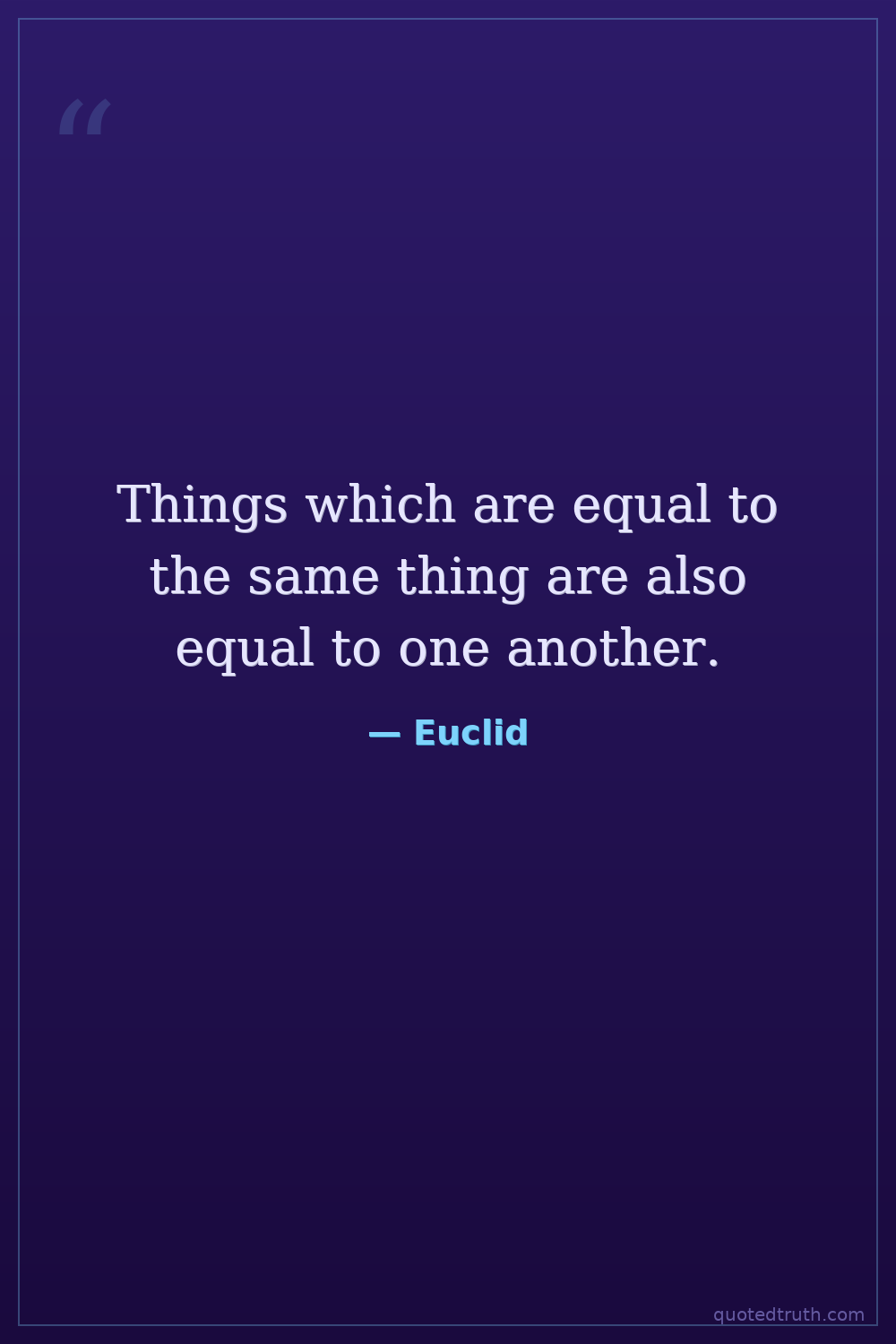
Euclid — "Things which are equal to the same thing are also equal to one another."
Things which are equal to the same thing are also equal to one another.
Things which are equal to the same thing are also equal to one another.
Click any product to generate a realistic preview. Up to 3 at a time.
* Initial load can take up to 90 seconds — revising the preview in another color is nearly instant.
"To draw a straight line at right angles to a given straight line from a given point on it."
"In any right-angled triangle, the square on the side subtending the right angle is equal to the squares on the sides containing the right angle."
"Parallelograms which are on the same base and in the same parallels are equal to one another."
"To construct a square on a given straight line."
"There are infinitely many prime numbers."
Found in 3 providers: grok,deepseek,gemini
3 sources checked
If two things are each equal to a third thing, they must be equal to each other. This is the transitive property of equality — one of the most basic rules of logical reasoning. It means you can chain comparisons: if A matches C and B matches C, then A and B match. Simple as it sounds, it underpins virtually all mathematics and formal logic, letting complex proofs be built from simple, undeniable relationships.
This is literally Common Notion 1 from Book I of Euclid's Elements, written around 300 BCE — the most reprinted textbook in history after the Bible. Euclid built all of geometry from just five postulates and five common notions like this one. His defining achievement was showing that vast mathematical truth could be derived purely from a handful of self-evident starting points, and this axiom was his very first foundational brick.
Euclid worked in Alexandria around 300 BCE during the Hellenistic era, as Greek thinkers were formalizing the concept of mathematical proof. Earlier Babylonian and Egyptian math was purely practical — measuring land, trading grain. Building on Aristotle's logic, Greek philosophers demanded rigorous deductive chains. Euclid's axioms arrived precisely when civilization needed a universal language of reasoning, standardizing how knowledge could be justified and reliably transmitted across generations.
AI-generated insights based on extensive research and information for context. Factual errors? Email [email protected].
Your cart is empty