What it means
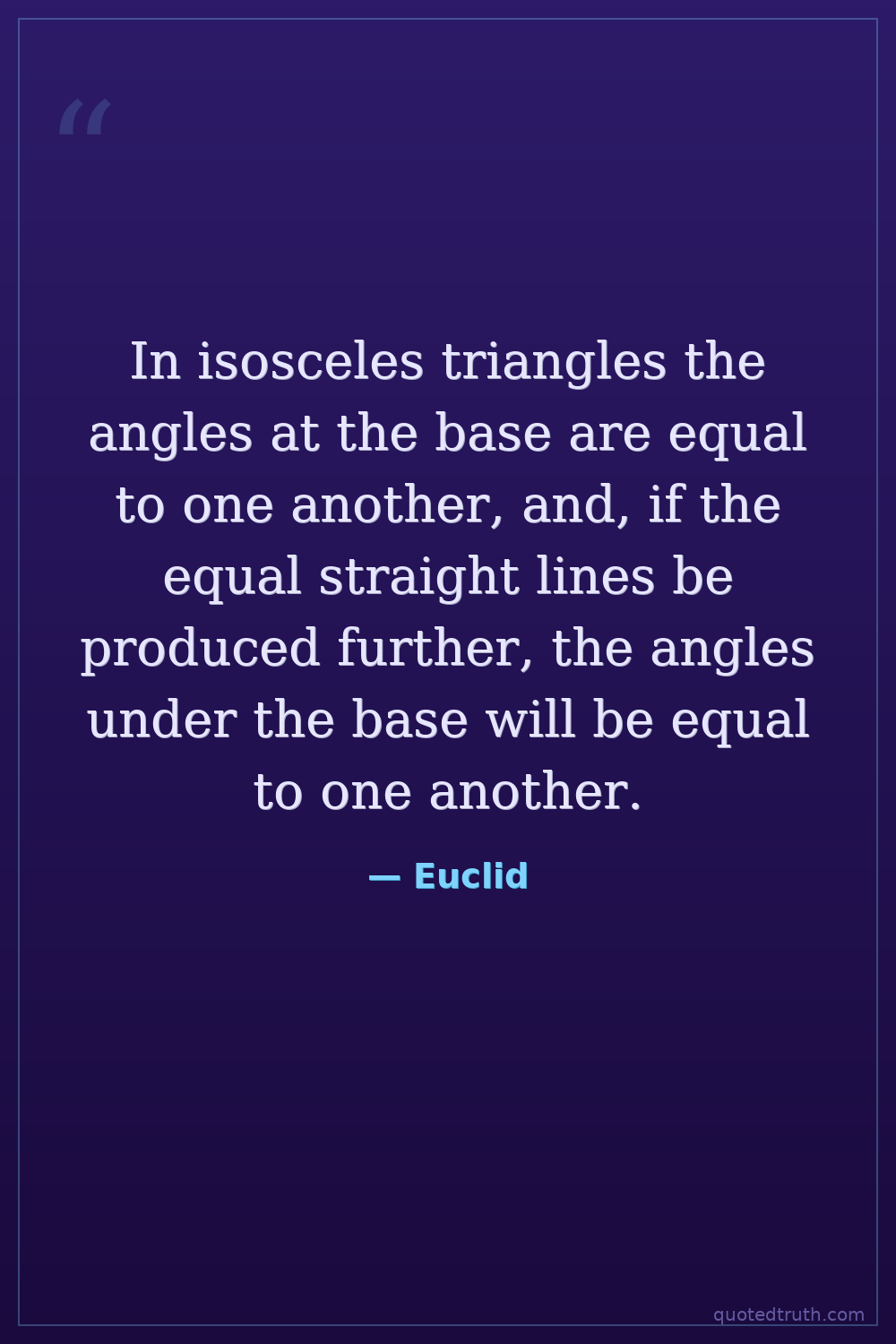
A triangle with two equal sides will always have equal angles at its base — it's perfectly symmetric. If you extend those equal sides beyond the base, the new angles formed below will also match each other. Symmetry generates symmetry. This isn't merely a rule about triangles; it demonstrates that geometric truth can be established with absolute certainty through pure logical deduction, not measurement or intuition.
Relevance to Euclid
Euclid's life's work was systematic rigor: his 13-volume Elements organized all known Greek mathematics into strict axiomatic proofs. This statement is Book I, Proposition 5 — nicknamed 'Pons Asinorum' (Bridge of Asses) — the first theorem that genuinely challenged students, separating serious geometers from casual ones. It embodies his core conviction that truth demands formal proof, not mere observation, and that every claim must be traceable back to self-evident first principles.
The era
Around 300 BCE, Alexandria under Ptolemy I was the Mediterranean's intellectual capital. Greek mathematics was shifting from practical land-measurement toward abstract proof-based reasoning. Earlier thinkers like Thales and Pythagoras had made geometric discoveries, but no one had unified them into a single deductive system. At a time when educated Greeks increasingly viewed the cosmos as rational and ordered, proving geometric truths from first principles felt like decoding the universe's underlying blueprint.
AI-generated insights based on extensive research and information for context. Factual errors? Email [email protected].