What it means
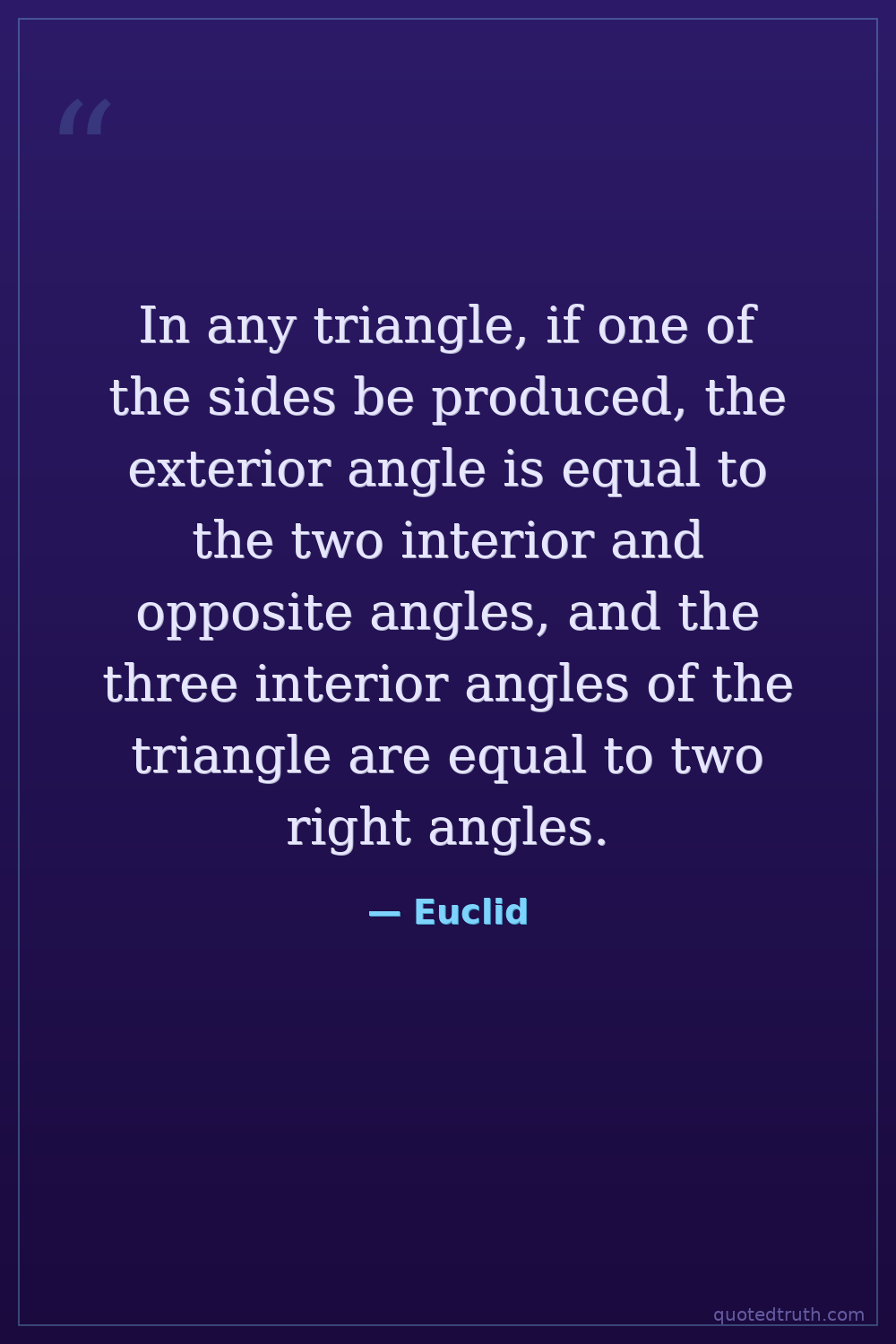
A triangle's three interior angles always sum to exactly 180 degrees—no exceptions, no matter how large or oddly shaped the triangle. Further, if you extend any side outward, the angle formed at that extension equals the combined measure of the two opposite interior angles. These aren't approximations; they're exact, universal truths about flat space that hold for every triangle ever drawn.
Relevance to Euclid
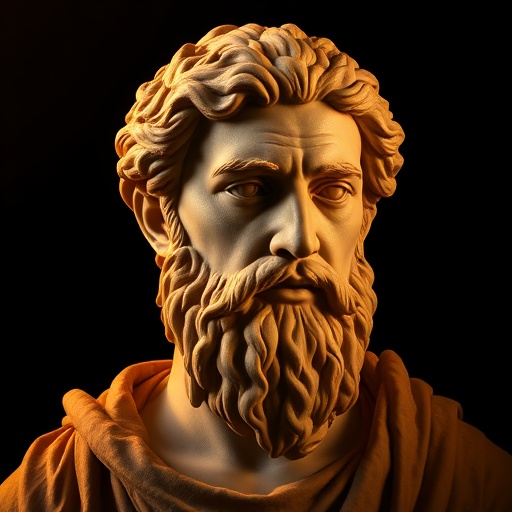
This is Proposition 32 from Euclid's Elements, his 13-volume systematic treatment of geometry written around 300 BCE in Alexandria. Euclid's defining achievement was deductive rigor—proving every theorem from a minimal set of self-evident axioms. This statement isn't an observation but a proven conclusion. It reflects his conviction that mathematical truth emerges not from measurement or intuition, but from pure logical necessity, a philosophy that shaped every mathematician after him.
The era
Around 300 BCE, Alexandria under Ptolemy I had become the Mediterranean's intellectual hub, home to its legendary library. Earlier civilizations—Babylonian and Egyptian—knew triangle angle relationships empirically through construction and surveying. What made Euclid's era distinct was the Greek insistence on proof over practical approximation. Geometric knowledge wasn't just useful; it was philosophically significant—a window into eternal, unchanging truth in an era when Plato's Academy had elevated mathematics to the pinnacle of human knowledge.
AI-generated insights based on extensive research and information for context. Factual errors? Email [email protected].