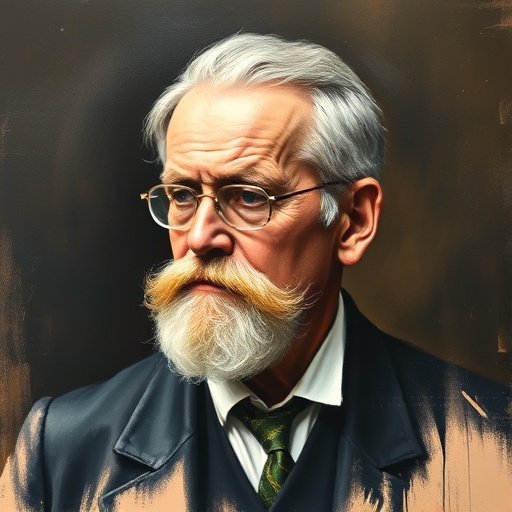
Gregor Mendel — "The Creator has arranged the world in such a way that nothing is left to chance."
The Creator has arranged the world in such a way that nothing is left to chance.
The Creator has arranged the world in such a way that nothing is left to chance.
Click any product to generate a realistic preview. Up to 3 at a time.
* Initial load can take up to 90 seconds — revising the preview in another color is nearly instant.
"I measure, I count, I compare—this is the way of science."
"The experiments have been carried out on a small scale, but the results are clear and unambiguous."
"I have experienced many a bitter hour in my life. Nevertheless, I admit gratefully that the beautiful, good hours far outnumbered the others."
"It requires indeed some courage to undertake a labor of such far-reaching extent."
"Jesus appeared to the disciples after the resurrection in various forms. He appeared to Mary Magdalene so that they might take him for a gardener. Very ingeniously these manifestation of Jesus is to o…"
Found in 1 providers: deepseek
1 source checked
Everything in the universe follows deliberate, discoverable patterns rather than random occurrence. Order and structure underlie all phenomena, and careful observation can reveal these hidden rules. The world operates according to consistent laws waiting to be uncovered by patient inquiry, not by accident or chaos.
Mendel spent years methodically crossbreeding pea plants in a monastery garden, convinced that inheritance followed precise mathematical ratios. His famous 3:1 ratio discovery proved heredity obeyed fixed laws. As an Augustinian friar, his faith and science merged: God's creation was orderly, and genetics was proof that nature's patterns rewarded disciplined, systematic investigation.
Mid-19th century science was overturning random speculation with empirical rigor. Darwin published natural selection in 1859 while Mendel worked. The era debated whether life followed mechanistic laws or divine caprice. Mendel's monastery setting reflected tension between faith and emerging biology, yet both traditions affirmed to him that underlying order, not randomness, governed living organisms.
AI-generated insights based on extensive research and information for context. Factual errors? Email [email protected].
Your cart is empty