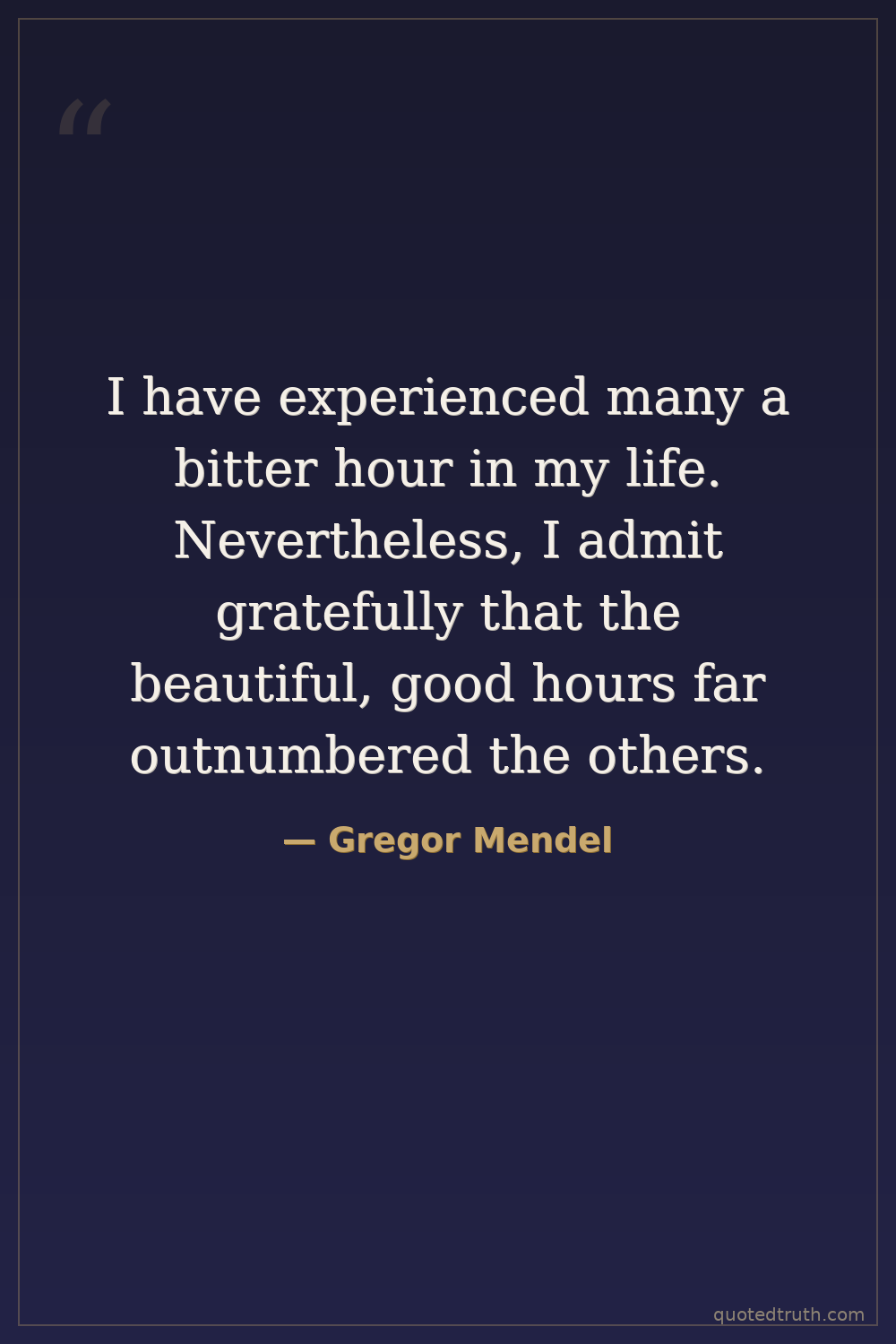
Gregor Mendel — "I have experienced many a bitter hour in my life. Nevertheless, I admit grateful…"
I have experienced many a bitter hour in my life. Nevertheless, I admit gratefully that the beautiful, good hours far outnumbered the others.
I have experienced many a bitter hour in my life. Nevertheless, I admit gratefully that the beautiful, good hours far outnumbered the others.
Click any product to generate a realistic preview. Up to 3 at a time.
* Initial load can take up to 90 seconds — revising the preview in another color is nearly instant.
"I have been called a fool, but time will prove me right."
"That no generally applicable law of the formulation and development of hybrids has yet been successfully formulated can hardly astonish anyone who is acquainted with the extent of the task and who can…"
"The traits of living things are governed by unseen laws."
"My scientific studies have afforded me great gratification; and I am convinced that it will not be long before the scientific world will become acquainted with the results of my experiments."
"The laws of heredity are as fixed as the stars in the heavens."
Found in 1 providers: gemini
1 source checked
Acknowledging hardship honestly while insisting that joy outweighs suffering — this is resilient gratitude, not naive optimism. Mendel isn't pretending pain didn't exist; he explicitly names the bitter hours. But he performs a deliberate reckoning of his life and lands on net positive. It's emotional maturity: holding difficulty without letting it define everything. The key move is the word 'gratefully' — he doesn't just count the good hours, he feels thankful for them.
Mendel published his landmark heredity paper in 1866 and received near-total silence — ignored for 35 years until rediscovered in 1900, sixteen years after his death. He endured prolonged conflict with Austrian tax authorities as monastery abbot, diverting him from research. Yet letters reveal a man genuinely absorbed in his garden experiments and monastic community. The quote maps precisely onto his biography: real frustration, real neglect, yet a life he ultimately judged as good.
Mendel worked in the 1850s–1880s, when Darwin's 1859 Origin of Species was reshaping biology and sparking fierce religious-scientific conflict. The 1848 revolutions had destabilized European institutions. Science was transitioning from gentleman-hobbyist inquiry to organized professional disciplines, with no international journals or conferences as we know them. A monk's painstaking garden work could easily vanish unnoticed — and Mendel's did. His gratitude for small good hours resonates against this backdrop of structural isolation and institutional indifference.
AI-generated insights based on extensive research and information for context. Factual errors? Email [email protected].
Your cart is empty