Confucius — "When you know a thing, to hold that you know it; and when you do not know a thin…"
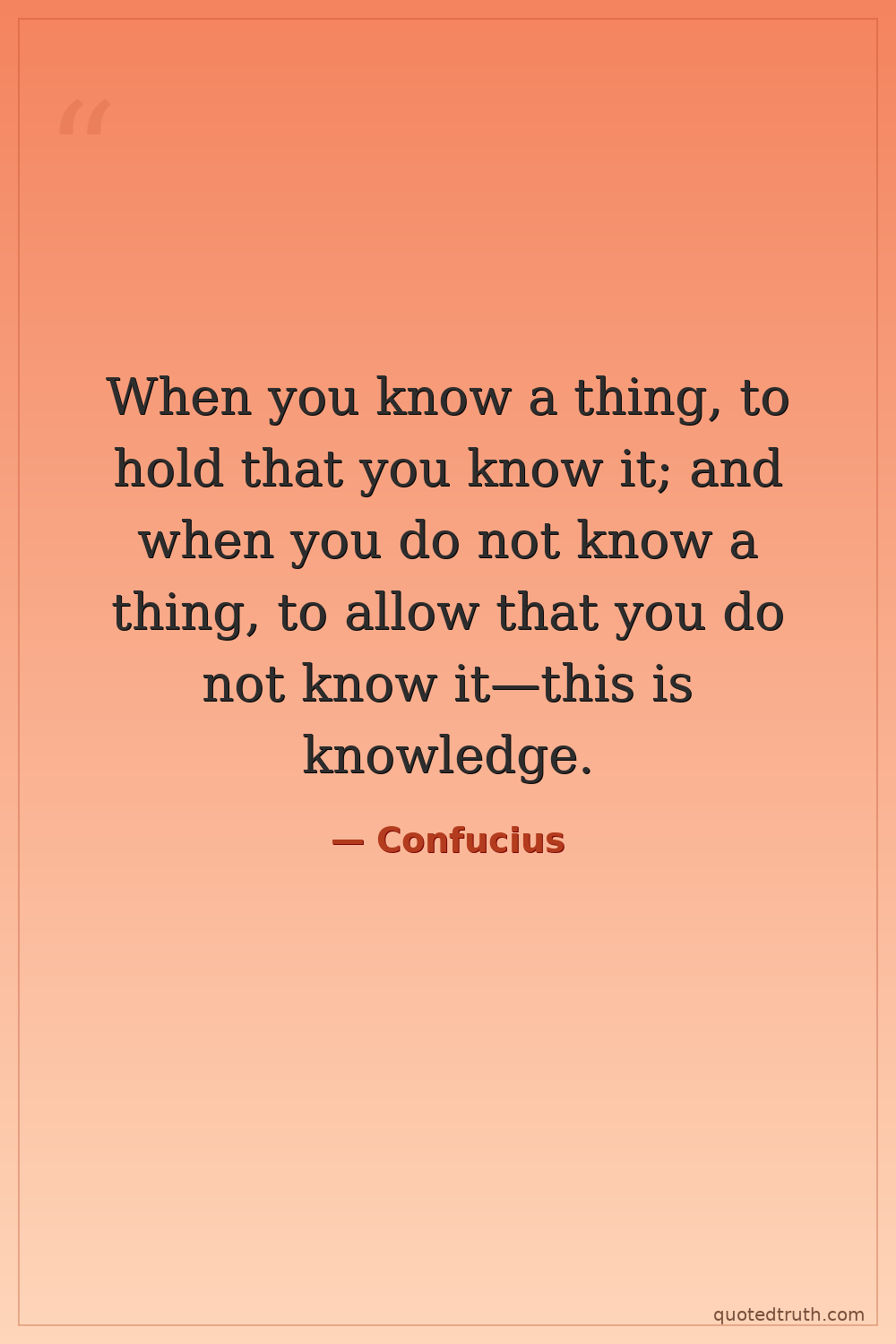
When you know a thing, to hold that you know it; and when you do not know a thing, to allow that you do not know it—this is knowledge.
When you know a thing, to hold that you know it; and when you do not know a thing, to allow that you do not know it—this is knowledge.
Click any product to generate a realistic preview. Up to 3 at a time.
* Initial load can take up to 90 seconds — revising the preview in another color is nearly instant.
"The superior man is catholic and not partisan. The mean man is partisan and not catholic."
"The superior man is universally benevolent, but not clannish."
"The superior man is modest in his speech, but exceeds in his actions."
"The superior man is easy to serve and difficult to please."
"The Master said, 'The superior man is universally benevolent, and not partisan. The mean man is partisan, and not universally benevolent.'"
Chinese philosopher and teacher whose teachings (compiled by his students in the Analects) became the foundational ethical framework of East Asian civilization for 2,500 years. Closely associated with Mencius (his most-influential follower a century later). For an intellectual contrast, see Laozi, near-contemporary Chinese sage and Tao Te Ching author — Confucius systematized social order through ritual and family hierarchy; Laozi's Taoist effortless-action philosophy argued such systems were the disease, not the cure. The two founding poles of Chinese moral philosophy — every East Asian moral tradition since has positioned itself between them.
The standard scholarly entry points to Confucius's work: Philip J. Ivanhoe (Georgetown, Chinese philosophy) — Confucian Moral Self Cultivation (2000); Edward Slingerland (UBC, Asian Studies) — Effortless Action: Wu-wei as Conceptual Metaphor (2003); Tu Weiming (Harvard, Confucian scholar) — Confucian Thought: Selfhood as Creative Transformation (1985). These are the works graduate seminars cite when teaching Confucius.
Found in 1 providers: grok
1 source checked
Real knowledge begins with honesty about what you actually understand versus what you don't. Pretending to know something you haven't grasped is a form of self-deception that blocks learning. Genuine wisdom means clearly distinguishing between verified understanding and guesswork, admitting ignorance openly, and refusing to bluff. Only by acknowledging the edges of your knowledge can you build anything reliable on top of it or know where to direct further study.
Confucius built his teaching around self-cultivation, sincerity, and rigorous self-examination, insisting that a true scholar corrects himself daily. As a teacher who trained disciples for government service, he valued intellectual humility over showy erudition because officials who faked competence damaged the state. His Analects repeatedly praise honest admission of limits, and this saying captures his conviction that moral and practical learning both depend on refusing to deceive oneself.
Confucius lived during the Spring and Autumn period (roughly 551–479 BCE), when the Zhou dynasty was fragmenting and rival states competed through warfare and diplomacy. Rulers hired advisors who often postured as experts to gain influence, while ritual traditions decayed. Educated men were expected to master texts, rites, and statecraft, yet charlatans abounded in courts. Against this backdrop of political chaos and performative scholarship, Confucius urged disciplined honesty about one's knowledge as the foundation for restoring social order.
AI-generated insights based on extensive research and information for context. Factual errors? Email [email protected].
Your cart is empty