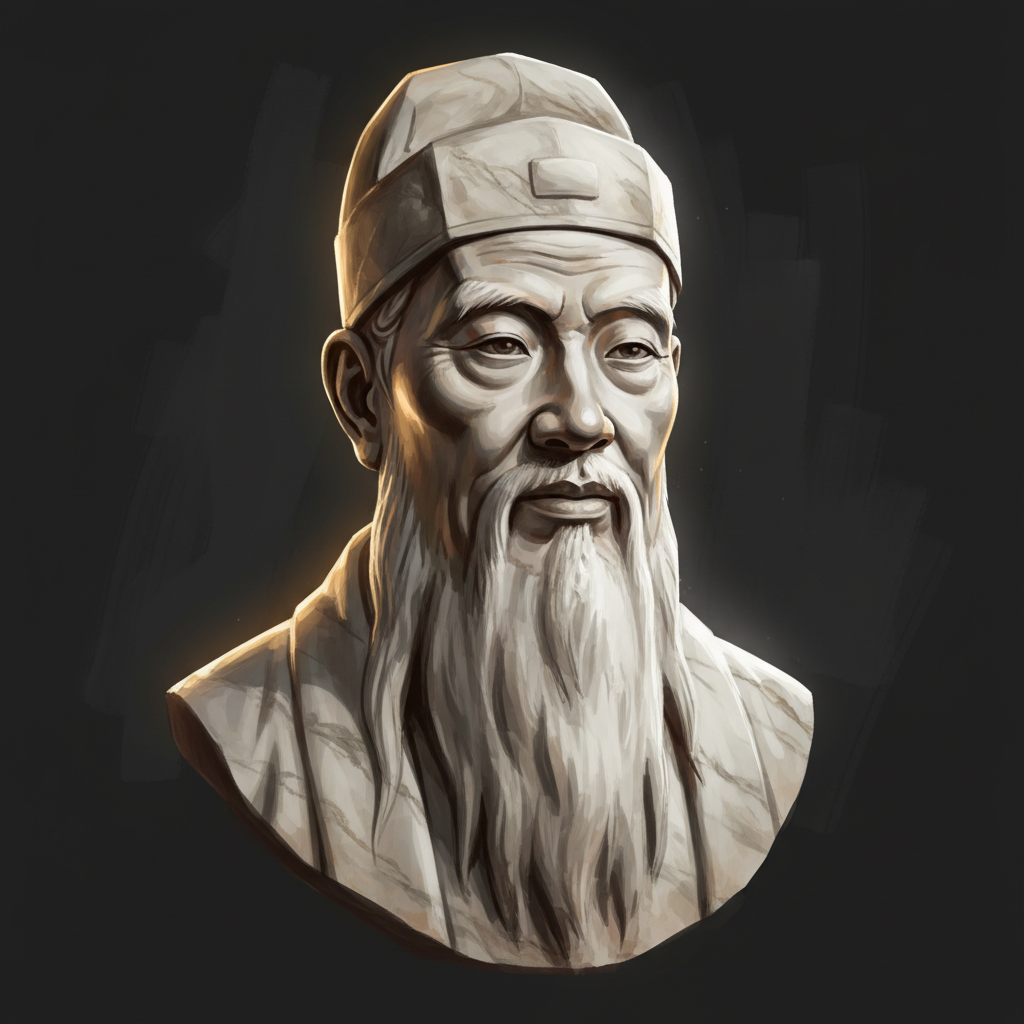
Confucius — "The superior man is easy to serve and difficult to please."
The superior man is easy to serve and difficult to please.
The superior man is easy to serve and difficult to please.
Click any product to generate a realistic preview. Up to 3 at a time.
* Initial load can take up to 90 seconds — revising the preview in another color is nearly instant.
"The superior man thinks of virtue; the small man thinks of comfort."
"The gentleman concerns himself with the Way; he does not worry about his salary."
"The man who moves a mountain begins by carrying away small stones."
"To worship ancestors whom one does not know is to be presumptuous."
"A good man is not a complete vessel."
Chinese philosopher and teacher whose teachings (compiled by his students in the Analects) became the foundational ethical framework of East Asian civilization for 2,500 years. Closely associated with Mencius (his most-influential follower a century later). For an intellectual contrast, see Laozi, near-contemporary Chinese sage and Tao Te Ching author — Confucius systematized social order through ritual and family hierarchy; Laozi's Taoist effortless-action philosophy argued such systems were the disease, not the cure. The two founding poles of Chinese moral philosophy — every East Asian moral tradition since has positioned itself between them.
The standard scholarly entry points to Confucius's work: Philip J. Ivanhoe (Georgetown, Chinese philosophy) — Confucian Moral Self Cultivation (2000); Edward Slingerland (UBC, Asian Studies) — Effortless Action: Wu-wei as Conceptual Metaphor (2003); Tu Weiming (Harvard, Confucian scholar) — Confucian Thought: Selfhood as Creative Transformation (1985). These are the works graduate seminars cite when teaching Confucius.
Found in 1 providers: grok
1 source checked
A person of strong character sets reasonable, fair demands on those who work with or for them, making daily cooperation smooth and predictable. But winning their genuine approval is hard because they judge by integrity and merit, not flattery or favors. In contrast, a petty person makes life miserable with endless nitpicking yet can be easily charmed by flattery or gifts. Real quality shows in what someone chooses to praise.
Confucius spent his life training officials and sons of nobles to become junzi, the morally cultivated gentleman. He himself was famously demanding about virtue yet generous with ordinary human failings, accepting students of any class who brought dried meat as tuition. Having served and advised rulers in Lu, he knew firsthand the difference between leaders who judged by character and those swayed by bribes, gossip, and personal loyalty above competence.
Confucius lived during the late Spring and Autumn period (551-479 BCE), when the Zhou dynasty's authority had collapsed and feudal lords fought constant wars. Court life was riddled with flattery, intrigue, and patronage, with advancement often depending on pleasing volatile rulers rather than on merit. Against this corruption, Confucius promoted a revolutionary ideal: leadership and friendship grounded in ethical cultivation rather than birth or sycophancy, reshaping East Asian governance for millennia.
AI-generated insights based on extensive research and information for context. Factual errors? Email [email protected].
Your cart is empty