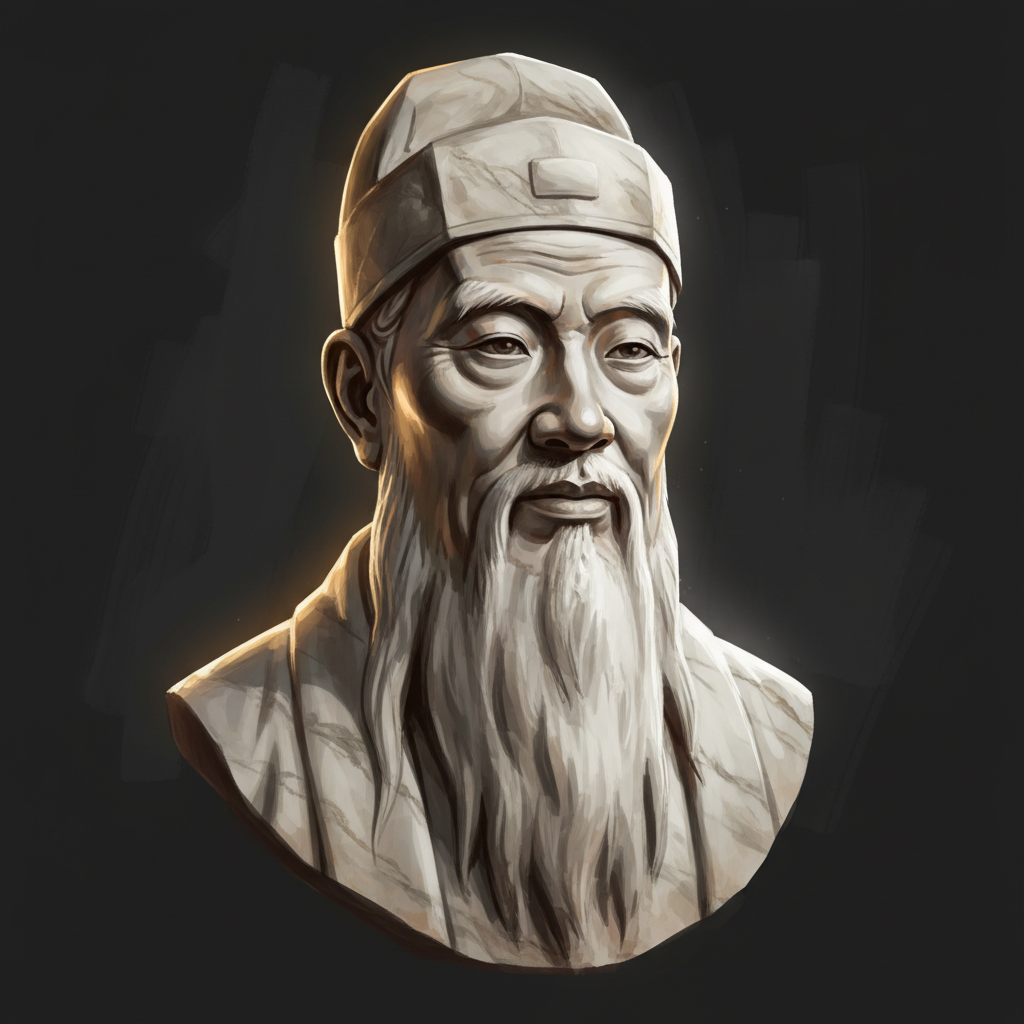
Confucius — "It is not the failure of others to appreciate your abilities that should trouble…"
It is not the failure of others to appreciate your abilities that should trouble you, but rather your own failure to appreciate theirs.
It is not the failure of others to appreciate your abilities that should trouble you, but rather your own failure to appreciate theirs.
Click any product to generate a realistic preview. Up to 3 at a time.
* Initial load can take up to 90 seconds — revising the preview in another color is nearly instant.
"I have never seen anyone who loved virtue as much as they loved sex."
"In a state governed by the Way, poverty and low station are cause for shame; in a state bereft of the Way, wealth and high rank are cause for shame."
"The gentleman concerns himself with the Way; he does not worry about his salary."
"The superior man is watchful over himself when alone."
"The Master said, 'The superior man is not an implement.'"
Chinese philosopher and teacher whose teachings (compiled by his students in the Analects) became the foundational ethical framework of East Asian civilization for 2,500 years. Closely associated with Mencius (his most-influential follower a century later). For an intellectual contrast, see Laozi, near-contemporary Chinese sage and Tao Te Ching author — Confucius systematized social order through ritual and family hierarchy; Laozi's Taoist effortless-action philosophy argued such systems were the disease, not the cure. The two founding poles of Chinese moral philosophy — every East Asian moral tradition since has positioned itself between them.
The standard scholarly entry points to Confucius's work: Philip J. Ivanhoe (Georgetown, Chinese philosophy) — Confucian Moral Self Cultivation (2000); Edward Slingerland (UBC, Asian Studies) — Effortless Action: Wu-wei as Conceptual Metaphor (2003); Tu Weiming (Harvard, Confucian scholar) — Confucian Thought: Selfhood as Creative Transformation (1985). These are the works graduate seminars cite when teaching Confucius.
Found in 1 providers: grok
1 source checked
Stop worrying about whether people recognize your talents or give you credit. The real problem is your own blindness to what others bring to the table. If you fail to see the strengths, skills, and worth in those around you, that is a flaw in your character. Shift your focus from seeking validation to genuinely valuing the people in your life and community.
Confucius spent years as a wandering teacher seeking rulers who would employ his ideas, often unrecognized and rejected. Rather than grow bitter, he built his philosophy on ren (humaneness) and respect for others. He famously welcomed students regardless of status and stressed self-cultivation over external reward. This saying mirrors his insistence that a junzi, or exemplary person, measures themselves by inward virtue, not applause.
Confucius lived during the Spring and Autumn period of ancient China, roughly 551 to 479 BCE, when the Zhou dynasty was fracturing into warring states. Rulers competed for talented advisors, and ambitious scholars chased recognition, titles, and court positions. Social hierarchy was rigid yet unstable, breeding resentment and rivalry. Against this backdrop of grasping ambition, Confucius urged a moral reversal: cultivate appreciation of others rather than envy their status or crave their praise.
AI-generated insights based on extensive research and information for context. Factual errors? Email [email protected].
Your cart is empty