Confucius — "The Master said, 'The superior man is dignified, but not proud. The mean man is …"
The Master said, 'The superior man is dignified, but not proud. The mean man is proud, but not dignified.'
The Master said, 'The superior man is dignified, but not proud. The mean man is proud, but not dignified.'
Click any product to generate a realistic preview. Up to 3 at a time.
* Initial load can take up to 90 seconds — revising the preview in another color is nearly instant.
"Everything has beauty, but not everyone sees it."
"To know what you know and what you do not know, that is true knowledge."
"The superior man is satisfied and composed; the inferior man is always full of distress."
"The Master said, 'A man can enlarge the Way, but the Way cannot enlarge a man.'"
"The student of virtue has no time for idleness."
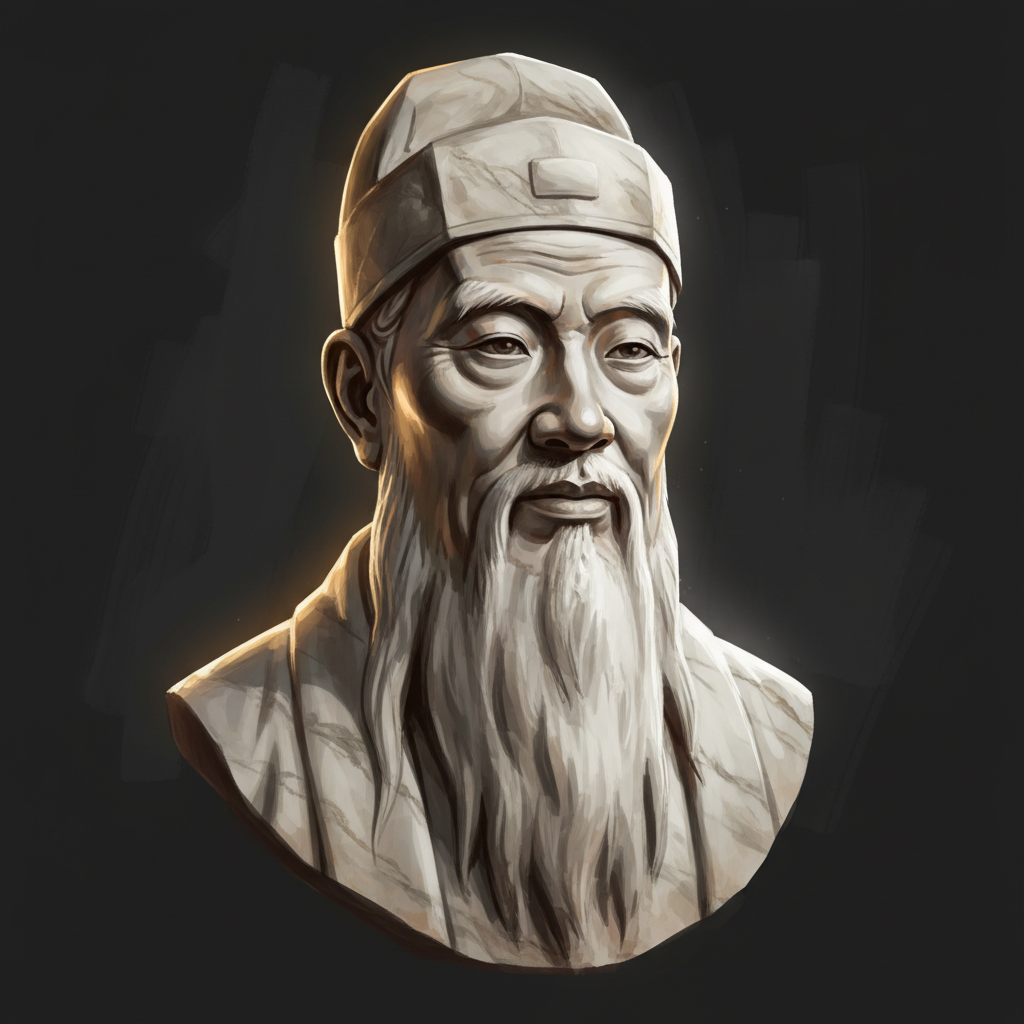
Chinese philosopher and teacher whose teachings (compiled by his students in the Analects) became the foundational ethical framework of East Asian civilization for 2,500 years. Closely associated with Mencius (his most-influential follower a century later). For an intellectual contrast, see Laozi, near-contemporary Chinese sage and Tao Te Ching author — Confucius systematized social order through ritual and family hierarchy; Laozi's Taoist effortless-action philosophy argued such systems were the disease, not the cure. The two founding poles of Chinese moral philosophy — every East Asian moral tradition since has positioned itself between them.
The standard scholarly entry points to Confucius's work: Philip J. Ivanhoe (Georgetown, Chinese philosophy) — Confucian Moral Self Cultivation (2000); Edward Slingerland (UBC, Asian Studies) — Effortless Action: Wu-wei as Conceptual Metaphor (2003); Tu Weiming (Harvard, Confucian scholar) — Confucian Thought: Selfhood as Creative Transformation (1985). These are the works graduate seminars cite when teaching Confucius.
Found in 2 providers: deepseek,grok
2 sources checked
True self-respect carries itself with calm assurance and treats others with courtesy, while arrogance is loud insecurity dressed up as confidence. A person of real character knows their worth without needing to announce it or put others down. Small-minded people, by contrast, inflate themselves because they lack inner steadiness. Dignity comes from integrity; pride comes from ego, and the two should not be confused even though they can look similar on the surface.
Confucius spent his life teaching that moral cultivation, not birth or wealth, made someone a junzi, the 'superior person' he references here. Having served briefly as a minister in Lu before wandering between courts seeking a ruler who would adopt his ethics, he saw firsthand how officials confused status with virtue. His entire project was training students to embody ren and li, inward character expressed through dignified conduct, rather than chase the hollow self-importance common among the aristocracy of his day.
Confucius lived during the late Spring and Autumn period (551-479 BCE), when Zhou dynasty authority had collapsed and rival states fought constantly. Hereditary nobles held power by birth, often arrogant and incompetent, while genuine talent went unused. Ritual propriety, the social glue binding classes together, was decaying into empty display. Against this backdrop, Confucius redefined nobility as a moral achievement available to anyone who cultivated themselves, directly challenging the swaggering aristocrats whose pride masked their unfitness to lead.
AI-generated insights based on extensive research and information for context. Factual errors? Email [email protected].
Your cart is empty